

Reach thousands of whisky and spirits lovers every day.


How Do You Build a Home Whisky Bar, and Which Bottles Should You Start With?
 by Christopher Deutsch I drink and collect with intention, drawn to the sherried depth of Dalmore and the balance of Yamazaki.
Follow Spiritory on Google News to get our latest guides and releases delivered straight to your feed.
How Do You Build a Home Whisky Bar, and Which Bottles Should You Start With?
A home whisky bar built on ten bottles should cover the main styles, from a light Lowland malt and a sherried Speyside to peated Islay, Irish pot still, bourbon, rye, Japanese and German whisky. With one standard release per style, a host can pour for almost any guest and the owner can learn by comparing the bottles side by side.
Key Takeaways
The ten slots cover a light Lowland malt, a sherried Speyside, a Highland all rounder, a peated Islay, a gently peated Campbeltown malt, an Irish pot still, a bourbon, a rye, a Japanese blend and a German single malt.
Each slot has one standard, widely available release, so the shelf is built to be poured and compared rather than kept.
Comparing two neighbouring bottles teaches more than tasting each alone, because it isolates what cask, grain or peat does.
Glassware and storage are covered by two linked guides, so you can start pouring with minimal equipment.
You can build the shelf one bottle at a time, filling the biggest style gap first.
Tip: Pour two bottles side by side in the same type of glass, such as Glenkinchie and Glenfarclas, or Woodford and Sazerac. Changing one variable at a time is the fastest way to learn what each style does.
Glenkinchie 12 Years Old Gives the Shelf a Light Lowland Baseline
Glenkinchie 12 Years Old is a Lowland single malt bottled at 43% ABV. Its official notes describe a flowery nose with vanilla and cut flowers, a sweet and soft start, and a herbal, drying finish. Whisky Magazine reviewers add lemon and apple, and one suggests it would suit a highball.
It earns its place because it is the gentlest bottle on the shelf. A host can hand it to a guest who says they do not like strong flavours, and it works as an aperitif before dinner. For the owner, it sets the baseline. Every other bottle below can be judged by how far it moves away from this light, unsmoked, unsherried style.
Glenfarclas 15 Years Old Shows What Sherry Casks Do to Speyside Malt
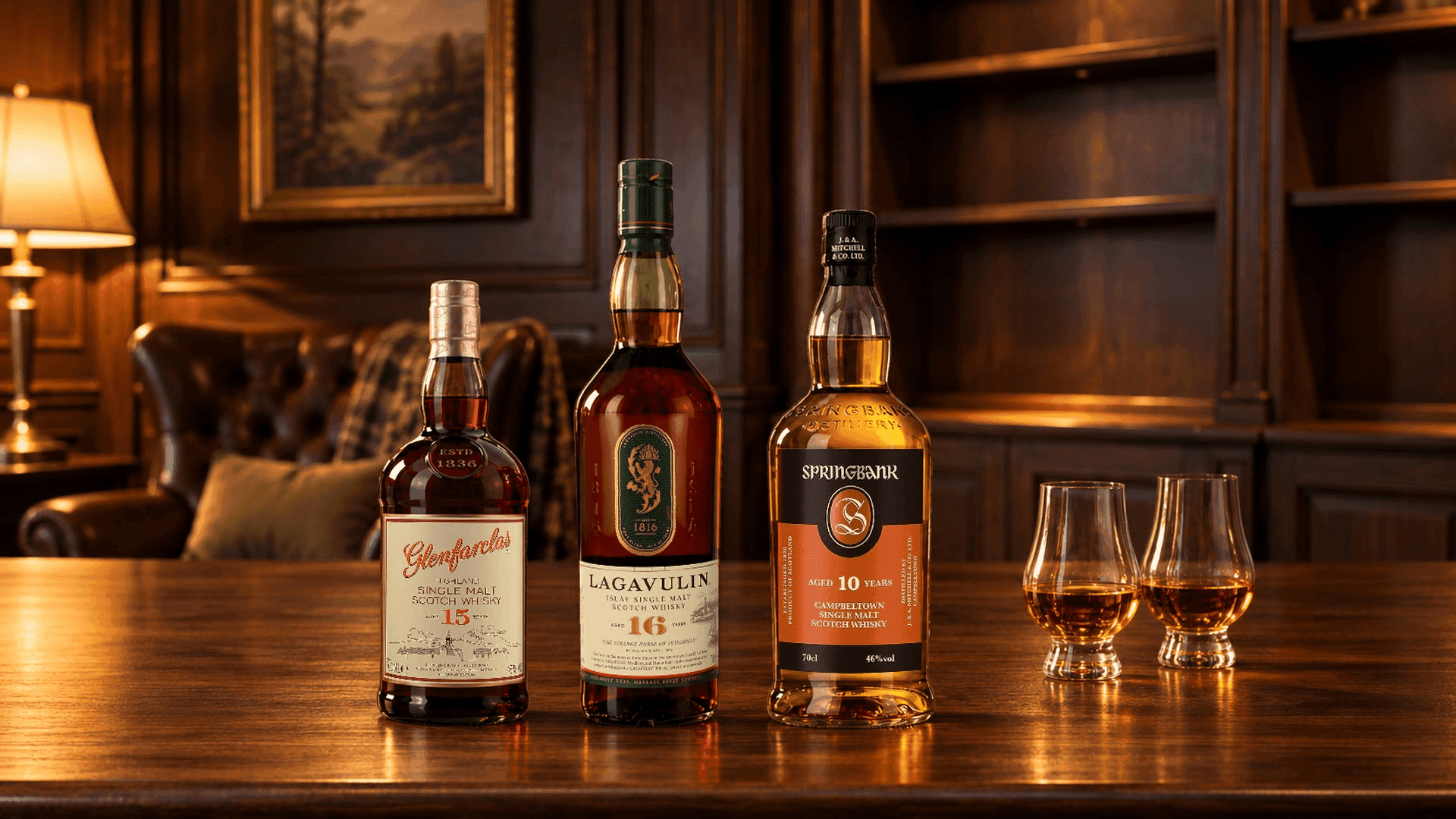
Glenfarclas 15 Years Old is a Speyside single malt bottled at 46% ABV. Difford's Guide reports that it is built from oloroso sherry butts, with 60% first and second fill and 40% third and fourth fill. Reviewers describe raisins, dates, orange peel, dark chocolate and spice.
This is the bottle for the guest who loves dessert wine, Christmas cake or dark chocolate. It also teaches one of the most important lessons in whisky. Pour it next to Glenkinchie and you taste the cask doing much of the talking. Tasting notes vary by reviewer and bottling year, so treat them as a range.
Oban 14 Years Old Is the Highland Malt That Bridges Fruit and Light Smoke
Oban 14 Years Old comes from the coastal town of Oban and is bottled at 43% ABV. Reviewers describe orange peel, honey, dried fruit and spice, with a light, maritime smokiness. Sources disagree on how much smoke there is. One set of published notes calls it the barest hint, while others notice a salty edge.
That uncertainty is exactly why it belongs here. Oban sits between the light and sherried bottles and the peated ones that follow, so it suits the guest who is curious about smoke but not ready for a full Islay. For the owner, it teaches how fruit, honey and a little coast can sit together in one glass.
Lagavulin 16 Years Old Is the Benchmark for Coastal Peated Islay
Lagavulin 16 Years Old is an Islay single malt bottled at 43% ABV. Reviewers consistently describe peat smoke with iodine, seaweed and sea salt, over a deep sweetness. The entry is often described as soft before the smoke takes over, and the finish is long.
Every home bar needs one bottle for guests who love smoke. It is also the clearest lesson in what peat means. The smoke comes from drying malted barley over burning peat, and Lagavulin shows how salty and sweet notes can sit underneath it. Our guide to peated versus unpeated whisky explains the style in more detail.
Springbank 10 Years Old Offers Gentle Peat and a Campbeltown Coastal Edge
Springbank 10 Years Old is a Campbeltown single malt bottled at 46% ABV, matured in a mix of bourbon and sherry casks. Reviewers and retailers describe orchard fruit, vanilla, a hint of peat smoke and a salty finish. Sellers give different cask splits, so the exact proportion is left out here.
It fills the gap between Oban and Lagavulin. A guest who found Lagavulin too much may enjoy this bottle, because the peat is a hint rather than the main event. It also introduces Campbeltown, one of the smallest and most distinctive whisky regions, which our comparison of the three Campbeltown distilleries covers in detail.
Redbreast 12 Years Old Brings Single Pot Still Irish Whiskey to the Shelf
Redbreast 12 Years Old is a single pot still Irish whiskey from the Midleton distillery, bottled at 40% ABV. It is matured in a mix of ex bourbon and oloroso sherry casks. Typical tasting notes mention vanilla, dried fruit, spice and a Christmas cake character.
Single pot still means a mash of malted and unmalted barley distilled in copper pot stills, which gives a creamy, spicy texture that differs from most Scotch. It is a safe pour for almost any guest and a good teaching bottle for anyone asking what makes Irish whiskey different. Our explainer on single pot still Irish whiskey goes deeper.
Woodford Reserve Distiller's Select Covers the Bourbon Corner
Woodford Reserve Distiller's Select is a Kentucky straight bourbon with a reported mash bill of 72% corn, 18% rye and 10% malted barley. It carries no age statement. Sources give its strength as 43.2% or 45.2% depending on the bottling and market, so check the label on your bottle.
Bourbon must be made from at least 51% corn and matured in new charred oak, which is why it tastes sweeter and rounder than most Scotch. Woodford is a good example of the style, easy to enjoy neat, over ice or in an Old Fashioned. It also gives the host a bottle for cocktails without opening the more precious ones. Our guide to bourbon versus Scotch explains the rules behind the difference.
Sazerac Straight Rye Adds Spice and a Base for a Manhattan
Sazerac Straight Rye is a Kentucky straight rye whiskey made at the Buffalo Trace Distillery in Frankfort and bottled at 45% ABV. Retailers describe rye grain, caramel, pepper spice and a dry finish. Published product notes recommend it in a Manhattan.
Rye is the driest and spiciest of the American styles, and a straight rye must be made from at least 51% rye grain. Putting it next to the bourbon is the clearest comparison on the shelf, because the barrels and the rules are similar while the grain changes the taste. It is also the bottle a host reaches for when a guest asks for a Manhattan.
Hibiki Japanese Harmony Shows How Blending Builds Balance
Hibiki Japanese Harmony is a blended Japanese whisky bottled at 43% ABV. It combines malt whisky from the Yamazaki and Hakushu distilleries with grain whisky from Chita, and the blend draws on several cask types including American white oak, sherry and Mizunara, the rare Japanese oak. Published product notes describe fruit and sweetness from Yamazaki, herbal notes from Hakushu and honey and spice from Chita.
This is the shelf's lesson in blending. Many people assume blends rank below single malts, but here a master blender joins several distilleries into one calm, elegant whisky. It is soft enough to serve neat and also works in a highball, which our guide to the Japanese whisky highball explains.
Slyrs Classic Completes the Shelf With a Bavarian Single Malt
Slyrs Classic is a Bavarian single malt from the Schliersee distillery near the Alps, bottled at 43% ABV. Retailers say it is matured in American white oak casks and describe apricot, orange, ginger and caramel on the nose, with malt and marzipan on the palate. The distillery has made whisky since 1999.
A German bottle makes the shelf feel local and gives guests a talking point. It also teaches that a young whisky matured in fresh American oak can taste rich in vanilla and fruit, which differs from the used cask style common in Scotland. For more German options, read our guide to the best German single malt.
Glassware, Storage and Building the Shelf Over Time Keep the Bar Working
Glassware
You only need one good type of glass to start pouring. Our guide to whisky accessories covers glasses, decanters and the rest, so this shelf does not repeat it.
Storing open bottles
A bar with ten bottles open at once means some will sit for months. How long an open bottle lasts depends on the fill level, light, heat and the closure. Our guide on how long an open bottle of whisky lasts has the full answer.
Building the shelf on a budget
You do not need to buy all ten at once. Start with three bottles that are far apart in style, such as Glenkinchie, Lagavulin and Woodford, and add one every few weeks. Choose each new bottle to fill the biggest gap in what you can pour, and set a limit per bottle before you shop. All ten here are standard releases, not rare ones. If you want only one bottle to begin with, read which whisky to buy first instead. This guide is about a shelf for hosting and comparing.
Tip: When friends visit, put out three small pours rather than one big one. Pair a light bottle, a sherried bottle and a smoky bottle, and let guests tell you which they prefer. It turns a drink into a conversation.
FAQ
How many bottles do you need for a home whisky bar?
Ten bottles, one per main style, is enough to pour for almost any guest. You can start with three that are far apart in style and add more over time.
Which whisky should be on every home bar?
A light malt such as Glenkinchie 12, a peated Islay such as Lagavulin 16, and a bourbon such as Woodford Reserve Distiller's Select cover a wide range of tastes.
Do you need a rye as well as a bourbon?
Yes, if you want to compare. Bourbon needs at least 51% corn and straight rye at least 51% rye grain, so similar barrels give a sweeter or a spicier whisky.
Are these ten bottles rare or collectable?
No. They are standard releases chosen to be poured, compared and replaced, not kept for later.
- Key Takeaways
- Glenkinchie 12 Years Old Gives the Shelf a Light Lowland Baseline
- Glenfarclas 15 Years Old Shows What Sherry Casks Do to Speyside Malt
- Oban 14 Years Old Is the Highland Malt That Bridges Fruit and Light Smoke
- Lagavulin 16 Years Old Is the Benchmark for Coastal Peated Islay
- Springbank 10 Years Old Offers Gentle Peat and a Campbeltown Coastal Edge
- Redbreast 12 Years Old Brings Single Pot Still Irish Whiskey to the Shelf
- Woodford Reserve Distiller's Select Covers the Bourbon Corner
- Sazerac Straight Rye Adds Spice and a Base for a Manhattan
- Hibiki Japanese Harmony Shows How Blending Builds Balance
- Slyrs Classic Completes the Shelf With a Bavarian Single Malt
- Glassware, Storage and Building the Shelf Over Time Keep the Bar Working
- FAQ
About the author

Christopher Deutsch
I drink and collect with intention, drawn to the sherried depth of Dalmore and the balance of Yamazaki.
To the author