

Reach thousands of whisky and spirits lovers every day.


What Is Single Pot Still Irish Whiskey?
 by Max RinkI’m a whisky enthusiast and aspiring writer, exploring new flavours and the stories behind every bottle.
Follow Spiritory on Google News to get our latest guides and releases delivered straight to your feed.
What Is Single Pot Still Irish Whiskey?
Single pot still Irish whiskey is legally defined by Ireland's Whiskey Technical File as whiskey distilled in pot stills from a mash of at least 30% malted barley and at least 30% unmalted barley, with up to 5% other cereals allowed, made entirely at a single distillery in Ireland. The unmalted barley in that mash is usually credited with giving the whiskey a spicier, creamier character than a single malt.
Key Takeaways
Single pot still Irish whiskey must come from a mash of at least 30% malted barley and at least 30% unmalted barley, with up to 5% other cereals, distilled in pot stills, under the Irish Whiskey Technical File.
The word single means all of it was distilled at one distillery, unlike blended Irish whiskey, which can combine whiskey from several distilleries or styles.
Unmalted barley became part of the mash partly because of a tax on malted barley introduced in 1785 and repealed in 1855, though some distillers were already using a portion of unmalted grain beforehand.
Today single pot still is produced at Midleton Distillery in County Cork, as well as smaller distilleries including Dingle and Teeling.
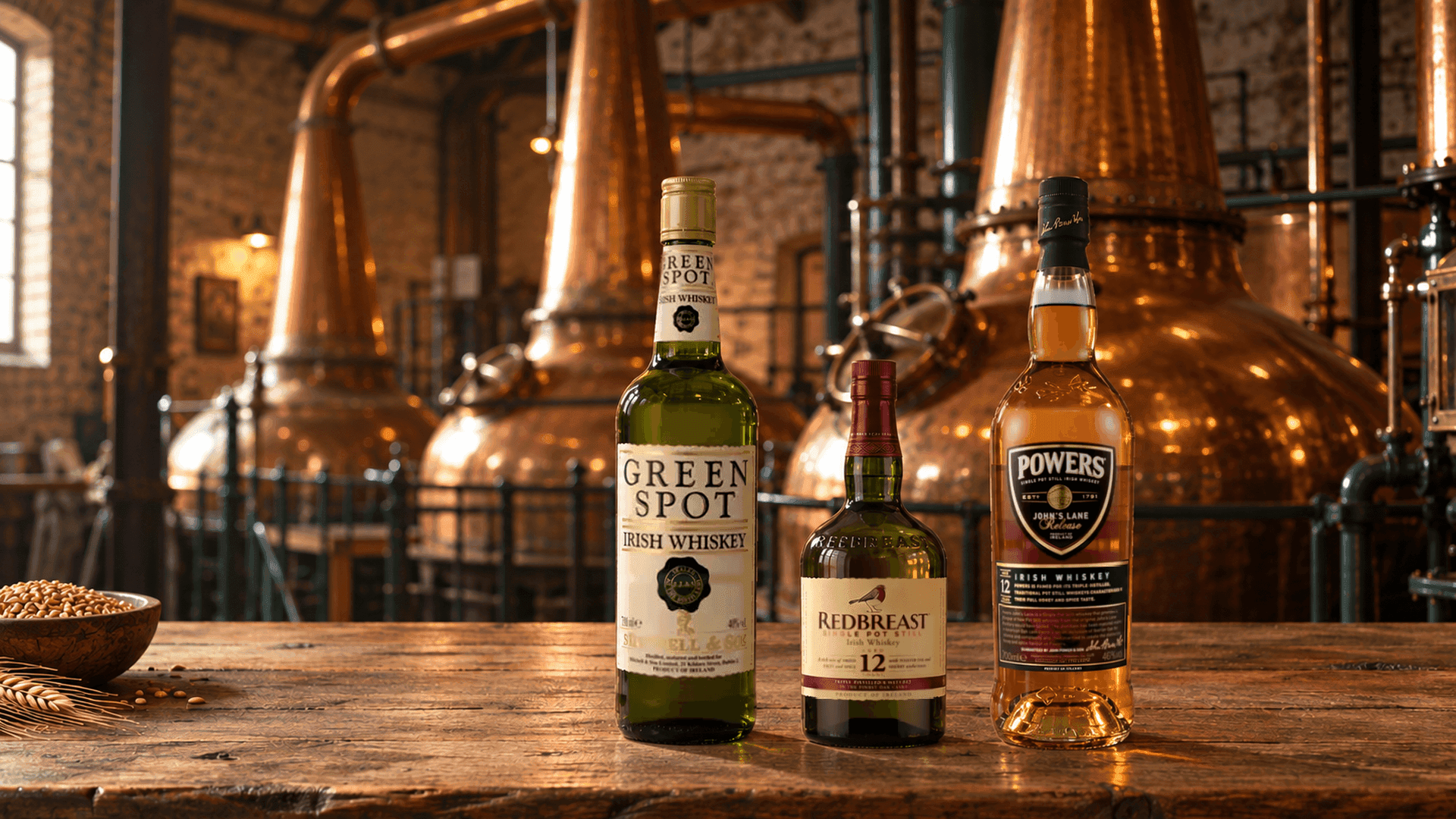
Redbreast, Green Spot, Powers and Method and Madness are among the best known single pot still brands, and all are listed on Spiritory.
Tip: Look for the words single pot still on the label rather than just pot still whiskey, since single confirms the whiskey was distilled entirely at one distillery.
The Legal Definition of Single Pot Still Irish Whiskey
Ireland's Whiskey Technical File sets out the exact rules for the category. The mash must contain at least 30% malted barley and at least 30% unmalted barley, with up to 5% other cereals such as oats or rye allowed. The whiskey must be distilled in pot stills, matured for at least 3 years in wooden casks like all Irish whiskey, and made entirely at a single distillery for the single pot still term to apply. These rules were formalised in the Technical File in 2014, after several years of discussion among Irish distillers. Bottlings that combine pot still whiskey from more than one distillery use the wider term pot still Irish whiskey rather than single pot still. Anyone who needs the current exact wording should check the Technical File published by the Irish government or contact the Irish Whiskey Association directly, since the specification has been under review.
Why Unmalted Barley Became Part of the Recipe
The use of unmalted barley in Irish whiskey is closely tied to a tax on malted barley that was introduced in 1785. Facing that duty, distillers began replacing some of the taxed malted barley in their mash with cheaper, untaxed unmalted barley. Some evidence suggests a portion of unmalted grain was already used before the tax, for the character it gave the spirit, and the tax then made the practice widespread across Irish distilleries. The malt tax was repealed in 1855, but by then the mixed mash had already become the standard Irish style, and it stayed part of the recipe. In the 19th century the style dominated Irish whiskey making and was known variously as pure pot still or Dublin sipping whiskey.
The Creamy Spicy Character of Single Pot Still
Unmalted barley is generally credited with giving single pot still whiskey a thicker texture and a spicier profile than a whiskey made entirely from malted barley. Whisky writers commonly describe the effect of unmalted barley as adding a spicier edge and a creamier texture to the spirit, a character that has become the signature of the style. Because this spice comes from the mash itself rather than from peat, it sits underneath whatever the whiskey picks up from maturation, whether that is a bourbon cask, a sherry cask or another wood, rather than replacing those flavours.
How Single Pot Still Differs From Single Malt, Grain and Blended Irish Whiskey
Irish whiskey comes in four main styles, and single pot still is only one of them. Single malt is made entirely from malted barley, and unlike single pot still it is produced all over the world, not only in Ireland. Single grain Irish whiskey is made mostly from grains such as corn or wheat in a continuous column still, and it is rarely bottled on its own, going instead into blends. Blended Irish whiskey combines whiskey from any of these styles, sometimes from more than one distillery, which is why the single pot still term specifically rules out blending across distilleries. Single pot still sits on its own within this group, built on the same mixed mash and pot still distillation that shaped Irish whiskey before blending became common in the 20th century.
Where Single Pot Still Whiskey Is Made Today
Most single pot still whiskey today comes from Midleton Distillery in County Cork, run by Irish Distillers, which produces the Redbreast, Powers and Method and Madness ranges as well as Midleton Very Rare. Green Spot is also distilled at Midleton, though it is bottled for the Dublin wine merchant Mitchell and Son rather than under the Irish Distillers name. A newer generation of independent distilleries has started releasing single pot still whiskey as well. Dingle Distillery in County Kerry released the first independent single pot still whiskey in decades in 2017, and Teeling Distillery in Dublin has released single pot still whiskey as part of its Wonders of Wood series. For a look at how these bottlings are trading among collectors, see Which Irish Whiskies Are Collectors Watching in 2026?
Bottles to Start With
These four bottles cover a useful range of the style, from an entry point to a heavier, higher proof release.
Redbreast 12 Years Old is matured in a combination of bourbon and sherry casks and bottled at 40% ABV, and it is often the first single pot still whiskey collectors try because of how widely it is available.
Green Spot carries no age statement, is matured in a mix of bourbon and sherry casks and bottled at 40% ABV, and is distilled at Midleton for the wine merchant Mitchell and Son.
Powers John's Lane Release 12 Years Old is matured mainly in American oak with a smaller share of Iberian oak and bottled at 46% ABV, a heavier style within the range.
Method and Madness Single Pot Still French Chestnut Finish is matured first in bourbon and oloroso sherry casks, then finished in French chestnut wood, and bottled at 46% ABV.
Tip: Compare a single pot still whiskey side by side with a single malt from the same region to notice how much of the spice comes from the mash itself rather than from peat or cask.
FAQ
What makes a whiskey single pot still?
A whiskey qualifies as single pot still Irish whiskey when it is distilled in pot stills from a mash of at least 30% malted barley and at least 30% unmalted barley, with up to 5% other cereals allowed, entirely at one Irish distillery, under the Irish Whiskey Technical File.
Is single pot still the same as single malt?
No. Single malt is made entirely from malted barley and is produced in many countries, while single pot still always includes a significant share of unmalted barley in the mash and can only be made in Ireland.
Why does single pot still whiskey taste spicier than single malt?
The unmalted barley in the mash is generally credited with giving single pot still whiskey a spicier, creamier character than a whiskey made only from malted barley, a difference that comes from the grain itself rather than from peat.
Where is single pot still whiskey made today?
Most of it comes from Midleton Distillery in County Cork, home to Redbreast, Green Spot, Powers and Method and Madness, alongside newer releases from independent distilleries such as Dingle and Teeling.
What is a good single pot still whiskey to start with?
Redbreast 12 Years Old and Green Spot are two of the most widely available starting points, both matured in a mix of bourbon and sherry casks and bottled at 40% ABV.
- Key Takeaways
- The Legal Definition of Single Pot Still Irish Whiskey
- Why Unmalted Barley Became Part of the Recipe
- The Creamy Spicy Character of Single Pot Still
- How Single Pot Still Differs From Single Malt, Grain and Blended Irish Whiskey
- Where Single Pot Still Whiskey Is Made Today
- Bottles to Start With
- FAQ
About the author

Max Rink
I’m a whisky enthusiast and aspiring writer, exploring new flavours and the stories behind every bottle.
To the author