

Reach thousands of whisky and spirits lovers every day.


7 Whisky Accessories That Make Great Gifts for Whisky Lovers
 by Janis WilczuraI'm one of Germany's leading whisky experts, featured in Handelsblatt and BILD. To me, whisky is craftsmanship and art.
Follow Spiritory on Google News to get our latest guides and releases delivered straight to your feed.
7 Whisky Accessories That Make Great Gifts for Whisky Lovers
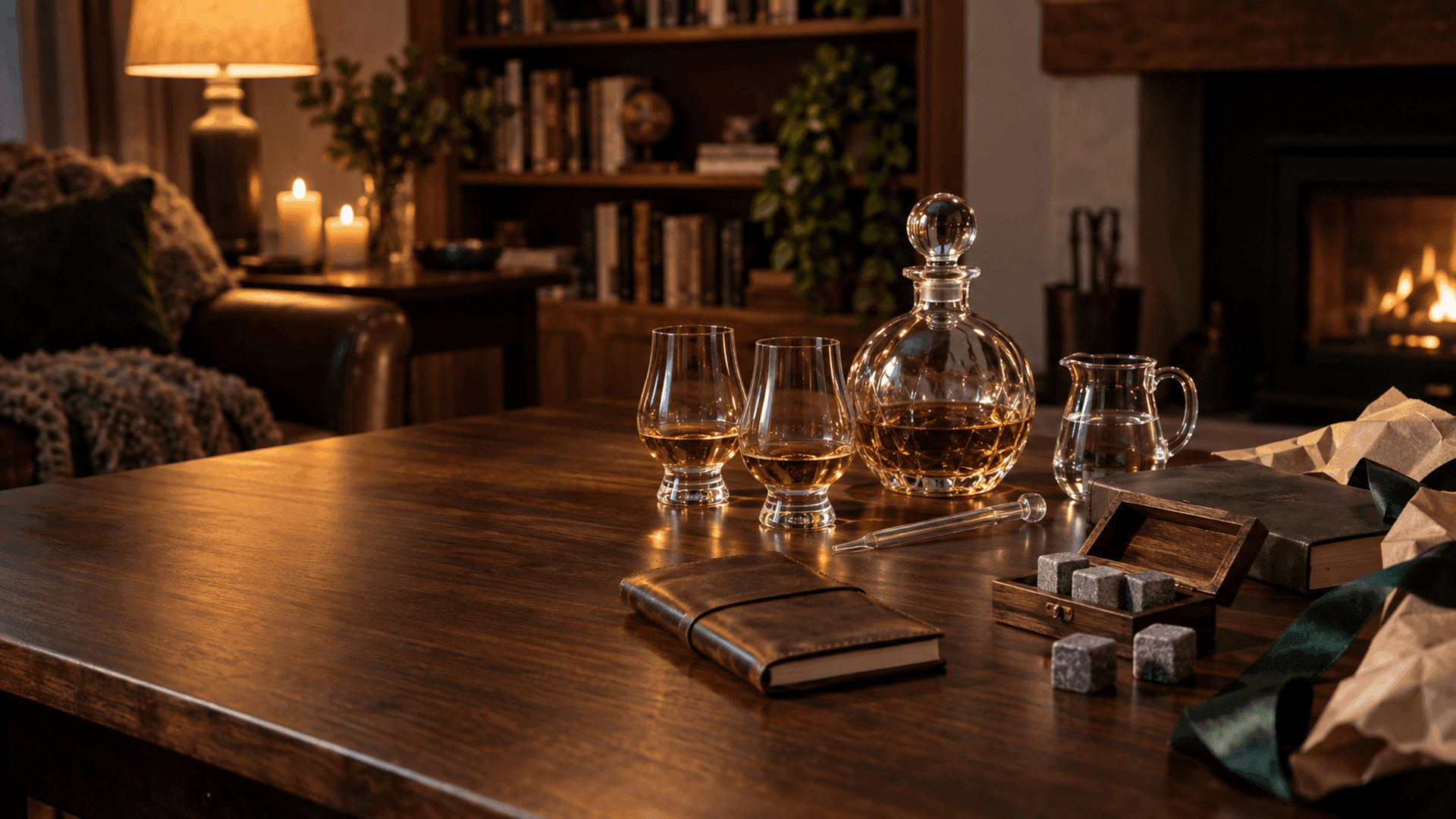
The best whisky accessory gifts include a nosing glass such as a Glencairn glass or a copita, a crystal decanter, a pipette and water jug, whisky stones, a tasting notebook, a well regarded whisky book, and a bottle display cabinet, since each one solves a different part of tasting, serving or keeping whisky rather than duplicating what a bottle already does. None of these needs to be expensive to be useful, since what matters most is how each one actually changes the way a dram is tasted, recorded or stored.
Key Takeaways
A tulip shaped glass with a narrower rim, such as a Glencairn glass or a copita, concentrates aroma better than a straight sided tumbler, and either shape makes a reliable gift for almost any whisky drinker.
A crystal decanter looks striking on display, but lead crystal should only hold whisky for a short serving. Long term storage lets lead leach into the spirit, according to McGill University's Office for Science and Society.
A pipette and a small jug of still water let a taster add water to a dram one drop at a time, which changes its aroma more precisely than pouring straight from a bottle.
Whisky stones cool a dram without diluting it, but Whisky Advocate's own testing found they cannot match the cooling power of ice, and they hold their chill for only around half an hour, according to Rabbit Hole Distillery.
Dave Broom's Whisky: The Manual, published by Mitchell Beazley, is a well known and still available guide for a recipient who wants to learn more about how to enjoy whisky in different ways.
Whisky bottles keep best stored upright, away from direct light and heat, since a bottle left in direct summer light can visibly change within four to eight weeks, according to Scotch Whisky magazine.
Tip: Ask what is already on the recipient's shelf before buying a glass or a decanter. These are gifts most whisky lovers only need one or two of, so a duplicate is easy to end up with.
A Proper Nosing Glass
A whisky glass with a tapering rim concentrates aroma toward the nose instead of letting it spread out, which is why tasting panels and blenders favour a shaped glass over a straight sided tumbler. Two shapes come up most often as gifts: the Glencairn glass and the copita.
The Glencairn Glass
Glencairn Crystal describes its glass as the world's first official whisky glass. It is made from lead free crystal, holds around 200 millilitres, and its short solid base gives it a sturdy stemless shape rather than the long stem of a wine glass. The tapering mouth is built specifically to focus aroma on the nose.
The Copita
The copita began as the traditional Spanish glass for tasting sherry and was later adopted across the whisky trade, where merchants once used a similar shape to nose shipments at the docks. Its long stem keeps the hand, and any smell on it, away from the nose, while its narrowed rim concentrates aroma in much the same way as the Glencairn glass.
Either shape works well as a gift. A copita suits someone who already owns stemmed glassware and wants to match it, and a Glencairn glass suits someone who prefers a sturdier glass without a stem.
A Crystal Decanter
A decanter turns a bottle into something worth leaving out on a shelf or a table, and it lets a host pour without handling the original bottle. The one detail worth knowing before buying, or gifting, a crystal decanter is what the crystal is actually made of.
Lead crystal typically contains between 24 and 32 percent lead oxide, and McGill University's Office for Science and Society has reported that lead can leach out of the glass into a spirit left standing in it. The same article cites testing that found port stored in a lead crystal decanter for four months measured between roughly 90 and 4,000 micrograms of lead per litre, and brandy stored for more than five years measured above 20,000 micrograms per litre, compared with the roughly 50 microgram per litre limit commonly used for drinking water. A short serving, poured for an evening and finished, is a different situation from long term storage.
What to Look For
Many decanters sold today are made from lead free crystal or glass, and the product description will usually say so. If a decanter is genuine lead crystal, the safest way to use it as a gift is as a serving piece for the evening rather than a permanent home for the bottle. A stopper that seals well keeps dust out between uses, which matters more for a decanter's appearance than for the whisky's flavour.
A Pipette and Water Jug
Adding water to whisky is common practice among distillers and blenders, since a few drops can open up aromas that stay closed in a full strength pour. A pipette and a small jug give a gift recipient a controlled way to do this, rather than guessing with a splash from the tap or a mixer bottle.
A glass pipette lets someone add water one drop at a time and judge the effect of each addition, which is harder to control when pouring straight from a jug or a bottle. The jug itself only needs to hold still water, since sparkling water or water with a strong mineral taste changes the flavour of the water before it ever reaches the whisky.
This pairing is especially useful for someone who hosts tastings at home, where several drams are compared side by side. How to Host a Whisky Tasting Night at Home covers how a tasting evening is typically run.
Whisky Stones or Ice
Whisky stones and ice solve different problems, so choosing between them as a gift depends on how the recipient actually drinks. Ice cools a dram more effectively than stones, but it also dilutes the whisky as it melts, while stones chill without diluting but cannot match ice for raw cooling power.
Whisky Advocate's own testing found that ice cools more effectively than stones because of a property called heat capacity: stones have a lower heat capacity than ice, so it takes far less energy to warm a stone back up. Large ice cubes melt slowly and dilute a dram gradually, while small or crushed ice cools faster but dilutes faster too. Rabbit Hole Distillery notes that whisky stones, most commonly made from soapstone but sometimes granite or gel filled stainless steel, need several hours in the freezer before use and typically hold their chill for only around half an hour.
Someone who drinks whisky neat most of the time is usually better suited to stones, since they lower the temperature slightly without changing the drink. Someone who already adds ice regularly, for a highball or a longer serve, is better suited to a proper set of large ice cube trays. Highball vs. Neat vs. On the Rocks: Which Serve for Which Whisky? covers which style tends to suit which whisky.
A Tasting Notebook or Journal
A tasting notebook gives a whisky drinker somewhere to record what they actually thought of a dram, rather than relying on memory a few bottles later. Kept consistently, it becomes a useful reference when deciding what to buy next or what to avoid.
A useful layout leaves room for the date, the whisky's name, and short notes on colour, nose, palate and finish, along with a simple rating. A pocket sized notebook suits someone who tastes at bars, festivals or tastings away from home, while a larger journal suits someone building a longer term record at their own pace.
A Whisky Book
A book is one of the few whisky gifts that keeps giving value long after it is opened, provided it is a genuinely well regarded title rather than a generic gift shop pick. Whisky: The Manual, written by Dave Broom and published by Mitchell Beazley, is one such example. First published in 2014, it explains how to enjoy whisky across different styles, including how water and mixers change a dram, without insisting that any single way of drinking it is correct.
Broom is a whisky writer whose other books include The World Atlas of Whisky, and his work has been recognised with industry awards including the Glenfiddich prize. A book like this suits someone who wants to understand more about whisky, not only someone who already collects it.
A Bottle Display or Cabinet
A collection that has outgrown a kitchen shelf is often better served by a proper display or storage cabinet, and how that cabinet is used matters more than how it looks. Scotch Whisky magazine reports that in summer a bottle exposed to direct light, such as in a window, can show a visible change within about four to eight weeks, affecting colour, flavour and the label itself.
Bottles should always be stored upright rather than on their side, since a whisky's high alcohol content can damage a cork or stopper left in prolonged contact with the liquid. A cool, stable temperature away from radiators and direct sun protects a bottle far better than an open shelf in a bright room, even when the open shelf looks better.
What to Look For
A closed cabinet, ideally with doors rather than fully open shelving, keeps light off the bottles between viewings. Position matters as much as the cabinet itself: away from a radiator, a window, or anywhere that gets direct sun for part of the day.
Tip: If space is limited, prioritise light and heat control over how a cabinet looks. A closed cabinet in a cool corner protects a growing collection better than an open shelf near a window.
FAQ
What is the best whisky accessory to give as a first gift?
A proper nosing glass, such as a Glencairn glass or a copita, is usually the safest choice. It suits almost any whisky drinker, costs relatively little, and its tapered shape genuinely changes how aroma reaches the nose compared with a standard tumbler.
Is it safe to serve whisky from a crystal decanter?
Yes, for a short serving. McGill University's Office for Science and Society has reported that lead can leach from lead crystal into a spirit over time, so a decanter is better used for an evening's serving than as a permanent home for the bottle.
Do whisky stones actually work as well as ice?
Not in the same way. Whisky Advocate's testing found that stones cool a dram less effectively than ice and lose their chill faster, though they do not dilute the whisky the way melting ice does. Each suits a different kind of drinker.
How should whisky bottles be stored at home?
Upright, away from direct light and heat. Scotch Whisky magazine notes that a bottle left in direct summer light can visibly change within four to eight weeks, and a cool, stable temperature protects both the liquid and the cork or stopper.
Is a whisky book a good gift for someone who already collects whisky?
It can be, if the title suits their interest rather than repeating what they already know. A guide such as Dave Broom's Whisky: The Manual works well for a collector who wants to deepen how they taste and enjoy whisky, not only add to a shelf.
About the author

Janis Wilczura
I'm one of Germany's leading whisky experts, featured in Handelsblatt and BILD. To me, whisky is craftsmanship and art.
To the author