

Reach thousands of whisky and spirits lovers every day.


Moscatel or Port? How the Two Lucky & Punch Casks Differ
 by Janis WilczuraI'm one of Germany's leading whisky experts, featured in Handelsblatt and BILD. To me, whisky is craftsmanship and art.
Follow Spiritory on Google News to get our latest guides and releases delivered straight to your feed.
Moscatel or Port? How the Two Lucky & Punch Casks Differ
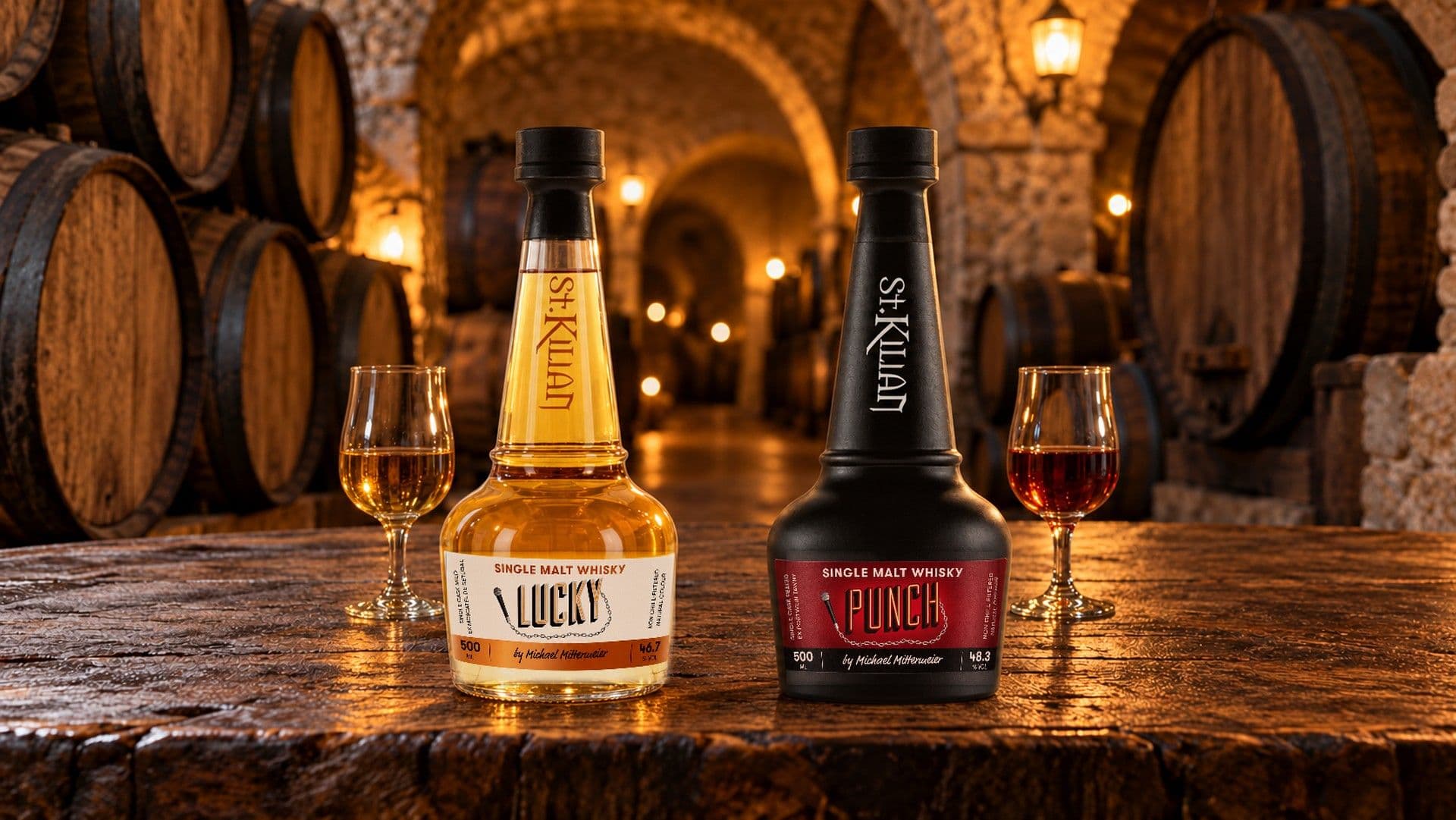
Lucky (Cask Nr.9394) matured in a cask that previously held Moscatel de Setúbal, a sweet fortified wine from Portugal's Setúbal peninsula, and is bottled at 46.7%, while Punch (Cask Nr.5914) comes from an ex Tawny Port cask, is heavily peated at 80 ppm and is bottled at 48.3%. Other whiskies from Moscatel casks have been described with orange blossom and citrus and from Tawny Port casks with caramel and dried fruit. According to the official release notes, Lucky shows floral and winey notes with fresh orange, dried fruit and caramelised walnuts, while Punch is fruity with red fruit and ripe figs and has ashy smoke on the palate.
Key Takeaways
Lucky and Punch are two single casks from St. Kilian Distillers in Rüdenau, Lower Franconia. Michael Mittermeier chose both casks himself at St. Kilian. It is his first whisky, and it is sold only on Spiritory.
Lucky is Cask Nr.9394, ex Moscatel de Setúbal, at 46.7%. Punch is Cask Nr.5914, ex Tawny Port, heavily peated at 80 ppm, at 48.3%. There are 500 of each.
Moscatel de Setúbal is a sweet fortified wine from the Setúbal peninsula south of Lisbon, protected as D.O. Setúbal. Tawny Port is a port that ages for a long time in wood and takes on its amber brown colour there, according to the IVDP.
Penderyn and The Whiskey Wash describe whiskies from Moscatel casks with orange blossom and citrus, and from Tawny Port casks with caramel and dried fruit. This is general knowledge about the cask types, not a description of Lucky or Punch.
According to the official release notes, Lucky is floral and winey with fresh orange and caramelised walnuts, while Punch is fruity with red fruit and ripe figs and has ashy smoke on the palate.
The 80 ppm figure refers to the malted barley, not to the finished whisky.
Tip: Taste Lucky before Punch. Peat smoke stays on the palate for a long time and can cover subtler notes in the next glass.
What Is Moscatel de Setúbal?
Moscatel de Setúbal is a fortified wine from Portugal's Setúbal peninsula, south of Lisbon. The regional wine commission, the CVR Península de Setúbal (CVRPS), says it is made from the Moscatel de Setúbal or Moscatel Roxo grape and carries the protected designation D.O. Setúbal. The wine reaches the market from 1.5 years of age, and the Superior category requires at least five years plus a high rating from a tasting panel.
How the Wine Is Made
The wine trade magazine The Buyer describes the method. Grape spirit is added while the wine is still fermenting. This stops the fermentation, so some of the sugar stays in the wine. The grape skins then remain in the wine for at least three months, and often for up to eight. According to The Buyer, the finished wines usually sit between 16 and 22% ABV and age for at least 18 months in steel tanks or oak casks.
What the Wine Tastes Like
The CVRPS describes Moscatel de Setúbal as golden in colour, with a strong citrus character, sweet and compote like. The Buyer adds that young wines show fresh orange, lemon and floral notes, while older wines bring candied orange peel, toasted nuts and dried fruit. A cask that held this wine takes some of it into the wood and can later pass some of it on to a whisky.
What Is Tawny Port?
Port comes from the Douro Valley in northern Portugal. Like Moscatel de Setúbal, it is fortified with grape spirit, which keeps it sweet and full bodied. Tawny is a style that ages for a long time in wood. According to the Instituto dos Vinhos do Douro e do Porto (IVDP), the official body for port wine, most tawnies are blends of wines from several years. Over time their colour fades to an amber brown. The IVDP says a bouquet of dried fruit and wood develops along the way, and the older the wine, the stronger these aromas become.
The Categories at a Glance
Tawny: a blend of wines that have aged for different lengths of time in casks or large wooden vats.
Tawny Reserve: at least six years in wood.
Tawny with an indication of age, such as 10, 20, 30 or 40 years: a blend of wines from several years that have aged in wood.
Colheita: a tawny from a single vintage, at least seven years in wood.
For Punch, only "Tawny Port" is stated. Which of these categories Cask Nr.5914 held before is not known.
What Each Cask Type Usually Brings to a Whisky
A cask that held wine passes some of that wine on to a whisky, along with colour and the aromas of the wood itself. How strong that effect is depends on the size of the cask, the time the whisky spends in it and the spirit. The descriptions below are therefore general background on the cask types. What the official release notes say about Lucky and Punch follows at the end of this section.
Moscatel de Setúbal Casks
Penderyn, the Welsh distillery, described a six year old single cask finished in ex Moscatel de Setúbal casks with orange blossom, citrus, orange peel, apricot and raisin, as The Whiskey Wash reported in 2022. St. Kilian knows this cask type well. Its Signature Edition Twelve, a four year old single malt released in 2022, matured mostly in 225 litre ex Moscatel de Setúbal casks, according to the distillery.
Tawny Port Casks
According to The Whiskey Wash, casks that held Tawny Port are linked with caramel, dried figs and nutty richness. Port casks also tend to make a whisky rounder and softer on the palate. Penderyn described a six year old single cask finished in a Tawny Port cask with vanilla, caramel, plum and red berries. St. Kilian has worked with port before as well: its Signature Edition Sixteen combines spirit from Port, Madeira and Moscatel de Setúbal casks, according to the distillery.
For more on how other cask types work, see What Does Each Cask Finish Actually Do to a Whisky?
What the Official Notes Say About Lucky and Punch
According to the official release notes, Lucky opens with floral and winey notes and fresh orange, joined by dried fruit, caramelised walnuts, honey and toffee, carried by creamy vanilla and gentle oak spice. On the palate it is soft, round and balanced: honeyed sweetness and fruit gradually give way to creamy toffee and fine nutty notes. The long finish lingers on vanilla, sweet toffee and caramelised walnuts.
Punch, according to the same notes, opens fruity with red fruit and ripe figs, backed by gentle oak spice and a touch of cinnamon. On the palate it is creamy and full bodied, with ashy smoke settling gently over the fruity, spicy notes without overpowering them. The long finish belongs to dark chocolate and well integrated smoke.
Why Punch Is Peated at 80 ppm
ppm stands for parts per million and measures phenols, the compounds that carry peat smoke. According to ScotchWhisky.com, the figure refers to the malted barley arriving at the distillery, not to the finished whisky. Some of the phenols are lost during distillation and maturation. For more, read The PPM Myth.
80 ppm is nothing unusual for St. Kilian. For its St. Kilian Peated, the distillery names heavily peated barley malt from the Scottish Highlands at 80 ppm. Its Signature Edition Fifteen was also made from Scottish peated malt at 80 ppm, according to about-drinks.com.
The names point to the contrast. Lucky Punch is the comedy club Michael Mittermeier runs with his wife Gudrun. For his first whisky he split the name in two: Lucky for the softer, sweeter cask, Punch for the one that hits harder. Punch pairs strong peat with a cask that once held a sweet port. How much smoke reaches the glass in the end also depends on distillation and maturation.
46.7% or 48.3%: What the Strength Tells You
Lucky is bottled at 46.7% and Punch at 48.3%. The gap is 1.6 percentage points. That sounds small, but you notice it in the glass. More alcohol carries aromas more strongly, feels warmer on the palate and is more likely to open up with a few drops of water.
Both whiskies are single casks, so every bottle of each comes from exactly one cask, and there are 500 bottles of 500 ml of each. Both are bottled with natural colour and without chill filtration. Whether they are at cask strength or were reduced with water is not stated. For what cask strength means, see What Does "Cask Strength" Mean?
The time in wood differs too. Punch was distilled in November 2020 and Lucky in July 2022, so Punch has had well over a year and a half more in the cask.
How to Taste Lucky and Punch Side by Side
Same glasses, same pour: use two identical nosing glasses and pour about 20 ml into each. That way you only compare the whisky.
Lucky first: it is lower in strength, and only Punch is described as peated. Smoke stays on the palate for a long time.
Nose first, then sip: with Lucky, see whether you find the notes named in the official release notes, such as fresh orange or floral notes, but trust your own nose. With Punch, notice how smoke and sweetness work together.
Water in small steps: after the first sip, add a few drops of water. At higher strength this can open up new aromas.
Go back to the start: nose Lucky again after Punch. Many differences only become clear when you switch back and forth.
Take notes: write a few words each on nose, palate and finish, and drink some water in between.
Lucky and Punch are sold only on Spiritory, the Munich based marketplace for whisky and spirits. Orders ship from 26 October 2026, and a limited number of bottles will also be sold in the shop that evening. Michael Mittermeier presents both whiskies at the whisky unveiling on Friday, 23 October 2026, from 5:00 pm at the Spiritory Shop at Stemmerhof, Plinganserstraße 6, 81369 Munich, and will be there in person. Read the full story behind the whisky in Lucky & Punch: 7 Things to Know About Michael Mittermeier's First Whisky.
Tip: Pour both whiskies a few minutes before you taste them. A short time in the air lets the alcohol settle a little, especially in Punch at 48.3%.
FAQ
What is the difference between Lucky and Punch?
Lucky comes from Cask Nr.9394, an ex Moscatel de Setúbal cask, and is bottled at 46.7%. Punch comes from Cask Nr.5914, an ex Tawny Port cask, is heavily peated at 80 ppm and is bottled at 48.3%.
What is Moscatel de Setúbal?
A sweet fortified wine from the Setúbal peninsula south of Lisbon, protected as D.O. Setúbal. According to The Buyer, grape spirit is added during fermentation and the grape skins stay in the wine for at least three months.
What does 80 ppm mean for Punch?
ppm measures the phenols in the malted barley, meaning the peat smoke that arrives at the distillery. It does not describe the finished whisky, because some of it is lost during distillation and maturation. St. Kilian uses peated malt from the Scottish Highlands.
Are there tasting notes for Lucky and Punch?
Yes. According to the official release notes, Lucky is floral and winey with fresh orange, dried fruit and caramelised walnuts, and finishes long on vanilla, toffee and walnuts. Punch is fruity with red fruit and ripe figs, has a creamy palate with ashy smoke, and finishes long on dark chocolate and well integrated smoke. The descriptions of the cask types in the other sections are general background.
Where can I buy Lucky & Punch?
Only on Spiritory, a bid and ask marketplace for whisky and spirits based in Munich that ships within the EU. There are 500 bottles of 500 ml of each whisky.
About the author

Janis Wilczura
I'm one of Germany's leading whisky experts, featured in Handelsblatt and BILD. To me, whisky is craftsmanship and art.
To the author