

Reach thousands of whisky and spirits lovers every day.


Will Your Favourite Smoky Whisky Still Taste the Same? 8 Things to Know About Peat
 by Janis WilczuraI'm one of Germany's leading whisky experts, featured in Handelsblatt and BILD. To me, whisky is craftsmanship and art.
Follow Spiritory on Google News to get our latest guides and releases delivered straight to your feed.
Will Your Favourite Smoky Whisky Still Taste the Same? 8 Things to Know About Peat
No UK or Scottish law banning the sale of peat is in force, no start date is set and whether whisky will be exempt has not been decided, so nothing changes for smoky whisky today. The longer question is open: a senior scientist at the Scotch Whisky Research Institute said in 2024 that nothing identified so far replicates peat flavour, while a new smoke process is reported to burn 30 to 40 percent less of it.
If you love smoky whisky, you know the line: it smells like a hospital, and you mean it as a compliment. Then the word "ban" turns up in the news, and the worry is fair.
Try one number first. The peat that Scotch whisky uses in a year comes from roughly 300 hectares. Scotland has about 1.8 million hectares of peatland. That is one part in 6,000. Small does not mean safe, though. Here is what is settled, what is open and what the industry is trying.
Key Takeaways
No law banning peat sales is in force in the UK or Scotland, and whether whisky gets an exemption has not been decided.
Scotch uses about 8,000 tonnes of peat a year from roughly 300 hectares, out of about 1.8 million hectares of Scottish peatland.
Three whisky companies are paying around €1.9 million (£1.6 million) to restore about 1,000 hectares of peatland on Islay.
A new smoke process is reported to burn 30 to 40 percent less peat; no flavour data is public yet.
Spruce and coffee tests were on new make spirit, and the Scotch Whisky Research Institute says nothing identified so far replicates peat flavour.
Tip: No rule in force affects bottles already filled or in cask. If a distillery ever changes its peat or smoke source, its own website is where to look for the news.
No Peat Sales Ban Is in Force Yet, and Whisky's Place in It Is Still Open
Here is where things stand in early November 2026. In a written answer on 23 October, the Department for Environment, Food and Rural Affairs said the government has pledged to ban the sale of peat and products containing peat when Parliamentary time allows. Officials in the four administrations are still considering the timing and approach, including transitional arrangements and exemptions, with details to follow. A private member's bill on horticultural peat, brought by Sarah Dyke MP, is still at second reading in the Commons and is not law.
Scotland's plan, set out in 2023, is to start with a ban on selling peat for home gardening and to look at commercial users later. Its own analysis of consultation responses found the whisky industry the group most likely to ask for an exemption, with the lack of an alternative to peat named as a particular challenge. In January 2026 the Scottish agriculture minister asked the UK government for legislation across the UK on horticultural peat, with a timetable.
So no exemption for whisky has been confirmed or refused, and nothing in force affects whisky already in bottles and casks. What matters next is how much peat whisky actually uses.
Whisky Uses About 8,000 Tonnes of Peat a Year From Roughly 300 Hectares
Guidance from May 2026, prepared by Scotland's Rural College with support from the Scotch Whisky Association, puts the industry's peat use at about 8,000 tonnes a year, taken from roughly 300 hectares. The tonnage is a best approximation, as peat moisture varies.
Most extracted peat goes into horticulture, not whisky. The Scottish Government said in 2023 that around 1% goes into malting for whisky, and the Scotch Whisky Association says it is less than 1%.
The same guidance says that of the emissions linked to peat use, roughly 75% come from burning the peat during malting and about 20% from harvesting it. That is why burning less matters. For the basics of how smoke gets into the barley, read What Does Peated Mean in Whisky?
Peatland Stores Carbon, and Whisky Companies Are Paying to Restore It
Peatland covers about 3% of the planet's land surface, yet the Scotch Whisky Association calls it the most effective carbon store on land. Over 80% of Scotland's peatland is degraded, which means it can leak carbon instead of holding it.
Whisky companies are paying to fix that. In November 2025, RSPB Scotland announced that Suntory Global Spirits, Diageo and The Glenmorangie Company would together put around €1.9 million (£1.6 million) into restoring about 1,000 hectares at The Oa nature reserve on Islay over five years. Each owns well known Islay distilleries.
On Arran, trade reports say Isle of Arran Distillers is working with Dougarie Estate on a project to restore 325 hectares of degraded peatland, funded mainly by Peatland Action, with the distillery paying for site monitoring afterwards.
Restoring bog is one answer. Burning less of it is another.
A New Smoke Process Is Said to Cut Peat Use by 30 to 40 Percent
The process is called Ionsmoke. Boortmalt, a malt producer, and EBSmoke, a Swiss firm, say it works by charging the smoke particles with high voltage, so the malt absorbs them. In a May 2026 release, EBSmoke says that since spring 2026 this lets Boortmalt burn 30 to 40 percent less peat to smoke whisky malt. Boortmalt says the aim is the same phenolic impact with less peat.
It also quotes David Cooke, responsible for innovation at Boortmalt, saying the smoking is significantly more consistent, with repeatable results.
What is known is limited to what the two companies say. EBSmoke reports that tests with the Scotch Whisky Research Institute confirmed the quality of the malt is unchanged. No tasting results or phenol figures for whisky made from this malt were found, and neither company page names which distilleries use it. The PPM Myth explains why a ppm figure never tells the whole story. Whether flavour stays the same when phenols do is the fair question, and the answer has not been published in anything we found.
Spruce, Coffee Grounds and Nettles Have Been Tried, but Nothing Matches Peat Yet
Researchers at Heriot-Watt University tested spent coffee grounds as a smoke source. Their October 2024 paper compared new make spirit from coffee smoked malt with peated spirit. Chemical analysis found similar levels of several smoke related phenolic compounds in both. A sensory panel found no significant difference in smoky or medicinal scores, but the coffee samples scored higher for burnt character.
A 2026 paper by the same lead author tested spruce wood. The abstract says peat gave a greater abundance of the desirable phenolic compounds when heated, while the spruce smoked spirit was described by the panel as lightly smoked, with no unpleasant off notes. The authors add that a fairer comparison would need the smoke intensities matched.
Both tests used new make spirit, not aged whisky. Elsewhere, the Danish distillery Fary Lochan says it smokes its malt with fresh nettles.
The plain answer from the Scotch industry is that nothing matches yet. Barry Harrison, a senior scientist at the Scotch Whisky Research Institute, said in 2024 that at the moment nothing has been identified which replicates peat flavour. The Rural College guidance agrees: studies so far show the flavour cannot be replicated with alternatives. The Scotch Whisky Technical File names three raw materials for malt whisky, malted barley, water and yeast, and whether another smoke fuel fits is not settled in the documents we checked. Harrison added that without peat a whisky could no longer be called peated.
Peat Tastes of Its Place, So the Source Matters
Laphroaig says its Islay bogs are unlike anything on mainland Scotland. With no forests on the island, the peat is built mostly from heather, lichen and moss, plus old sea vegetation it links to a maritime character.
GlenAllachie uses mainland peat from St Fergus, which it says gives a sweeter, oakier smoke than coastal peat. Different place, different smoke. For a wider view of how smoke styles differ, see Peated vs Unpeated Whisky.
This matters if supply ever changes. The same guidance says most distilleries that make peated whisky do not own a bog or take part in harvesting. Peat is cut at a select number of sites, and in many cases the maltster, not the distiller, deals with the extractor. The guidance warns that some operators may be left without viable supply options. How that would play out is not known. What is certain is that the smoke in your glass has an address.
Blended Scotch Carries Peat Too, Not Only Islay Bottles
The Scotch Whisky Association says peat is found in a wide variety of blended and single malts. The Scotch Whisky Technical File says the distiller decides how peated a malt is, from none to heavily peated. Peat reaches blends through the peated malts inside them.
So a change in peat supply would reach beyond Islay. If you have wondered what the biggest ppm numbers mean, What Does 80 ppm Mean? covers it. The Association also notes that many of its members are end users and do not control the sites where their peat is cut.
Three Bottles Show Three Ways Peat Can Taste Today
For a smoke lover, the practical step is to learn which style of peat you like. Strengths are from our own catalogue.
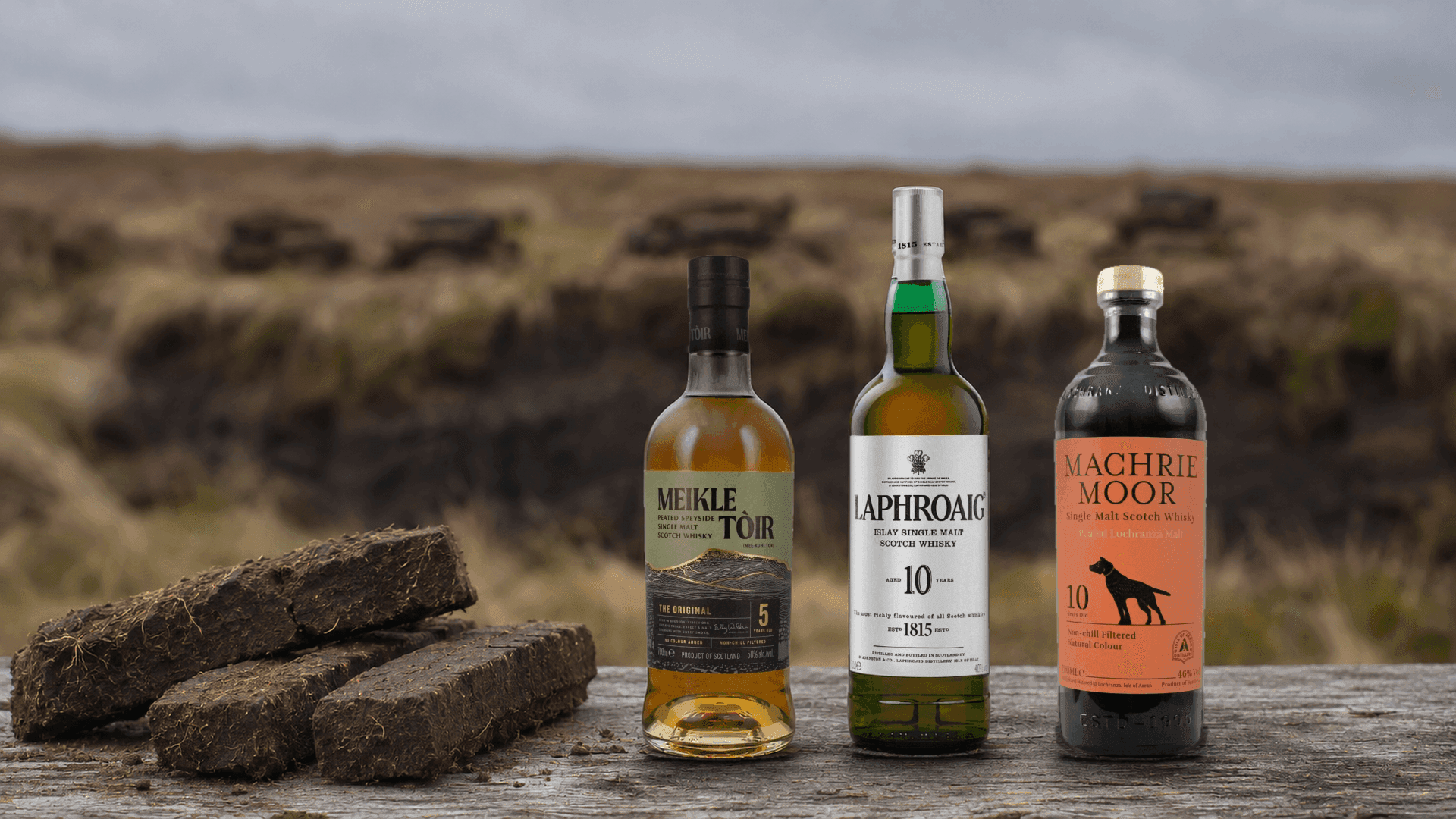
Laphroaig 10 Years Old is an Islay malt at 40%. Laphroaig says it burns its peat at a low temperature, a cold smoking process it links to the tarry note.
Meikle Tòir 5 Years Old The Original comes from GlenAllachie and uses the mainland peat from St Fergus. It is five years old and bottled at 50%. GlenAllachie gives the spirit 35 ppm, says the peated production runs for about six weeks a year, and describes stem ginger and sweet spice.
Machrie Moor 10 Years Old Peated Lochranza Malt comes from Arran at 46% and is named after a peat bog and standing stones on the island's west coast. Arran says Lochranza stopped making peated spirit in 2017, and its Lagg distillery makes heavily peated whisky. Its maker also backs peatland restoration.
Tip: Taste any smoky whisky and ask one question: does the smoke read as medicinal, sweet or earthy? That tells you which peat style you enjoy most.
FAQ
Will smoky whisky taste different soon?
Not under any rule in force today. No law banning peat sales is in force and no date is set. The longer term unknown is that a Scotch Whisky Research Institute scientist said in 2024 that nothing identified so far replicates peat flavour.
Will whisky be exempt from a peat ban?
That has not been decided. The UK government says exemptions are being considered by officials in the four administrations, and in Scotland's consultation analysis the whisky industry was the group most likely to ask for one.
How much peat does whisky use?
A 2026 guidance document estimates about 8,000 tonnes a year from roughly 300 hectares. The Scottish Government said in 2023 that around 1% of extracted peat goes to whisky malting.
Is there a way to use less peat?
The supplier EBSmoke says Boortmalt's Ionsmoke process burns 30 to 40 percent less peat, and Boortmalt's David Cooke describes more consistent smoking. EBSmoke reports unchanged malt quality in tests, but no tasting results were found.
Do blended whiskies use peat?
Yes. The Scotch Whisky Association says peat is found in a wide variety of blended and single malts.
- Key Takeaways
- No Peat Sales Ban Is in Force Yet, and Whisky's Place in It Is Still Open
- Whisky Uses About 8,000 Tonnes of Peat a Year From Roughly 300 Hectares
- Peatland Stores Carbon, and Whisky Companies Are Paying to Restore It
- A New Smoke Process Is Said to Cut Peat Use by 30 to 40 Percent
- Spruce, Coffee Grounds and Nettles Have Been Tried, but Nothing Matches Peat Yet
- Peat Tastes of Its Place, So the Source Matters
- Blended Scotch Carries Peat Too, Not Only Islay Bottles
- Three Bottles Show Three Ways Peat Can Taste Today
- FAQ
About the author

Janis Wilczura
I'm one of Germany's leading whisky experts, featured in Handelsblatt and BILD. To me, whisky is craftsmanship and art.
To the author