

Reach thousands of whisky and spirits lovers every day.


What Does "Peated" Mean in Whisky?
 by Christopher Deutsch I drink and collect with intention, drawn to the sherried depth of Dalmore and the balance of Yamazaki.
Follow Spiritory on Google News to get our latest guides and releases delivered straight to your feed.
What Does "Peated" Mean in Whisky?
Key Takeaways
Peated whisky is made from malted barley dried over a peat fire, which gives the spirit its smoky character.
Peating levels are given in parts per million (ppm) of phenols in the malt, not in the finished whisky, and much of that is lost during production.
Islay is the region most associated with heavily peated whisky, led by Ardbeg, Laphroaig, and Lagavulin.
Published malt specifications run from single figures to well over 100 ppm; Lagavulin sits at about 35 ppm and Ardbeg at a minimum of 55 ppm.
Peat is a stylistic choice, not a requirement, and many distilleries work with unpeated malt.
Smoke softens over time, both in the cask and in an opened bottle, because phenols are gradually lost.
Peat, Phenol, and the Smoking Process
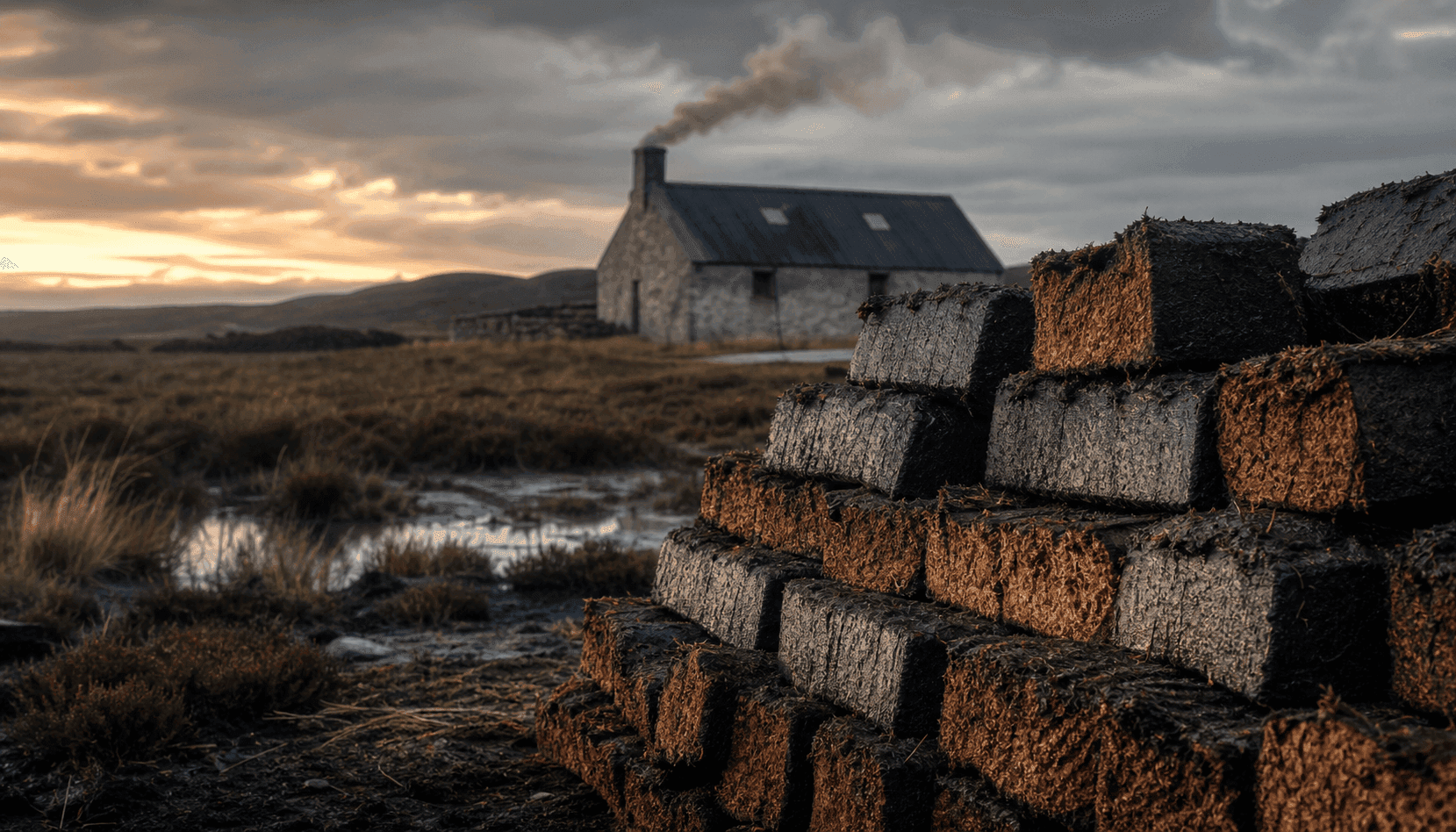
Peat is partially decayed vegetation, such as mosses, grasses, and heather, that builds up in waterlogged bogs over thousands of years. It is cut from the ground, traditionally by hand, and left to dry before it is burned. To make peated malt, a peat fire is lit at the start of kilning, beneath the barley while it is still damp. The smoke rises through the perforated kiln floor, and its phenolic compounds attach to the moist grain; at Laphroaig, peat smoke passes through the kiln for around 10 to 12 hours. Unpeated malt is dried without peat smoke.
Most Scotch distilleries buy their malt from commercial maltsters and specify the phenol level they require. Only a handful still malt barley on their own traditional floors, among them Laphroaig, Bowmore, Highland Park, Kilchoman, and The Balvenie. Springbank goes furthest and malts all of its barley this way. Drying barley over peat fires is a long tradition; today, peat is used above all for the flavor it brings.
Peat smoke contains a family of phenolic compounds. Phenol itself is usually present in the highest concentration but is not especially aromatic; cresols bring tarry, antiseptic notes, while guaiacol contributes smoke, earthiness, and medicinal tones even at low concentrations. The peating level is the total phenol content of the malted barley in parts per million (ppm), measured in the maltings' laboratory. It describes the malt, not the bottled whisky: phenols are left behind in the draff after mashing, remain in the feints during distillation, and decline further in the cask. A higher ppm figure therefore does not translate directly into a smokier glass, as our guide to the PPM myth explains.
Published figures show the range. Ardbeg states that its malt is peated to a minimum of 55 ppm, and its limited Supernova releases went beyond 100 ppm. Whisky Advocate cites 45 ppm for most Laphroaig releases, 35 ppm for Lagavulin and Caol Ila, and 22 ppm for Talisker 10 Year Old. Bruichladdich makes Octomore from malt at 80 ppm and above, and Octomore 06.3 reached 258 ppm. All of these figures refer to the malt. A lower number does not mean a lesser whisky; it reflects a different flavor goal.
Islay and Other Peated Regions
Islay, off Scotland's west coast, is the region most closely associated with heavily peated whisky. Ardbeg, Laphroaig, and Lagavulin all work with heavily peated malt and are known for a pronounced smoky, medicinal, and tarry character that divides drinkers. Laphroaig describes the plants behind its local peat as primarily heather, lichen, and moss. Caol Ila uses malt with the same 35 ppm specification as Lagavulin, yet the two whiskies taste distinctly different, because milling, mashing, fermentation, distillation cuts, and maturation all influence how much smoke reaches the glass.
Peat itself varies from place to place. A 2009 study of peat from Islay, Orkney, and two sites on the Scottish mainland found clear differences in chemical composition, and more heather in Orkney peat than in Islay peat. Highland Park on Orkney malts part of its barley on its own floors and dries it over peat from Hobbister Moor, which is rich in heather and which the distillery credits with a subtle, aromatic smoke. Talisker on Skye sits in the moderate range, and its official tasting notes highlight peat smoke and a peppery finish.
Many distilleries use no peat at all. Most Speyside whisky is unpeated or only lightly peated, and most Irish and American whiskey is made without peat. Peated whisky is not exclusive to Scotland, however: Connemara is a peated Irish single malt, and Japan's Hakushu 12 Years Old is made from lightly peated malt, listed by Whisky Advocate at 8 ppm. Peat is a regional tradition and a stylistic choice, not a universal practice.
Tip: Newcomers to peat often do best by moving up gradually. Highland Park 12 Year Old Viking Honour offers a subtle, aromatic smoke, Talisker 10 Year Old brings more pronounced peat smoke with a peppery finish, and Laphroaig Quarter Cask or Ardbeg Ten Years Old sit at the intense end of the scale.
Peat Character Over Time
Peat character evolves during maturation. New make spirit from peated malt is raw, and its phenolic notes dominate. In the cask, some phenols evaporate while others are absorbed or transformed, and the smoke integrates with wood spice, tannins, and fruit. A peated Islay malt aged for ten years therefore tastes more rounded than its new make, although the smoke remains central to its profile.
Older peated whiskies usually show a softer, more integrated smoke alongside deeper oak flavors, while younger bottlings keep the peat more direct. Some collectors prize this evolution; others prefer the intensity of younger releases.
FAQ
Does peat make whisky taste bad?
No, it is a matter of preference. Many enthusiasts consider peat an essential part of a distillery's character, while others find heavy smoke unpleasant. Tasting peated and unpeated whiskies side by side is the most reliable way to discover a personal preference.
Can I taste peat in whisky if I'm new to spirits?
Yes. Newcomers often describe peat as smoky, ashy, or medicinal, and those descriptors are accurate. It can take time to appreciate, so many drinkers start with a gently smoky whisky such as Highland Park before moving on to heavily peated Islay styles.
Is all Islay whisky heavily peated?
No. Bunnahabhain is best known for unpeated whisky, and Kilchoman peats the barley for its 100% Islay range to 20 ppm, well below the 50 ppm malt it uses for its other whiskies. Bowmore is generally regarded as more moderately peated than Ardbeg or Laphroaig. Not every Islay whisky is a peat monster.
Does peat character fade after the bottle is opened?
It can, gradually. Strongly peated whiskies can lose intensity the longer a bottle stays open, and the change speeds up as the level drops and more air fills the bottle, because smoky phenols are among the compounds most readily lost to oxidation. Keeping bottles upright, tightly closed, and away from heat and direct sunlight helps, and decanting a partly finished bottle into a smaller one reduces contact with air.
Do any distilleries make both peated and unpeated whisky?
Yes. Bruichladdich on Islay makes its unpeated Bruichladdich single malt alongside Port Charlotte, peated to 40 ppm, and the super heavily peated Octomore. In Campbeltown, Springbank produces lightly peated Springbank, heavily peated Longrow, and unpeated Hazelburn at a single distillery. Comparing expressions from the same producer shows clearly what peat adds.
About the author

Christopher Deutsch
I drink and collect with intention, drawn to the sherried depth of Dalmore and the balance of Yamazaki.
To the author