

Reach thousands of whisky and spirits lovers every day.


Why Is Indian Single Malt Suddenly So Popular? 6 Things Behind It, From Heat to Trade Deals
 by Christopher Deutsch I drink and collect with intention, drawn to the sherried depth of Dalmore and the balance of Yamazaki.
Follow Spiritory on Google News to get our latest guides and releases delivered straight to your feed.
Why Is Indian Single Malt Suddenly So Popular? 6 Things Behind It, From Heat to Trade Deals
Indian single malt became popular for six reasons: a hot climate that matures whisky fast, pride at home where it reportedly passed Scotch single malt, early brands such as Amrut and Paul John, local six row barley and unusual casks, prices that suit buyers in India, and a 2026 trade deal that halves the Scotch tariff from 150% to 75%. Behind the rise sits one number: a cask can lose 11 to 12% of its whisky a year in Bangalore, against about 2% in Scotland.
Fill a cask and come back in five years. In Scotland, about a tenth of the whisky has drifted into the air by then. In Bangalore, by the same sum, nearly half has gone.
Most makers would call that a disaster. Indian makers say the same heat is why their whisky is ready early, and drinkers at home reportedly now buy more of it than of Scotch single malt. Six things sit behind that, and the heat comes first.
Key Takeaways
Heat: a former Amrut master blender estimates a year in India does the work of about three in Scotland, at the price of losing 11 to 12% of the cask each year.
Home pride: Indian single malt has reportedly overtaken Scotch single malt in India. One industry estimate points to 2023, other figures to 2024.
Most whisky sold in India is a different product: a blend built on molasses spirit, not single malt.
Amrut sold in Glasgow in 2004 and in India only from 2010. Paul John, Indri and Rampur followed.
Scotch import duty in India fell from 150% to 75% when the UK and India trade deal took effect on 15 July 2026, and is due to reach 40% by year ten.
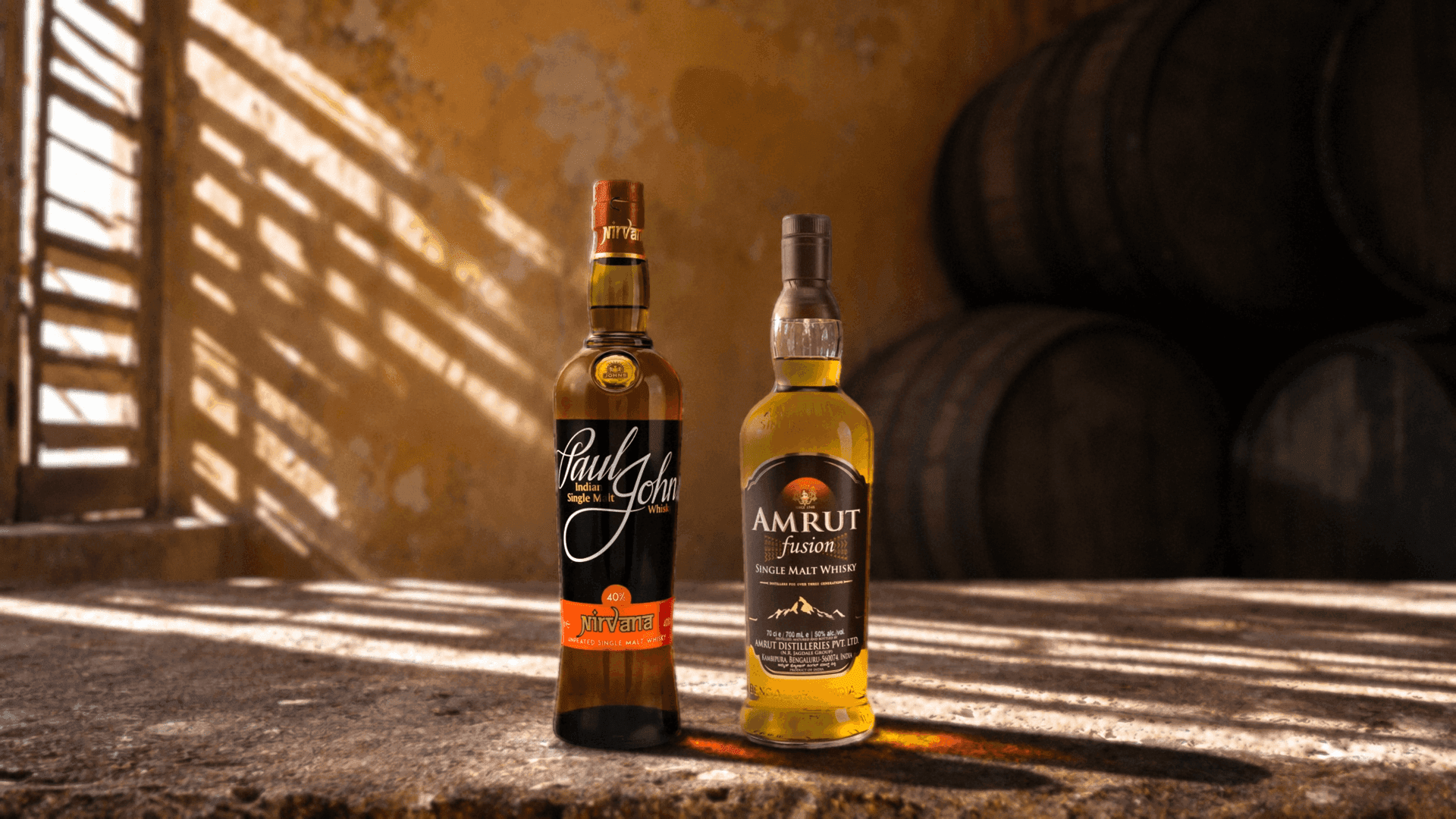
Easy places to start: Paul John Nirvana, Amrut Fusion and Rampur Barrel Blush.
Tip: Look for the words "single malt" on the label. A bottle that only says Indian whisky may be one of the molasses blends explained below, which is a different drink.
A Cask in Bangalore Can Lose 11 to 12% a Year, Against About 2% in Scotland
That 11 to 12% figure comes from Surrinder Kumar, a former Amrut master blender who now makes whisky for Indri. Paul John gives its own number for Goa: an angel's share of 8 to 10% a year, which the company says speeds up maturation. Warehouses differ, so read all of these as ranges. The five year sum above is simplified, but it shows why Indian makers cannot simply wait.
In the glass, heat pushes whisky in and out of the wood much faster. Indian whisky researcher Charnelle Martins says warm conditions cause a very rapid extraction of compounds from the wood. Kumar's rule of thumb is that one year in India equals about three in Scotland. A five year old can taste rich, spicy and well oaked, so it can taste older than its age. It is still a different thing from a 12 year old Scotch, which has changed slowly over a long time, and too much speed can push oak flavour too far.
For the wider market picture, read our explainer Is India the Next Whisky Powerhouse? What Collectors Should Know. Fast whisky is only useful if someone buys it, and at home, someone does.
Indian Single Malt Reportedly Passed Scotch at Home, but Sources Disagree on the Year
The claim is simple: Indian single malt now outsells Scotch single malt in India. It is probably true, but the details are messy.
In early estimates for 2023, the Confederation of Indian Alcoholic Beverage Companies put Indian made single malts at a little over half of the single malt sold in India.
Reports of figures from the market research firm IWSR say Indian single malt sales grew by more than 75% in 2023 and came close to Scotch single malt. A further rise of more than 25% in 2024 put them clearly ahead.
In August 2026 IWSR wrote that Indian single malt "has now overtaken Scotch single malt in volume and value". It gave no year and no numbers in that piece.
So the crossover year is 2023 by one estimate and 2024 by another, and the two sources may not count the same way.
One more thing to know: this is a story about a small corner of a huge market. All single malt sold in India, Indian and imported, was estimated at about 675,000 cases in 2023. One mainstream whisky brand, Royal Stag, sold 32.6 million nine litre cases in 2025, according to IWSR preliminary data. The years differ, but the gap is wide either way.
Most of that mainstream whisky is made differently. It is usually a blend built mostly on neutral spirit from molasses, the dark syrup left over when sugar is made, often with a little malt or grain whisky added for flavour. In the EU and the US, whisky must come from grain, so most of these drinks could not be sold there as whisky. Single malts such as Amrut, Paul John and Indri are made from malted barley, as Scotch is. How did those malts get noticed? Not at home first.
Amrut Launched in Glasgow in 2004, and India Only Got It in 2010
Amrut Distilleries, founded in Bangalore, launched its single malt in Glasgow in 2004. It went on sale in India only in 2010. Trust was built abroad first, and Indian drinkers heard about it second.
In 2010 the whisky critic Jim Murray placed Amrut Fusion third among the world's whiskies in his annual guide.
Others followed. Paul John, made in Cuncolim in Goa, released its first single malt in 2012. Kumar's career shows how small this world was: he moved from Amrut to Indri, a newer brand from Piccadily Distilleries in Haryana. Indri says its Diwali Collector's Edition won Best in Show, Double Gold at the Whiskies of the World Awards 2023. That is a competition award, not a ranking of every whisky. Rampur is made by Radico Khaitan, and its Barrel Blush reached the UK in October 2024. So what do these makers put in the barrel?
Indian Six Row Barley and Unusual Casks Give the Whisky Its Own Flavour
Paul John says its whisky is made from indigenous Indian six row barley sourced from across north India. Scottish whisky is usually made from two row barley. Six row barley has a different balance of starch and protein, which can make malting harder. No public test shows that this alone changes the taste, so treat flavour claims as the makers' own.
The makers do describe a style. For Paul John Nirvana, the brand lists honey, fruitcake and vanilla. For Rampur Barrel Blush, the brand lists tropical fruit, florals and oak on the nose.
Casks add the next layer. Amrut says its Naarangi was matured in casks first seasoned for three years with Oloroso sherry and orange peel. Rampur Asava is finished in Indian Cabernet Sauvignon wine casks, which the company called a first. Barrel Blush uses American bourbon barrels, then Australian Shiraz casks chosen by master distiller Anup Barik: an Indian malt with an Australian wine in it. The casks explain the flavour. The price explains the crowd.
Until July 2026 Imported Scotch Paid a 150% Duty, and Local Malt Did Not
For years, imported whisky entered India with a 150% import duty. State taxes came on top, and they differ by state. Indian made malt avoided the import duty.
IWSR gave rupee price ranges in its May 2025 analysis of the trade deal. Converted at the ECB rate of 2 November 2026, they look like this:
Most local whisky: around €5 to €8.
Standard blended Scotch: around €13 to €15.
Premium imported blends: around €30 to €34. IWSR says Indian single malts sell at similar prices.
The picture for a buyer in India is clear. Indian single malt competes with premium imports, not with the cheap local blends, and it did not carry the import duty that lifted the price of foreign bottles. That edge is now shrinking.
The Scotch Tariff Is Now 75% and Falling to 40%, and Nobody Agrees Who Wins
The UK and India trade deal took effect on 15 July 2026. The UK government says Scotch whisky tariffs fall from 150% to 75% immediately, then to 40% over ten years. The price Indian drinkers pay will also depend on state taxes, so the shelf change may be smaller than the tariff change.
Will it hurt Indian single malt? In May 2025 IWSR said price gaps protect local brands, and that "some will prosper, others may falter" as protection falls. Indian producers had pushed for a minimum import price to prevent dumping, and it was unclear whether they would win it.
Or will it help? IWSR also expected local premium whiskies that use bulk imported Scotch to gain a small cost benefit, much like Scotch that is bottled in India. And at 75% falling to 40%, imported bottles still carry a duty that Indian made malt does not. It is too early to say which wins.
Where to start, by flavour
Soft and sweet: Paul John Nirvana. It is unpeated, 40% ABV, matured in ex bourbon barrels, and the brand lists honey and vanilla.
A little smoke: Amrut Fusion. It is 50% ABV and uses 25% peated Scottish barley. If peat is new to you, read What Does "Peated" Mean in Whisky?
Wine cask lovers: Rampur Barrel Blush. It is 45% ABV, from bourbon barrels and then Australian Shiraz casks.
Tip: A young whisky from a hot country is not a lesser one. It is a different one. Judge it on its own terms, and not against a 12 year old Scotch.
FAQ
Is Indian whisky the same as Indian single malt?
No. Most whisky sold in India is a blend built on neutral spirit from molasses. Indian single malts such as Amrut, Paul John and Indri are made from malted barley.
Does whisky really age faster in India?
Makers say so. Paul John gives an angel's share of 8 to 10% a year in Goa, and Surrinder Kumar estimates 11 to 12% in Bangalore, against about 2% in Scotland.
Did Indian single malt overtake Scotch in India?
Reportedly yes. One industry estimate points to 2023 and IWSR figures point to 2024, and in August 2026 IWSR said Indian single malt has overtaken Scotch single malt in volume and value. The exact year is uncertain.
What changed with the Scotch tariff in India?
Under the UK and India trade deal, in force since 15 July 2026, the tariff on Scotch fell from 150% to 75%. It is due to reach 40% by year ten.
Which Indian single malt should I try first?
Paul John Nirvana is soft and unpeated, Amrut Fusion adds a little smoke, and Rampur Barrel Blush is finished in Shiraz wine casks.
- Key Takeaways
- A Cask in Bangalore Can Lose 11 to 12% a Year, Against About 2% in Scotland
- Indian Single Malt Reportedly Passed Scotch at Home, but Sources Disagree on the Year
- Amrut Launched in Glasgow in 2004, and India Only Got It in 2010
- Indian Six Row Barley and Unusual Casks Give the Whisky Its Own Flavour
- Until July 2026 Imported Scotch Paid a 150% Duty, and Local Malt Did Not
- The Scotch Tariff Is Now 75% and Falling to 40%, and Nobody Agrees Who Wins
- FAQ
About the author

Christopher Deutsch
I drink and collect with intention, drawn to the sherried depth of Dalmore and the balance of Yamazaki.
To the author