

Reach thousands of whisky and spirits lovers every day.


What Is a Whisky Mac? And Two More Ginger and Honey Drinks for Cold Evenings
 by Christopher Deutsch I drink and collect with intention, drawn to the sherried depth of Dalmore and the balance of Yamazaki.
Follow Spiritory on Google News to get our latest guides and releases delivered straight to your feed.
What Is a Whisky Mac? And Two More Ginger and Honey Drinks for Cold Evenings
A Whisky Mac is blended Scotch mixed with green ginger wine, two parts Scotch to one part Stone's Ginger Wine and served without ice according to Scotch Whisky magazine, while the Rusty Nail pairs Scotch with Drambuie at about three to one and the Penicillin, created by Sam Ross at Milk & Honey in New York in 2005, shakes blended Scotch with honey, ginger and lemon and floats a peated Islay malt on top. None of the three recipes here is heated, and Scotch Whisky magazine warns that the Rusty Nail can quickly taste like cough medicine if the liqueur is overdone.
Key Takeaways
The Whisky Mac has two ingredients. Scotch Whisky magazine gives 2 parts Scotch to 1 part Stone's Ginger Wine with no ice, while Difford's Guide stirs 45 ml blended Scotch with 30 ml ginger wine and serves it over ice.
The Rusty Nail is Scotch and Drambuie. Difford's Guide says about 3 to 1 is preferred by most, with 60 ml blended Scotch, 20 ml Drambuie and 2 dashes of Angostura bitters.
The Penicillin is a modern drink. Sam Ross created it in 2005 at Milk & Honey in New York, and it combines honey, ginger, lemon, blended Scotch and a float of peated Islay malt.
None of the three recipes here uses hot water. The warmth comes from ginger spice and honey.
You need only one blended Scotch and one peated Islay malt to make all three at home, plus ginger wine and Drambuie for the first two.
Tip: Treat every ratio here as a starting point. Measure with a jigger, make the drink once at the printed ratio, then change the liqueur or ginger wine by 5 ml at a time. Difford's Guide notes that its reviewer prefers about 1.5 parts whisky to 1 part ginger wine, while a commenter on the same page found 2 to 1 more balanced.
What Is a Whisky Mac?
The Whisky Mac is the simplest of the three: Scotch and green ginger wine, nothing else. In a 2015 piece on winter whisky drinks, Alice Lascelles of Scotch Whisky magazine gives the classic ratio as 2 parts Scotch to 1 part Stone's Ginger Wine, served with no ice. Difford's Guide takes a slightly different route. It stirs 45 ml blended Scotch and 30 ml ginger wine with ice, strains the drink over a large cube and garnishes it with candied ginger on a stick.
Difford's Guide lists the finished drink at about 23.5% ABV, which makes it a short, strong drink that is meant to be sipped. Its recipe names Lyme Bay Ginger Wine rather than Stone's, so more than one brand of green ginger wine works.
Where does the name come from?
The full name is Whisky MacDonald. Difford's Guide repeats the legend that it was created in 1899 by Major General Sir Hector Archibald MacDonald, known as Fighting Mac, while he served in India. The same page doubts the story and concludes that he may or may not have created the drink. Treat the origin as a legend rather than a fact.
How can you vary it?
Scotch Whisky magazine suggests splitting the ginger wine with King's Ginger Liqueur, adding a few drops of chocolate or orange bitters, or finishing with a large orange or lemon twist. It also lists a long version served over ice with 125 ml of cloudy apple juice. Brian Silva of Balthazar London, quoted in the same article, says he finds Grouse the best all round mixing Scotch.
How Do You Make a Rusty Nail Without It Tasting Like Cough Medicine?
Use less Drambuie than you think you need. Scotch Whisky magazine describes the Rusty Nail as about 3 parts Scotch to 1 part Drambuie and warns that it is a drink that can quickly turn to cough medicine, in all the wrong ways. Drambuie describes itself as a blend of aged Scotch whisky, heather honey and aromatic herbs and spices.
Difford's Guide gives 60 ml blended Scotch, 20 ml Drambuie and 2 dashes of Angostura bitters, stirred with ice and strained into an ice filled rocks glass with a lemon zest twist. Whisky Advocate (Brittany Risher, May 2020) uses 2 oz Scotch and 3/4 oz Drambuie, and also offers a drier option of 2 oz Scotch to 1/4 oz Drambuie. Its tip for stronger flavour is to split the base, for example 1.5 oz blended Scotch and 3/4 oz Islay Scotch.
How old is the Rusty Nail?
Whisky Advocate quotes Paul Taylor of Columbia Room in Washington, D.C., who says most historians point to the 1937 British Industries Fair as the debut of Scotch and Drambuie together, in a drink called the B.I.F. The same article says that a 1967 recipe in Old Mr. Boston De Luxe Official Bartender's Guide called for equal parts Scotch and Drambuie, and that modern versions are drier. Difford's Guide gives two accounts. It says the drink is said to have been created in 1942 at a Hawaiian bar for the artist Theodore Anderson and popularised in the 1950s at Club 21 in New York, and it adds that David Wondrich traced the mixing of Scotch and Drambuie back to the B.I.F. of 1937. Scotch Whisky magazine also places the invention in Hawaii but gives no year. Whisky Advocate adds that some attribute the recipe to bartenders at the 21 Club in New York, but calls that uncertain.
What Makes the Penicillin Different From the Other Two?
It is shaken, it contains lemon, and it needs a honey and ginger syrup. Difford's Guide credits the Penicillin to Sam Ross at Milk & Honey in Manhattan in 2005 and says it began as a riff on the Gold Rush, a bourbon, honey and lemon drink. Scotch Whisky magazine calls it a cross between a toddy and a whisky sour, and Difford's Guide describes the result as a whisky sour with honey richness, subtle smoke and enlivening ginger spice.
Difford's Guide lists Ross's original build as 60 ml blended Scotch, 22.5 ml lemon juice and 22.5 ml honey and ginger syrup, shaken with ice and strained into an ice filled rocks glass, then topped with 7.5 ml of peated Islay single malt. For the syrup, it says to simmer sliced ginger, honey and water for 5 minutes, steep for 12 hours and use within three days. Difford's Guide puts its ginger liqueur version at about 18% ABV, lighter than the Whisky Mac at about 23.5%.
Is there a shortcut?
Yes. Difford's Guide also gives a home version that swaps the ginger syrup for ginger liqueur: 45 ml blended Scotch, 15 ml ginger liqueur, 10 ml peated single malt, 20 ml lemon juice and 20 ml honey syrup made from 3 parts honey to 1 part water by weight. Scotch Whisky magazine gives yet another version, with 15 ml honey water, 35 ml peaty Islay malt, 25 ml blended Scotch, 5 ml King's Ginger Liqueur and 20 ml lemon juice, garnished with stem ginger. The amount of peated malt therefore ranges from 7.5 ml to 35 ml depending on the source, so start small and add smoke to taste.
Which Whiskies Suit These Three Drinks?
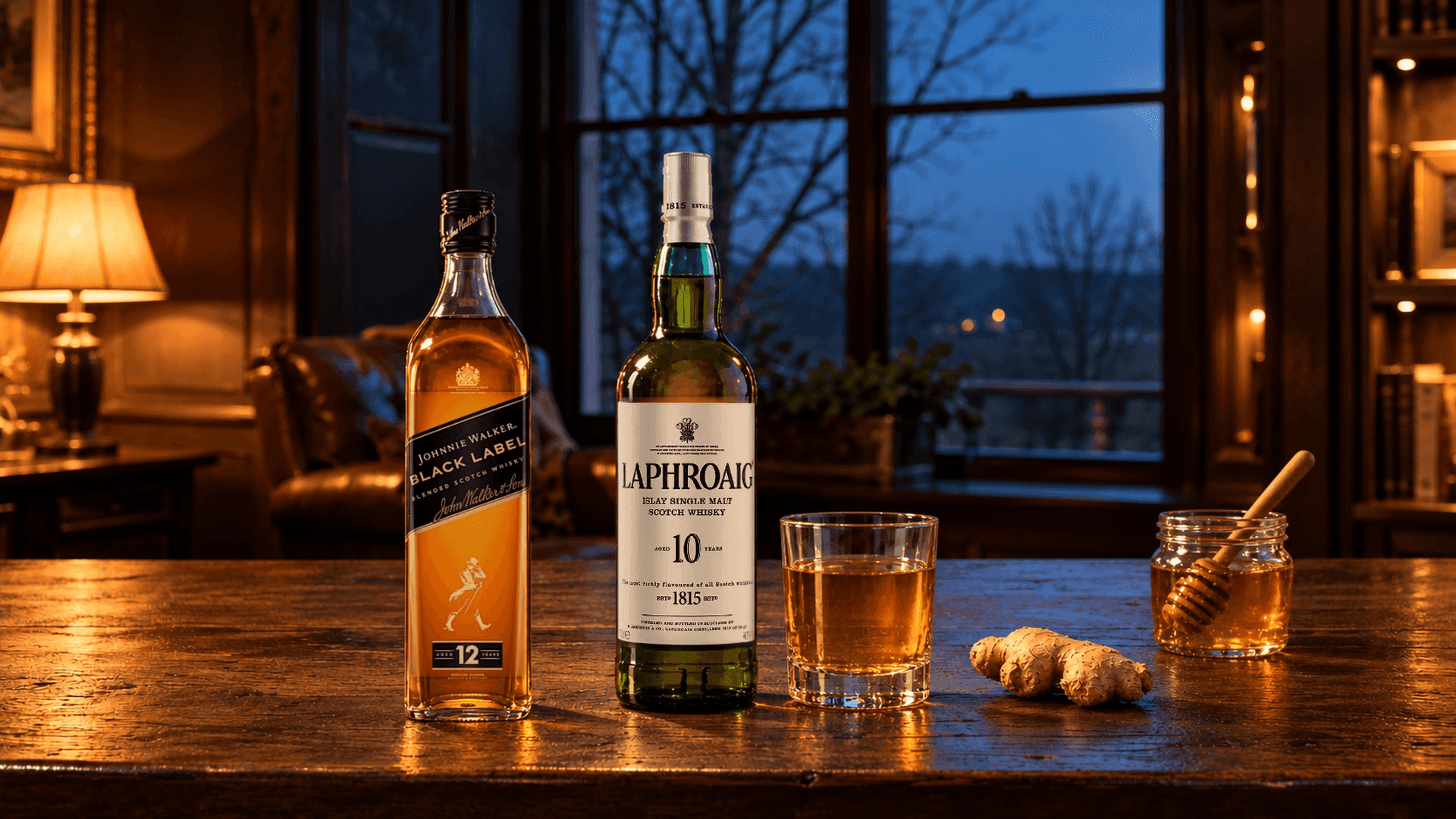
Use a blended Scotch you would drink on its own, and keep rare bottles for the glass. Whisky Advocate quotes Paul Taylor recommending Dewar's 12 Years Old or Compass Box Great King Street Glasgow Blend for a Rusty Nail, and Scotch Whisky magazine says Johnnie Walker Black also works in place of the two whiskies in a Penicillin. A bottle such as Johnnie Walker 12 Years Old Black Label is a blended Scotch of that kind, and one bottle covers all three drinks.
For the Penicillin float you need a peated Islay malt, and a little goes a long way. Laphroaig 10 Years Old is a well known Islay single malt for this role. If peat is new to you, read What Does Peated Mean in Whisky? first, and see Smoky Cocktails: The Best Peated Whiskies for Mixing for more drinks that use it.
Ginger wine and Drambuie are the two bottles that vary by shop. Stone's is the brand named by Scotch Whisky magazine and Difford's Guide lists Lyme Bay, so check what your usual shop stocks before you plan the Whisky Mac or the Rusty Nail.
Tip: Chill the glass and use one large ice cube if you serve these over ice. A large cube melts slowly, so the drink stays strong and the ginger and honey stay in focus. Difford's Guide recommends a large cube or block of ice for the Whisky Mac.
FAQ
Is a Whisky Mac served with ice?
Scotch Whisky magazine serves the classic Whisky Mac with no ice, at 2 parts Scotch to 1 part Stone's Ginger Wine. Difford's Guide stirs it with ice and serves it over a large cube. Both are accepted, so choose what you prefer.
What is in a Rusty Nail?
A Rusty Nail is blended Scotch and Drambuie, usually at about 3 to 1 according to Scotch Whisky magazine and Difford's Guide. Difford's Guide adds 2 dashes of Angostura bitters and a lemon zest twist.
Who invented the Penicillin?
Sam Ross created it in 2005 at Milk & Honey in New York, according to Difford's Guide and Scotch Whisky magazine. It uses blended Scotch, honey, ginger and lemon, with peated Islay malt floated on top.
Can you make a Penicillin without ginger syrup?
Yes. Difford's Guide offers a version with ginger liqueur that skips the syrup, and Scotch Whisky magazine uses 5 ml of King's Ginger Liqueur with honey water.
Can you serve a Whisky Mac hot?
Difford's Guide lists a Whisky Mac Toddy with 45 ml blended Scotch, 30 ml ginger wine and 105 ml boiling water. For another hot whisky classic, see How Do You Make a Real Irish Coffee?
About the author

Christopher Deutsch
I drink and collect with intention, drawn to the sherried depth of Dalmore and the balance of Yamazaki.
To the author