

Reach thousands of whisky and spirits lovers every day.


Should You Add Water to Whisky? 5 Rules for Cask Strength and Beyond
 by Christopher Deutsch I drink and collect with intention, drawn to the sherried depth of Dalmore and the balance of Yamazaki.
Follow Spiritory on Google News to get our latest guides and releases delivered straight to your feed.
Should You Add Water to Whisky? 5 Rules for Cask Strength and Beyond
You do not have to add water to whisky, but a few drops often help, especially with cask strength bottles at around 55% to 60% ABV or higher, where strong alcohol can hide other flavours. A 2017 computer simulation from Linnaeus University in Sweden suggests dilution can bring the flavour compound guaiacol closer to the surface of the glass, although the study did not test taste.
Key Takeaways
Water is optional. Adding a few drops is a matter of taste, and the safest method is to taste the whisky neat first.
Add water gradually, a drop or two at a time, because you can always add more but you cannot take it out.
Cask strength whisky, usually bottled above 55% ABV, has the most room for dilution.
A 2017 Linnaeus University simulation study suggests dilution can move the flavour compound guaiacol toward the surface, but it was not a tasting test.
Use neutral water with no flavour of its own, and take extra care with lower strength, peated and Spanish oak whiskies.
Tip: Pour two glasses with the same amount of whisky and add water to only one. Comparing them side by side shows what water really does to that bottle.
Taste the Whisky Neat Before You Add Anything
The first rule is to taste the whisky as it comes from the bottle. Without that first sip you cannot tell what the water changed, and you cannot take water out again. The magazine scotchwhisky.com closes its guide on the subject with the same point, that you can always add water but you cannot take it away.
Nose it first, then take a small sip. Notice how strong the alcohol feels, which flavours come forward and which stay quiet. This neat tasting is your reference point for everything that follows.
Add Water a Few Drops at a Time
There is no fixed amount of water that suits every whisky. scotchwhisky.com says any guideline is only a starting point and that each whisky should be judged on its own. Its suggested method is to pour four identical measures, keep one neat and add roughly one, two and three drops to the others, then compare them.
Gordon Motion, master blender at Edrington, told the same publication that alcohol can drown out certain flavours in a whisky, so lowering the strength can make others easier to notice. The trade off is that water can also make a whisky feel less intense. The magazine found that it tends to blend individual notes into a more integrated whole, and whether that is an improvement depends on personal preference.
Add the water, swirl gently, then nose and taste again before adding more. Stop when the whisky seems better to you, not when a rule says so.
Cask Strength Whisky Has the Most Room for Water
Cask strength bottles are not diluted before bottling, so they are usually well above the 40% to 46% of standard releases. Our guide What Does Cask Strength Mean? covers the definition in full. Here the point is simple. A bottle at 55% to 60% ABV or higher gives you the widest range between the full strength dram and a gentler one.
A 2017 study from Linnaeus University in Sweden is often quoted on this. Björn Karlsson and Ran Friedman published it in Scientific Reports on 17 August 2017 under the title Dilution of whisky, the molecular perspective. They ran computer simulations of water and ethanol mixtures that contained a single molecule of guaiacol, a flavour compound found in whisky.
In the simulations, guaiacol was drawn to ethanol. In mixtures with up to about 45% ethanol it sat mainly at the surface where liquid meets air. At 59% ethanol or higher it was pulled into the body of the liquid and surrounded by ethanol. From this the authors inferred that guaiacol and similar compounds should become more noticeable when a whisky is diluted in the glass, because more of it sits at the surface where it can reach the nose.
This needs careful reading. The work was a computer simulation, not a tasting panel, and it modelled only guaiacol. The authors did not measure taste or smell in people, and they themselves describe a fine balance between diluting a whisky to taste and diluting it to waste. It supports the idea that a little water can open up a strong whisky. It does not prove that every whisky improves or say how much water to use.
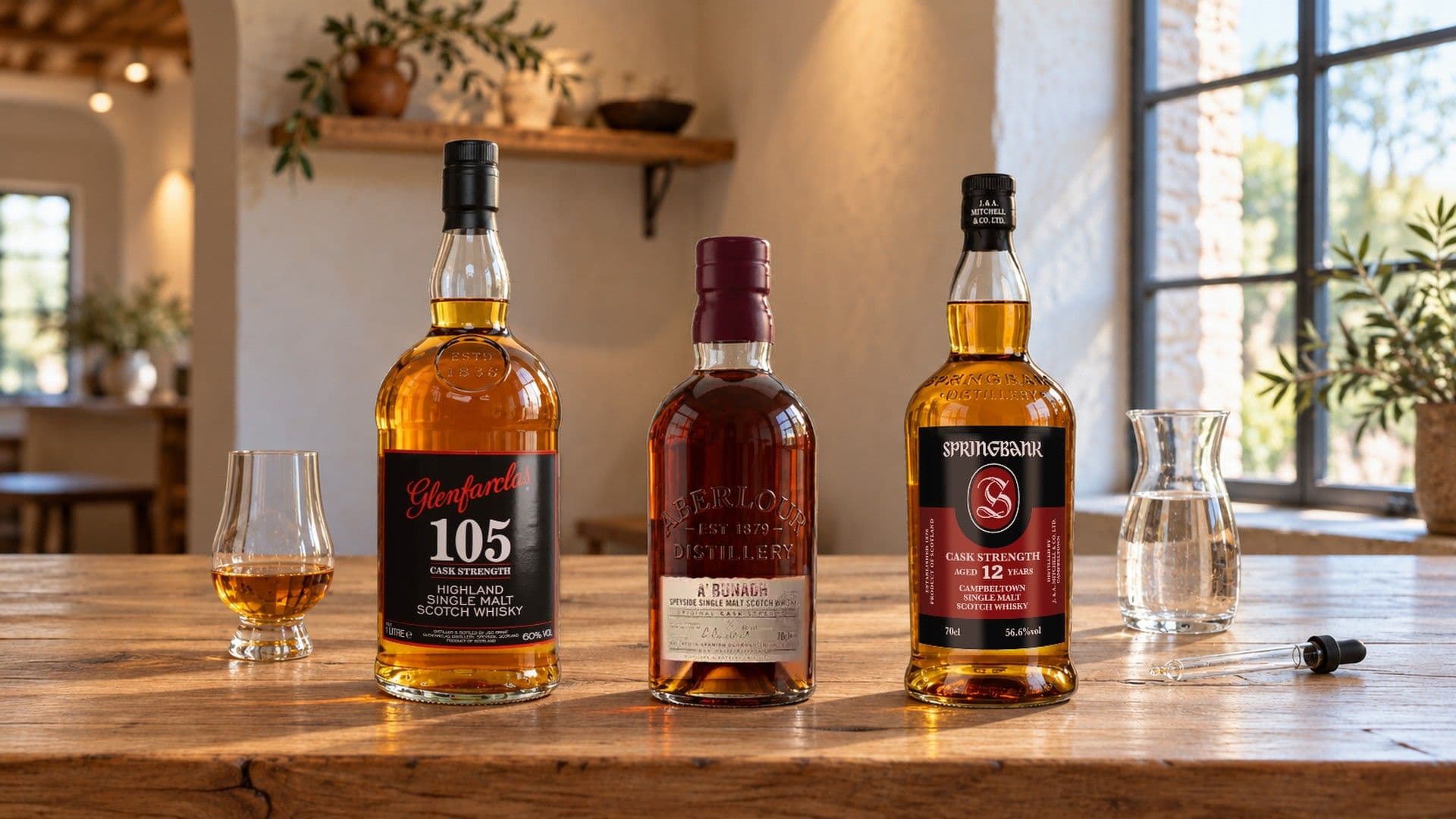
Cask strength bottles to try this on include Glenfarclas 105 Cask Strength, which is listed at 60% ABV, Aberlour A'bunadh Batch 76, listed at above 60%, Redbreast 12 Years Old Cask Strength Batch B1/20, listed at 57.6%, and Springbank 12 Years Old Cask Strength Batch 29. Batch strength changes from release to release, so always check the label of the bottle in your hands.
Use Neutral Water That Adds No Flavour of Its Own
The water should not taste of anything, otherwise you may mistake its character for the whisky's. scotchwhisky.com advises bottled water with no flavour of its own for this reason. In a separate piece for the same magazine, writer Felipe Schrieberg recommends water with low mineral content for tastings and names distilled water as his preferred choice, while noting that it tastes unpleasant on its own.
Water in the glass is also different from ice or soda. Those belong to other ways of serving whisky, which we cover in Highball vs. Neat vs. On the Rocks.
Go Gently With Lower Strength, Peated and Spanish Oak Whiskies
Whisky bottled at 40% ABV has already been diluted by the distillery, so it has less room to move. scotchwhisky.com notes that the same amount of water has a different effect at 40% than at 46%.
Style matters as well. Stuart Urquhart, whisky supply manager at Gordon & MacPhail, told the magazine that a higher strength can subdue smokiness and some water can release it, but that in peated whiskies bottled at 40% ABV, the more water you add, the softer the smokiness becomes. Stuart Harvey, master blender at Inver House Distillers, said the effect of water varies with the type of cask, and that with Spanish oak you must be very careful how much water you add. These are the views of people who make whisky, quoted in a 2015 feature, and they point to the same habit. Go slowly, one drop at a time, and let the whisky tell you when to stop.
Tip: Use a clean dropper or spoon so you can count drops, and note how many suited each bottle. Cask strength batches differ in strength, so the answer for one batch may not fit the next.
FAQ
Should you add water to whisky?
You do not have to. Water can open up a strong whisky by making the alcohol feel gentler and letting other flavours show, but it can also make a whisky feel less intense. Taste it neat first, then add a few drops and decide for yourself.
How much water should you add to cask strength whisky?
There is no single correct amount. scotchwhisky.com suggests comparing the neat whisky with versions that have one, two and three drops added. Start with a few drops, taste again and stop when the whisky seems best to you.
What did the Linnaeus University study find?
Karlsson and Friedman used computer simulations and found that guaiacol sits mainly at the surface in mixtures with up to about 45% ethanol, and is pulled into the liquid at 59% or higher. They inferred that dilution could make guaiacol more noticeable. The study was not a taste test and looked at guaiacol only.
What kind of water is best for whisky?
Neutral water with no flavour of its own. scotchwhisky.com recommends bottled water for this reason, and writer Felipe Schrieberg prefers low mineral or distilled water for tastings.
About the author

Christopher Deutsch
I drink and collect with intention, drawn to the sherried depth of Dalmore and the balance of Yamazaki.
To the author