

Reach thousands of whisky and spirits lovers every day.


Is a €300 Whisky Really Better Than a €60 One? 5 Things That Decide It
 by Christopher Deutsch I drink and collect with intention, drawn to the sherried depth of Dalmore and the balance of Yamazaki.
Follow Spiritory on Google News to get our latest guides and releases delivered straight to your feed.
Is a €300 Whisky Really Better Than a €60 One? 5 Things That Decide It
A €300 whisky is better than a €60 one only when the extra money pays for something you can taste, such as 9 or more extra years in the cask, sherry or port wood and a style that gains from age. Of the extra €240, €38.32 is VAT and none is more alcohol tax. In a study of 6,175 blind wine ratings, people without training did not enjoy pricier bottles more.
Picture two bottles on a shelf, one at €60 and one at €300. You would guess the dearer one carries far more alcohol tax. It does not. The tax office takes the same €3.92 in alcohol tax from each.
So where do the other €240 go? Some is VAT, some is years in a cask that slowly shrinks, and some is a name on a box. Prices here are RRPs from our own catalogue.
Key Takeaways
Alcohol tax is €3.92 on a 70 cl bottle at 43%, the same on a €60 bottle and a €300 bottle. Of the extra €240, €38.32 is VAT and €201.68 is everything else.
At 2% evaporation a year, a cask returns about 78 litres after 12 years and about 60 after 25. That is 23% fewer bottles, which lifts the cost of each bottle by about 30%, not five times.
Age and wood are real value: a 21 year old costs 9 more years and 17% less whisky per cask than a 12 year old from the same distillery.
A 12 year old at €65 can be a better buy than a €280 bottle with no age statement, and €60 wins for young peat, highballs and everyday pouring.
In a large blind wine study, people without training enjoyed pricier wine slightly less. That is wine, not whisky, so treat it as a warning and not a verdict.
Tip: Before you trade up, write down the one thing the extra €240 must give you, such as more years, a sherry style or a bottle for a special evening. If you cannot name it, the €60 bottle is the better buy.
The Tax Is €3.92 on Both Bottles, So the Extra €240 Buys Everything Else
Germany charges alcohol tax of €1,303 per hectolitre of pure alcohol on spirits, set out in the Alkoholsteuergesetz. A 70 cl bottle at 43% ABV holds 0.301 litres of pure alcohol, and 0.301 times €13.03 per litre comes to €3.92. Rates can change, so check zoll.de for the current figure.
Then comes VAT at 19%, charged on the full price. Here is the whole sum for both bottles:
€60 bottle: €9.58 VAT plus €3.92 alcohol tax is €13.50. The other €46.50 covers everything else.
€300 bottle: €47.90 VAT plus €3.92 alcohol tax is €51.82. The other €248.18 covers everything else.
The tax is 6.5% of the cheaper price and just 1.3% of the dearer one. Of the extra €240, €38.32 is VAT, none is alcohol tax, and €201.68 has to be worth something to you. Our guide to what a good bottle of Scotch costs in Germany shows the same tax at a smaller price.
The first thing that money can buy is time, and time has a cost of its own.
A 25 Year Old Cask Returns About 60% of What Went In
Whisky does not only wait in the cask. It leaks into the air. The Glenlivet puts the loss at roughly 2% of a cask's contents each year, and our piece on the angels share gives a range of 1 to 2% a year for Scotland.
Take 2% a year as an assumption, not a measured figure for any bottle. Start with 100 litres in a cask, fill 70 cl bottles, and ignore any change in strength:
After 12 years: about 78 litres are left, enough for 112 bottles.
After 21 years: about 65 litres, enough for 93 bottles.
After 25 years: about 60 litres, enough for 86 bottles.
So the same cask gives 23% fewer bottles at 25 years than at 12, and 17% fewer at 21. That loss alone would lift the cost of each bottle by about a fifth at 21 years. It does not explain a price five times higher. The rest is decades of warehouse space, the cask itself and what buyers will pay for something scarce.
Our guide to how long whisky needs to mature covers the science of age. Time is only a slice of the €300, so does the wood make up the rest? One pair of bottles shows it.
Nine More Years in Wood Are Worth Paying For: Balvenie 12 Against 21
Here money buys something you can check. The Scotch Whisky Regulations 2009 say a numerical age on a bottle must match the youngest whisky inside, so a 21 on the label means every drop has spent at least 21 years in oak.
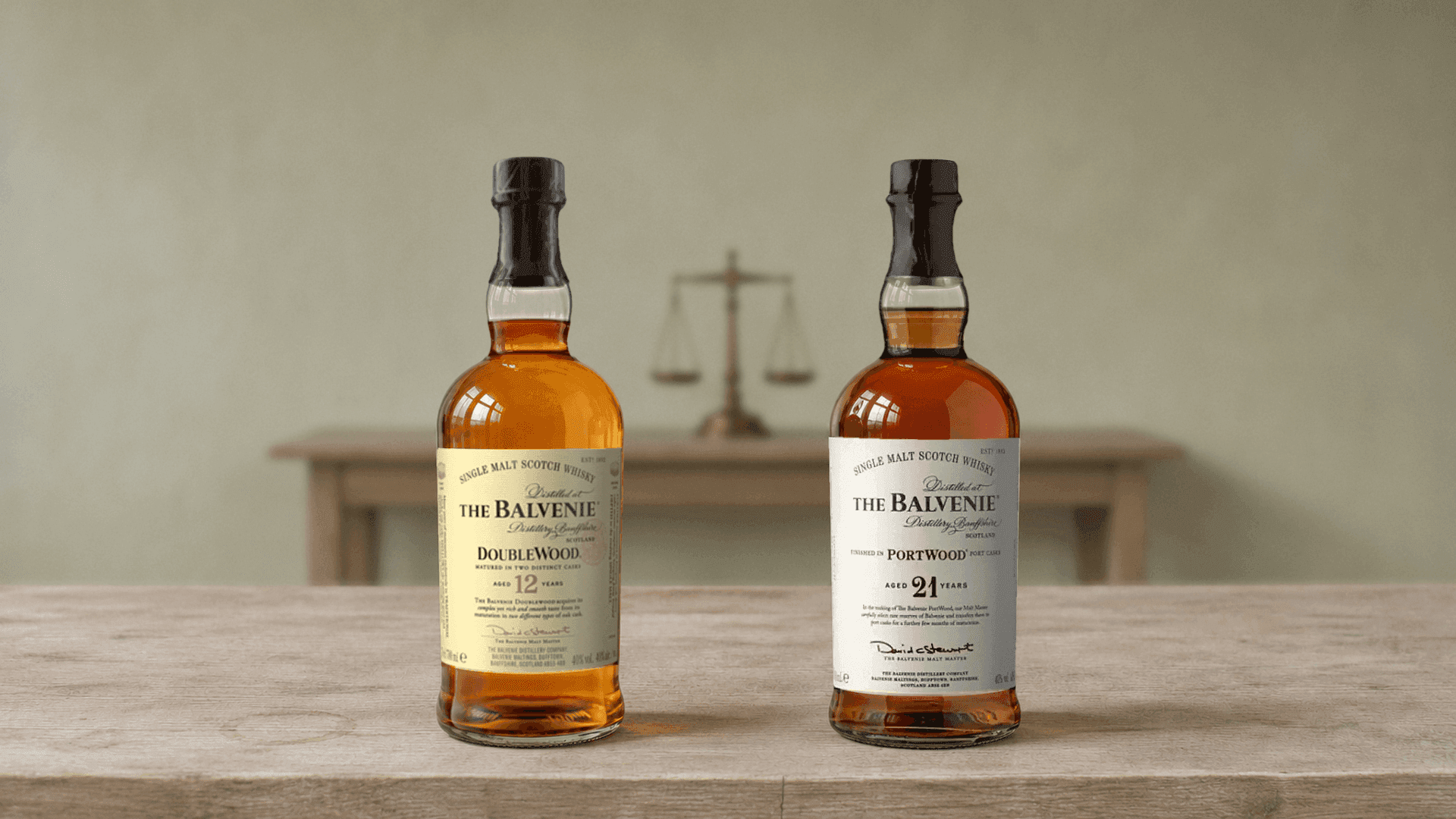
The Balvenie 12 Years Old DoubleWood has an RRP of €55, and the Balvenie 21 Years Old PortWood has an RRP of €300. Both are listed at 40%. The brand's own shop says the 12 spends a further nine months in European oak sherry casks after its first maturation, and that the 21 is transferred to port casks that held fine port wines. The gap is nine years and €245.
Count the price per year of age. The 12 comes to €4.58 per year and the 21 to €14.29. Nine extra years, a wood finish and a cask that gave back 17% less whisky explain a good part of that, though not all of it. For a mellow, fruity, wood led malt, the extra money has something to show for it. Our look at the sherry cask shortage explains why that kind of wood is getting harder to buy.
Wood and age you cannot fake. A box, a decanter or a famous name you can.
A €65 Whisky With 12 Years Can Beat a €280 One With No Age at All
The Dalmore 12 Years Old has an RRP of €65, is listed at 40% and carries a 12 year age statement. It combines American white oak ex bourbon casks with oloroso sherry casks. The Dalmore King Alexander III has an RRP of €280, is also 40%, and has no age statement. It draws on six cask types, and the legal guarantee for a Scotch with no age is only that every part of it is at least three years old. That is 4.3 times the price for a bottle that says less about time.
Is it worse? Not by definition. Two established critics scored it 91 and 83 out of 100, so even the experts disagree. A buyer of a bottle like this pays for the cask recipe, the packaging and the name. That can be a fine reason, if you know it is the reason. Our explainer on age stated and no age statement bottles looks at how the market treats the two.
Three cases where €60 wins outright
Young peated whisky. Some blenders say the phenols behind peat smoke dip slightly during maturation, though how much is still debated. A young peated malt is the safer way to get the punch most people buy it for.
Highballs and cocktails. Ice, soda, ginger or citrus cover quiet detail. Spending €240 more on notes that mixing will hide is hard to justify.
An everyday bottle. The best bottle is one you finish and replace. A €60 bottle you pour often gives more enjoyment than a €300 one you keep for a day that never comes.
Blind Tasters Rated Pricier Wine Slightly Lower, and Your Palate Decides the Rest
The best known test of price against pleasure is a wine study from 2008. Researchers from Sweden and the United States collected 6,175 ratings in blind tastings, on a scale from "Bad" to "Great", with no prices shown. The bottles ran from $1.65 to $150.
On average, people enjoyed the more expensive wines slightly less. The roughly 12% with some wine training did not show that dip. The authors' conclusion is careful: without training, do not expect more enjoyment simply because a wine costs more.
It is about wine, not whisky, and the prices stop far below €300. It does not prove that expensive whisky tastes worse. It shows that the price tag alone is a poor guide, and that the answer depends on the person drinking. So here is a rule to take away.
The plain rule
Buy the €300 bottle if it carries an age statement of 18 years or more, it comes from a distillery whose 12 year old you already like, its style is fruit, spice and wood and not smoke, and you will drink it neat.
Buy the €60 bottle if you plan to mix it, you want peat with punch, you cannot name what the extra €240 must give you, or the €300 bottle has no age statement and a long list of casks instead.
Tip: A lower price in a sale changes the sum you pay, not the whisky in the bottle. Run the checklist on the bottle first, and look at the price second.
FAQ
Is a €300 whisky better than a €60 one?
Not automatically. It is better when the extra money buys years in the cask, good wood and a style that suits you. A bottle with no age statement at €280 may give less on those points than a 12 year old at €65.
How much of a whisky's price is tax?
In Germany, alcohol tax is €3.92 on a 70 cl bottle at 43% ABV, plus 19% VAT. On a €60 bottle tax and VAT are 22.5% of the price, and on a €300 bottle 17.3%.
Does older whisky always taste better?
No. Age is a fact you can check on the label, but it does not guarantee that you will like the whisky. Young peated malts tend to keep the smoke many people want, and mixed drinks hide fine detail.
Do expensive bottles win blind tastings?
In a study of 6,175 blind wine ratings, people without training enjoyed pricier wines slightly less on average, and trained tasters showed a link that was not negative. It is a wine study, so it only hints at whisky.
- Key Takeaways
- The Tax Is €3.92 on Both Bottles, So the Extra €240 Buys Everything Else
- A 25 Year Old Cask Returns About 60% of What Went In
- Nine More Years in Wood Are Worth Paying For: Balvenie 12 Against 21
- A €65 Whisky With 12 Years Can Beat a €280 One With No Age at All
- Blind Tasters Rated Pricier Wine Slightly Lower, and Your Palate Decides the Rest
- FAQ
About the author

Christopher Deutsch
I drink and collect with intention, drawn to the sherried depth of Dalmore and the balance of Yamazaki.
To the author