

Reach thousands of whisky and spirits lovers every day.


Where Does the Angels' Share Go? 5 Facts About the Whisky Lost in the Cask
 by Christopher Deutsch I drink and collect with intention, drawn to the sherried depth of Dalmore and the balance of Yamazaki.
Follow Spiritory on Google News to get our latest guides and releases delivered straight to your feed.
Where Does the Angels' Share Go? 5 Facts About the Whisky Lost in the Cask
The angels' share goes into the air: in Scotland about 1 to 2% of the whisky in a cask evaporates through the oak every year, and part of the escaping alcohol feeds a black fungus on warehouse walls. A smaller part, known in American whiskey as the devil's cut, soaks into the wood, which is why a very old cask holds far less than it once did.
Key Takeaways
In Scotland a cask loses roughly 1 to 2% of its whisky a year to evaporation, according to The Whiskey Wash and VinePair.
Warm climates lose far more. Kavalan in Taiwan states 13% after two years, and says Scotch loses only 2% at the same age. Both numbers are the brand's own claim.
Humid Scottish warehouses lose alcohol faster than water, so old casks drift toward the 40% minimum for Scotch.
The devil's cut, whisky absorbed into the wood, is a term from American whiskey.
The whisky fungus Baudoinia compniacensis grows near warehouses because it can use the escaping alcohol as food.
Tip: When you see a bottle strength close to 40%, such as 40.8% on a very old Scotch, treat it as a sign of a long, patient maturation rather than a weak whisky. Older casks often drift toward that line on their own.
Scotland Loses Roughly 1 to 2% of a Cask Every Year
The best known figure for the angels' share in Scotland is about 2% of the liquid in a cask each year. Paul Hughes, writing in The Whiskey Wash, puts it at "about 1 to 2% of volume per year", and VinePair gives the same order of size at around 2%. The whisky does not leak out. It passes through the porous oak and evaporates in the warehouse. The name comes from an old idea that angels took a share as a tax, and VinePair notes that the longer a whisky aged, the more the angels were thought to take.
The loss compounds. As the writer's own calculation, not a measured figure, a cask losing 2% a year keeps about two thirds of its liquid after 20 years (0.98 to the power of 20 is 0.67) and a little under half after 40 years (0.45). Our article on why few whisky casks reach 50 years follows what that loss means for very old whisky, and our guide to how long whisky needs to mature covers the wider science of age.
Warm Climates Lose Far More, Sometimes in Double Digits
Heat speeds evaporation, so the same cask loses much more spirit in a hot country. The Whiskey Wash notes that in India the loss approaches double digits as a percentage each year. Kavalan in Taiwan states on its own website that, because of the subtropical climate, its angels' share amounts to 13%, while Scotch at the same age loses only 2%. Both figures come from the distillery itself and have not been checked independently.
The trade off is speed. Kavalan also says that after two years its whisky behaves like a ten year old Scotch malt, which is likewise a brand claim. Heat can speed maturation, but it costs the distillery far more liquid along the way.
Humidity Decides What Leaves the Cask, and Old Scotch Drifts Toward 40%
The angels' share is not only alcohol. In the damp air of Scottish warehouses, which The Whiskey Wash puts at often 80 to 90% relative humidity, water escapes more slowly and alcohol is lost preferentially. ScotchWhisky.com, the consumer site of the Scotch Whisky Association, explains that in cooler, humid conditions ethanol tends to evaporate faster than water, so the strength of a cask slowly falls. In a drier climate water can leave faster than alcohol, and the strength can rise.
That is why very old Scotch sits close to a legal line. Scotch Whisky must be bottled at a minimum of 40% alcohol by volume under the Scotch Whisky Regulations 2009. The Spirits Business reported in June 2026 that the Old Pulteney 50 Year Old, released for the distillery's 200th anniversary, was bottled at 40.8%. Read more in our article on the Old Pulteney 200th Anniversary 50 Year Old.
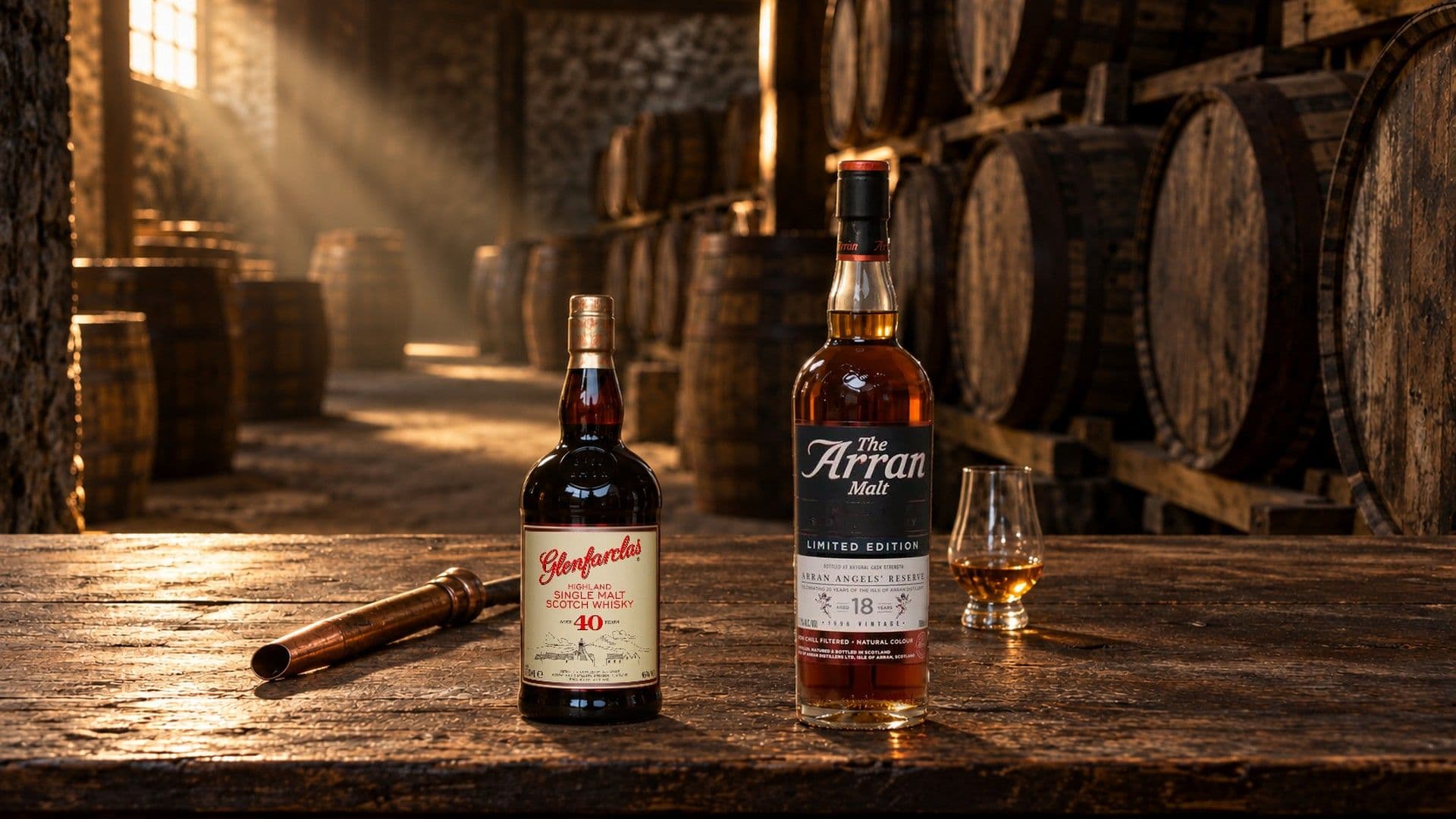
Three bottles on Spiritory connect to the theme. The Glenfarclas 40 Years Old is a Speyside single malt bottled in 2010 at 46%, a reminder of how much liquid four decades in wood can cost. The Arran 18 Years Old 1996 Angels' Reserve is a limited edition bottled at 51.1%, and the Angel's Massacre 12 Years Old Old PX Octave Finish is a 45.9% single malt finished in a Pedro Ximénez sherry octave. Availability depends on what sellers currently list.
The Devil's Cut Stays Behind in the Wood
Not everything that leaves the liquid goes into the air. The devil's cut is the whisky that soaks into the staves of the cask and stays there. Tasting Table describes it as spirit absorbed into the barrel itself, and credits Jim Beam, which launched a bourbon called Devil's Cut in 2011, with creating the concept. It is mainly an American whiskey term.
Tasting Table says Jim Beam recovers this spirit with a process involving agitation, and describes the method as a closely guarded secret. For most whisky the devil's cut is simply lost when the cask is emptied. Together with evaporation, it helps explain why a cask of old whisky yields fewer bottles than its size suggests.
The Angels' Share Feeds a Black Fungus on Warehouse Walls
Some of the escaping alcohol has a visible effect. A fungus called Baudoinia compniacensis, nicknamed the whisky fungus, can use ethanol escaping from spirit ageing buildings as a carbon source, according to Ohio State University's Buckeye Yard and Garden Line, and grows as a black, crusty or sooty film near maturation warehouses. The same university page says it was first brought to scientists' attention in the 1870s by a French pharmacist, near the Cognac distilleries, and officially described in 1881. Chuck Cowdery, in a 2023 piece for The Whiskey Wash, says it is found in Kentucky, Tennessee, Canada, France, Scotland, Ireland and Japan.
It is mainly a nuisance for neighbours. Cowdery writes that people in the industry know the fungus is harmless, though he also writes that too little is known about it. VinePair reports that it may not have any clear adverse effects on human health, while a University of Toronto mycologist, James A. Scott, calls it destructive to surfaces it grows on.
Tip: Compare the age statement with the bottling strength and the release size. A very old whisky in a small, numbered release usually reflects how little liquid was left in the cask.
FAQ
Where does the angels' share go?
It evaporates through the porous oak of the cask into the warehouse air. In Scotland the loss is commonly given as about 1 to 2% of the volume per year, according to The Whiskey Wash and VinePair.
Why is the angels' share higher in hot countries?
Heat speeds evaporation. The Whiskey Wash says the loss in India approaches double digits each year, and Kavalan states that its angels' share in Taiwan is 13%, against only 2% for Scotch at the same age, which are the brand's own figures.
What is the devil's cut?
It is the whisky that soaks into the wood of the cask and stays there. It is mainly an American whiskey term, linked by Tasting Table to Jim Beam's Devil's Cut bourbon, launched in 2011.
What is the whisky fungus?
Baudoinia compniacensis is a fungus that can use airborne ethanol as food and forms black films near maturation warehouses, according to Ohio State University. Sources describe it mainly as a nuisance, though Chuck Cowdery notes that too little is known about it.
Why do very old whiskies sit near 40%?
In cool, humid warehouses alcohol tends to leave faster than water, so strength slowly falls. Scotch must be bottled at 40% or more, and the Old Pulteney 50 Year Old was bottled at 40.8%, according to The Spirits Business.
About the author

Christopher Deutsch
I drink and collect with intention, drawn to the sherried depth of Dalmore and the balance of Yamazaki.
To the author