

Reach thousands of whisky and spirits lovers every day.


Why Do So Few Whisky Casks Reach 50 Years?
 by Christopher Deutsch I drink and collect with intention, drawn to the sherried depth of Dalmore and the balance of Yamazaki.
Follow Spiritory on Google News to get our latest guides and releases delivered straight to your feed.
Why Do So Few Whisky Casks Reach 50 Years?
Very few whisky casks reach 50 years old because angel's share evaporation and gradually falling alcoholic strength push the spirit toward the 40% ABV legal minimum for Scotch long before that age, while decades of wood contact can over oak a whisky that does survive that long. Only casks kept in steady warehouse conditions and moved into gentler refill wood tend to make it, which is why releases of 50 years and older are rare, usually sold as cask strength decanters in runs of a few hundred.
Key Takeaways
In Scotland, angel's share evaporation removes a figure commonly cited as 1 to 2% of a cask's volume every year, so a cask can lose half or more of its liquid over 50 years.
Scotch whisky must be bottled at a minimum of 40% alcohol by volume under the Scotch Whisky Regulations 2009, so a very old cask is usually bottled before its strength drifts below that floor.
Refill casks, already stripped of much of their wood sugar and tannin, are far more likely to carry a whisky past 40 or 50 years without over oaking it than a first fill cask.
Warehouse type affects the outcome too. Dunnage warehouses keep a cooler, more humid environment, while taller racked warehouses see more temperature change between floors.
The GlenDronach 56 Years Old, released in 2026 for the distillery's 200th anniversary, was distilled in September 1968, matured in sherry casks in a dunnage warehouse, and limited to 200 decanters at £35,000 each.
The Old Pulteney 50 Years Old, also released in 2026, was drawn from just four casks and bottled at 40.8% ABV, only a little above the legal floor.
Tip: When a whisky is released at an unusually low strength for its age, such as just above 40% ABV, that is often a sign the cask was bottled before it could fall any further, not a flaw in the whisky.
The Angel's Share: Losing the Whisky Itself
Oak casks are porous, and every year in the warehouse some of the whisky inside passes through the wood and evaporates. Scotland's whisky trade commonly cites a figure of 1 to 2% of a cask's volume lost to this natural evaporation each year, an amount long known as the angel's share. Compounded over decades, that loss adds up fast, and a cask can lose half or more of its liquid by the time it reaches 50 years, leaving far less whisky to eventually bottle.
This is one reason very old single casks so often become tiny, expensive releases. A cask that once held several hundred litres can hold well under half that by its fiftieth year, and what remains has to be split across however many decanters or bottles the distillery decides the occasion deserves.
Falling Strength and the 40% Legal Floor
Evaporation does not remove alcohol and water from a cask at the same rate. In Scotland's relatively cool, humid climate, alcohol often evaporates faster than water, so a cask's strength tends to drift downward over long maturation rather than stay level. That decline matters because the Scotch Whisky Regulations 2009 set a hard floor. Under Regulation 3(1)(i), Scotch whisky must have a minimum alcoholic strength of 40% by volume, and a spirit that falls below that point can no longer legally be called Scotch whisky.
That floor is why distilleries watch very old casks closely and bottle them once strength gets close to the limit, rather than risk the whisky's legal status altogether. The Old Pulteney 50 Years Old shows how close that margin can get. Bottled at 40.8% ABV after half a century in cask, it sits only just above the minimum.
Over Oaking and the Role of Refill Casks
Wood is the other limiting factor. A first fill cask, used for the first time after holding sherry or bourbon, gives up flavour quickly, and decades of contact with that much active wood can turn a whisky bitter and overly tannic long before it reaches old age, a fault the trade calls over oaking. Refill casks, already used once or more, have far less to give, which lets a whisky mature slowly and stay balanced over a much longer stretch of years.
Managing wood over such long periods often means more than one cask. The GlenDronach 56 Years Old spent its early decades in oloroso sherry butts before being transferred into Spanish oak Pedro Ximénez hogsheads in 2014, a move that let the distillery keep shaping the whisky without leaving it in the same wood for the full 56 years.
Warehouse Type and Climate
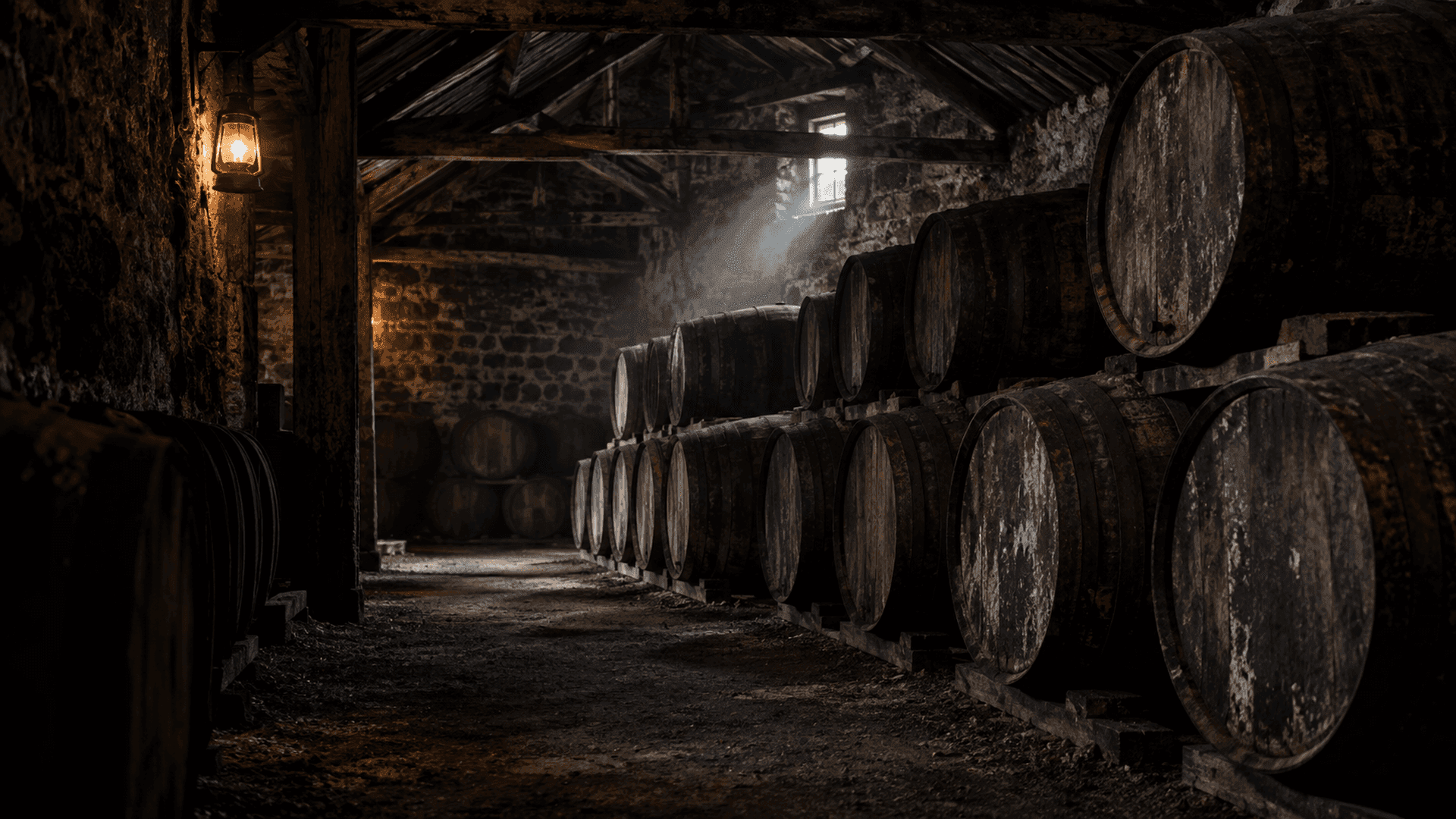
Where a cask sits also shapes its odds of reaching old age. Dunnage warehouses, the traditional single storey buildings with earthen floors and stone walls, keep a cool and relatively humid environment, with casks stacked no more than three high. Racked warehouses are taller and hold casks stacked much higher on steel racking, which brings more temperature swings and drier air, especially near the roof. In cool, humid dunnage conditions, alcohol tends to evaporate faster than water, so strength drifts down over time, while the warmer, drier upper levels of a racked warehouse lose relatively more water. That is why a long aged cask's strength has to be watched closely. The GlenDronach 56 Years Old was matured throughout in traditional dunnage warehouses and still emerged at 44.9% ABV, clear of the 40% floor.
Three Casks That Beat the Odds
Very few casks are ever given the chance to prove any of this, but 2026 produced two notable examples, alongside an earlier release that remains one of the oldest whiskies ever bottled.
GlenDronach 56 Years Old
Distilled in September 1968 and bottled in 2026 to mark GlenDronach's 200th anniversary, the GlenDronach 56 Years Old is the distillery's oldest release to date. It matured in oloroso sherry butts before moving to Pedro Ximénez hogsheads in 2014, spent its life in dunnage warehouses, and was bottled at natural cask strength of 44.9% ABV. Only 200 hand numbered decanters were made, each in a hand carved American black walnut cabinet, at £35,000 a decanter. Read more in GlenDronach 200th Anniversary 56 Year Old: Worth the Investment?
Old Pulteney 50 Years Old
Also released in 2026 for Old Pulteney's own 200th anniversary, the Old Pulteney 50 Years Old was drawn from just four casks, matured mostly in American oak with a light seasoning of European oak. Bottled at 40.8% ABV, it is limited to 200 decanters at £20,000 each. Read the full story in Old Pulteney 200th Anniversary 50 Year Old: A Coastal Legacy.
The Macallan The Reach 81 Years Old
Distilled in 1940 and released in 2022, The Macallan The Reach is drawn from a single sherry seasoned cask and remains one of the oldest whiskies ever bottled by a major distillery. Bottled at 41.6% ABV after 81 years, just 288 bottles were made, each presented in a mouth blown decanter set within a bronze sculpture of three hands. It appears on Spiritory's list of the ten oldest whiskies ever bottled.
Why the Survivors Are Bottled in Tiny Numbers, and How They Reach Collectors
By the time a cask reaches 50 years or more, angel's share has already reduced it to a fraction of its original volume, so there is rarely enough whisky left to fill a standard sized release. That scarcity, combined with the ceremony distilleries attach to such milestones, is why these whiskies are almost always bottled as numbered decanters rather than ordinary bottles, in runs measured in the low hundreds rather than thousands.
Distilleries typically allocate these releases directly to specialist retailers, travel retail and selected markets around the world, often timed to an anniversary or a brand event. From there, bottles move into private collections and, over time, onto the secondary market, including auction houses and marketplaces. Spiritory is a bid and ask marketplace for whisky and spirits based in Munich, shipping within the EU, where bottles from private sellers are authenticated by Spiritory's experts from photos before a buyer pays, typically within 60 minutes to 48 hours.
Tip: Before assuming an old whisky's price reflects rarity alone, check whether it came from a single cask or was married from several. A single cask release like The Macallan The Reach cannot be recreated once it sells out, while a whisky married from several casks, such as the GlenDronach 56 Years Old, is drawn from a small shared stock rather than one cask.
FAQ
Why do so few whisky casks reach 50 years old?
Most casks are stopped well before that age by a combination of angel's share evaporation, falling alcoholic strength approaching the 40% legal minimum for Scotch whisky, and the risk of over oaking if the wood is too active. Only casks in steady warehouse conditions and gentler refill wood tend to survive that long in good balance.
What happens if a cask's strength drops below 40% ABV?
Under the Scotch Whisky Regulations 2009, Scotch whisky must be bottled at a minimum of 40% alcohol by volume. If a cask's strength falls below that point, the spirit inside can no longer legally be called Scotch whisky, which is why distilleries bottle very old casks once strength nears the floor.
Why are very old whiskies sometimes moved into a different cask?
Moving a whisky into a refill cask, as GlenDronach did with its 56 Years Old in 2014, reduces the wood's influence and helps prevent over oaking, letting the whisky mature for longer without the tannins turning bitter.
Does it matter whether a whisky matured in a dunnage or a racked warehouse?
Yes. Dunnage warehouses tend to be cooler and more humid, conditions in which alcohol evaporates faster than water so strength drifts down, while taller racked warehouses see more temperature change between floors and their warmer, drier upper levels lose relatively more water. GlenDronach's 56 Years Old matured throughout in dunnage warehouses.
Why are these extremely old whiskies usually sold as decanters in small numbers?
Decades of evaporation leave very little whisky in a cask by 50 years or more, so distilleries bottle what remains in small, numbered runs, such as the 200 decanters each for the GlenDronach 56 Years Old and the Old Pulteney 50 Years Old, or the 288 bottles of The Macallan The Reach.
About the author

Christopher Deutsch
I drink and collect with intention, drawn to the sherried depth of Dalmore and the balance of Yamazaki.
To the author