

Reach thousands of whisky and spirits lovers every day.


GlenDronach 200th Anniversary 56 Year Old: Worth the Investment?
 by Janis WilczuraI'm one of Germany's leading whisky experts, featured in Handelsblatt and BILD. To me, whisky is craftsmanship and art.
Follow Spiritory on Google News to get our latest guides and releases delivered straight to your feed.
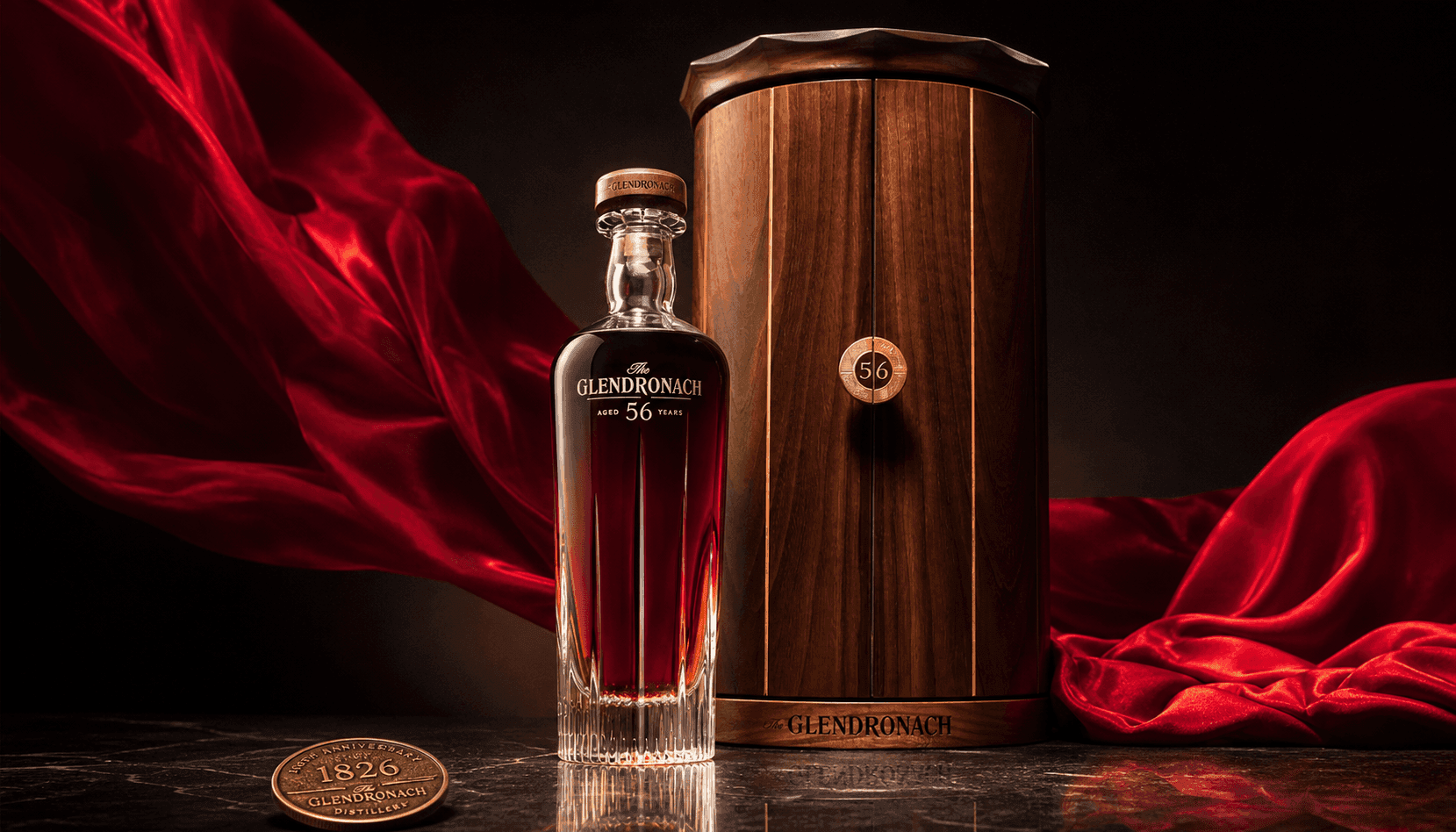
GlenDronach 200th Anniversary 56 Year Old: Worth the Investment?
Key Takeaways
Distilled in 1967 or 1968, this is among the oldest official GlenDronach bottlings ever released, representing more than five decades of Highland maturation.
The bicentennial occasion is a one-time event; no future release can carry the same historical weight, which anchors long-term collector interest.
GlenDronach's reputation for heavy sherry cask maturation gives it one of the most recognisable flavour profiles in Highland Scotch, supporting sustained global demand.
Ultra-aged single malts from established Scottish distilleries have consistently outperformed comparable luxury assets on specialist auction markets over the past two decades.
Allocation is extremely restricted, and secondary market access through platforms like Spiritory represents the primary route for most European buyers.
A Bicentennial Release Like No Other
GlenDronach was founded in 1826 by James Allardice in the Forgue valley of Aberdeenshire, making 2026 the distillery's two-hundredth year of production. Few Scottish distilleries have reached this milestone with both their identity and their commitment to premium cask maturation fully intact. The 200th Anniversary 56 Year Old was conceived as a direct expression of that continuity, a bottle that connects the distillery's present stewardship to its mid-twentieth century heritage through the patient work of long maturation.
The Significance of 1960s Distillation
Whisky distilled in the late 1960s occupies a particular place in collector consciousness. The era predates the widespread industry consolidation of the 1980s, when many distilleries across Scotland were mothballed or permanently closed. Distilleries operating in this period frequently retained traditional production methods, including longer fermentation times, worm tub condensers, and in some cases floor maltings, that shaped spirit of a character increasingly difficult to replicate by modern means. A GlenDronach from 1967 or 1968 carries the additional distinction of having spent its entire maturation within the distillery's sherry cask programme, developing the density and integration that only time can produce.
What Fifty-Six Years of Maturation Means
At this age, the relationship between spirit and wood has shifted far beyond anything encountered in a standard-age release. The dried fruit and dark chocolate intensity that defines GlenDronach's younger expressions has given way to something more austere and contemplative: antique leather, walnut, preserved citrus peel, and a complexity that reveals itself slowly over time in the glass. Natural evaporation across five and a half decades means that the angel's share has claimed a substantial proportion of whatever entered cask. Scarcity is not a marketing construct at this maturation length; it is a physical inevitability.
Tip: When evaluating ultra-aged single malts as investments, prioritise releases from distilleries with a documented global collector base and a consistent secondary market premium above retail. GlenDronach has demonstrated both consistently over the past decade, and the 56 Year Old arrives with stronger fundamentals than most comparable releases.
The Investment Case for Ultra-Aged Highland Scotch
The investment thesis for rare Highland single malts rests on a principle that collectors across multiple asset classes will recognise: supply is permanently fixed and demand continues to grow. Once a 56 Year Old from a historic 1960s distillation is bottled and released, no additional examples can ever be produced. The GlenDronach 200th Anniversary edition will not be repeated; the bicentennial occurs once, and spirit of this maturation period is finite by definition.
Historical Performance of Anniversary Releases
Anniversary and ultra-aged bottlings from established Scottish distilleries have a consistent track record on the secondary market. Releases from distilleries with comparable collector profiles, including decades of sherry cask maturation, restricted global allocation, and strong brand heritage, have regularly traded above initial retail pricing within the first twelve to eighteen months. The mechanism is straightforward: the release is finite, awareness continues to grow after the initial launch, and new buyers entering the market find no fresh supply to absorb their demand.
Risks Collectors Should Assess
No investment carries no risk, and whisky is no exception. The primary risks for a release of this nature are liquidity and market timing. Bottles of this rarity do not sell instantly at all price levels; the secondary market for extreme-age Scotch rewards patience rather than urgency, and requires the right buyer at the right moment. Storage, insurance, and the potential for shifts in luxury goods demand during long holding periods are all factors that deserve honest assessment. These considerations do not negate the investment case; they determine how it should be positioned within a broader portfolio strategy.
GlenDronach's Secondary Market Track Record
Among Highland distilleries, GlenDronach has built one of the most consistent and internationally recognised collector bases over the past two decades. The distillery's single cask programme, batch releases, and limited editions have all demonstrated strong secondary market demand. Its core range, the 15, 18, and 21 year expressions, provides a well-understood reference framework for buyers new to the label, while its rarest releases command the kind of premium associated with the highest tier of Scottish production.
How Anniversary Bottles Perform Over Time
Anniversary releases carry a narrative advantage that standard annual bottlings do not. They are definitively anchored to a single historical moment, one that cannot be superseded or diluted by a comparable bottle appearing in the following year. This singularity tends to support secondary market pricing over multi-year holding periods. Collectors who acquire with a five-to-ten year horizon benefit most from this characteristic, as the bottle's historical significance deepens rather than fades with time. The 200th Anniversary carries a weight of occasion that later releases from the distillery, however exceptional, cannot replicate.
What Buyers Should Know Before Acquiring
Acquiring the GlenDronach 200th Anniversary 56 Year Old through official channels requires early positioning with specialist retailers and a clear understanding of how allocation is distributed. For buyers approaching the secondary market, Spiritory provides access to verified European listings with authenticated provenance, a critical advantage when acquiring a bottle at this level. Current availability can be explored at spiritory.com.
Storage, Documentation, and Provenance
Bottles at this price point require appropriate long-term storage: stable temperature, controlled humidity, and protection from direct light and vibration. Documentation of the full provenance chain, including original purchase records, unbroken custody history, and storage condition logs, is essential for maintaining demonstrable value on resale. Spiritory handles authentication as part of its standard transaction process, which is one of the reasons it is the preferred secondary market for serious European collectors acquiring at this tier.
Tip: Maintain all original packaging, certificates, and purchase documentation for investment-grade whisky. A bottle with a complete and clear provenance history commands a meaningfully stronger secondary price than one with gaps, regardless of the underlying quality of the spirit inside.
FAQ
Is the GlenDronach 200th Anniversary 56 Year Old a sound investment?
For collectors with appropriate storage and a long-term perspective, the case is strong. Extreme rarity, a globally recognised distillery with a consistent secondary market record, and a once-only bicentennial context combine to produce favourable fundamentals. As with all illiquid investments, it is best suited to those who do not require rapid capital conversion.
How limited is the release?
Exact bottle counts were not publicly confirmed at time of publication. Releases at this maturation length typically number in the dozens to low hundreds globally. Any buyer with access to an allocation should treat it as a genuinely rare opportunity rather than a widely available release.
Where can I find it on the secondary market?
Spiritory is the leading verified secondary marketplace for rare Scotch in Europe. Search for the GlenDronach 56 Year Old at spiritory.com to view current listings with transparent pricing and authenticated provenance details.
What makes GlenDronach particularly compelling for investment buyers?
The combination of a clear house identity, long maturation in premium sherry casks from an Aberdeenshire distillery with a 200-year history, and a loyal international collector base creates the conditions in which rare releases appreciate over time. GlenDronach is not a speculative brand; it is a well-established name with a proven secondary market record that positions its rarest bottlings among the most defensible acquisitions in Highland Scotch.
About the author

Janis Wilczura
I'm one of Germany's leading whisky experts, featured in Handelsblatt and BILD. To me, whisky is craftsmanship and art.
To the author