

Reach thousands of whisky and spirits lovers every day.


Age-Stated vs. NAS: Which Bottles Actually Hold Value?
 by Janis WilczuraI'm one of Germany's leading whisky experts, featured in Handelsblatt and BILD. To me, whisky is craftsmanship and art.
Follow Spiritory on Google News to get our latest guides and releases delivered straight to your feed.
Age-Stated vs. NAS: Which Bottles Actually Hold Value?
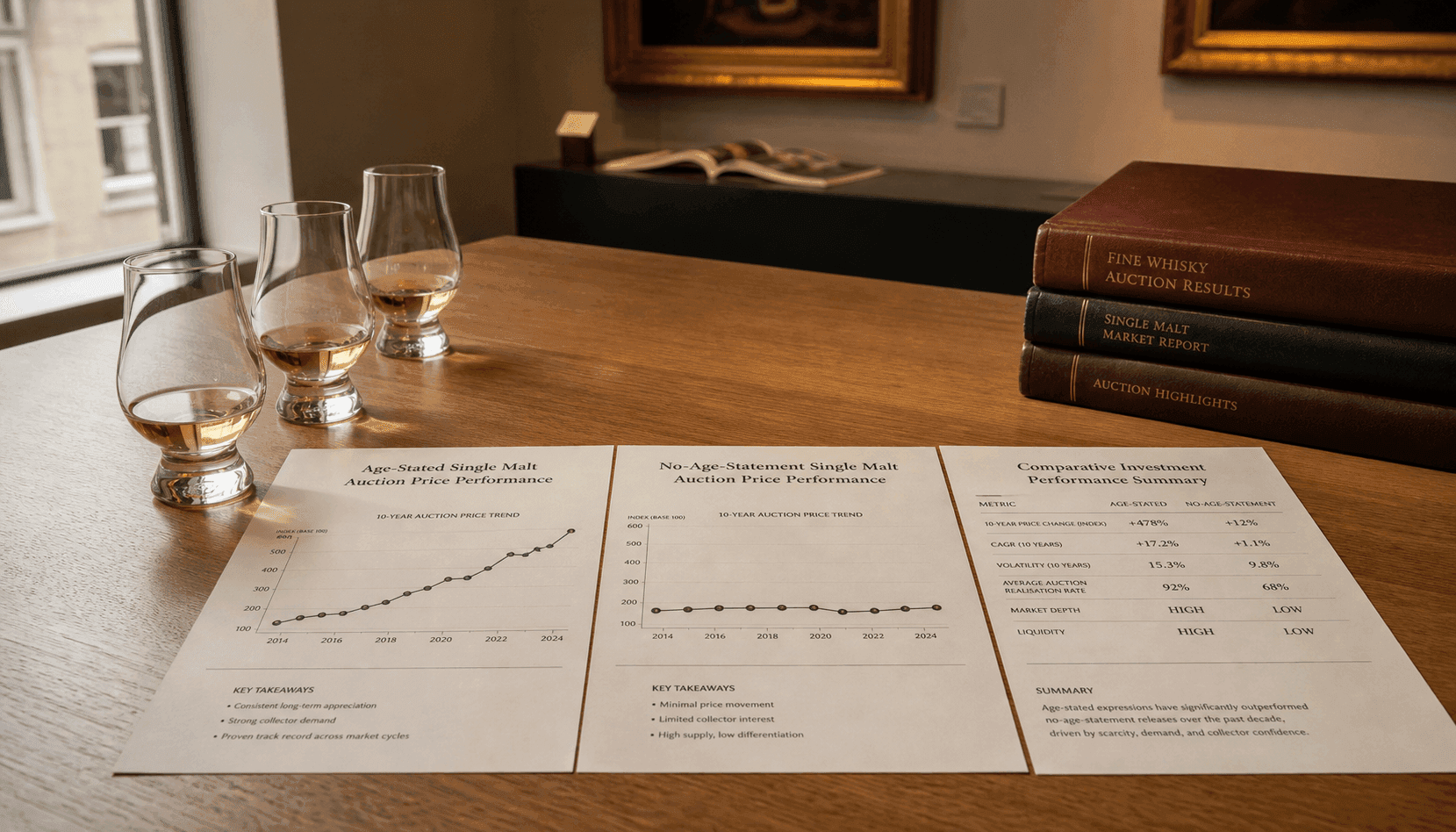
Age-stated whisky has consistently commanded stronger secondary-market premiums than no-age-statement expressions, with the most pronounced gap visible above 18 years from distilleries operating under genuine capacity constraints. NAS releases from major distilleries do occasionally outperform, particularly when tied to very limited editions or cult releases with exceptional reputations, but the structural scarcity argument is harder to sustain without a verifiable age. For investors, age statement remains one of the clearest proxies for long-term secondary-market value.
Key Takeaways
Age-stated expressions of 18 years and above from constrained distilleries carry the strongest, most verifiable scarcity credentials.
NAS releases rarely appreciate as consistently as age-stated equivalents, though exceptions exist in limited and cult categories.
The secondary-market premium between age-stated and NAS expressions from the same distillery has widened in 2025 and 2026.
Distilleries reformulating from age-stated to NAS send a clear signal of constrained aged stock, which typically strengthens secondary pricing for remaining age-stated bottles.
For investors, an age statement is not sufficient on its own: distillery provenance, production volume, and collector demand all matter equally.
Track live price differences between age-stated and NAS expressions on Spiritory to monitor how the market is pricing this distinction in real time.
What an Age Statement Really Means
An age statement on a Scotch whisky bottle represents a legal minimum: every drop of spirit in that bottle has spent at least the stated number of years in oak cask. It is a verifiable, regulated claim, not a marketing assertion. When a distillery bottles a 21-year-old, the consumer and collector know with certainty that the whisky has been maturing for a minimum of 21 years. This transparency is the foundation of the age statement's investment value.
Scarcity Embedded in the Number
Every year of additional maturation narrows the pool of available spirit. A distillery that produced one million litres of new make in a given year will have progressively less spirit surviving from that cohort as the years pass, due to the angel's share evaporation, cask leakage, and quality selection at bottling. A 25-year-old expression from a moderately sized distillery represents a genuinely small volume of whisky. This mathematical reality is why older age statements from respected distilleries carry inherent scarcity value that is not present in younger expressions from the same site.
The Role of Production History
The scarcity value embedded in an age statement is amplified by the distillery's production history. A 21-year-old from a distillery that cut production in 2004 and 2005 is doubly scarce: first because 21 years of maturation is inherently limiting, and second because the pool of spirit that reached that age was smaller than in years of normal production. Researching production history before investing in an age-stated expression reveals this layered scarcity dynamic.
The NAS Argument: Where It Has Merit
No-age-statement whisky is not inherently inferior. Many outstanding expressions carry no age statement, and some of the most celebrated independent bottlings and special releases have delivered exceptional secondary-market performance without disclosing a specific age. The investment argument for NAS is simply harder to make on structural grounds, and requires a different analytical approach.
When NAS Can Outperform
NAS expressions can outperform age-stated equivalents in specific circumstances. Limited releases with very small production numbers, expressions that develop cult status through critical acclaim, and NAS bottlings from closed or severely constrained distilleries can all command strong secondary premiums. The key is that in these cases, some other scarcity mechanism is providing the value foundation that the age statement would otherwise supply. Without that alternative scarcity anchor, NAS appreciation tends to be driven by sentiment rather than fundamentals, which makes it less reliable over a full market cycle.
NAS from Closed Distilleries
A NAS expression from a permanently closed distillery is a partial exception to the general principle. When a distillery has ceased production entirely, its entire remaining stock is finite regardless of age statement. Expressions from closed Japanese distilleries or permanently mothballed Scotch sites can appreciate strongly even without an age statement, because the supply ceiling is absolute.
Tip: When comparing a distillery's age-stated and NAS expressions at auction, look at the trend over 24 months rather than a single price point. If age-stated expressions are consistently achieving premiums of 30 per cent or more above NAS equivalents from the same site, that gap reflects genuine market valuation of the age statement, not random variation.
Secondary Market Evidence in 2026
The available secondary-market data from 2025 and into 2026 consistently supports the premium for age-stated expressions. The gap is most pronounced in the 18-year and above range, where the combination of maturation time and production history creates the strongest scarcity argument.
The Widening Premium
Several distilleries that have moved significant portions of their range from age-stated to NAS expressions over the past decade provide a natural experiment. In almost every case, secondary-market prices for the remaining age-stated expressions from those distilleries have risen materially following the announcement of the change. The market interprets an age-stated discontinuation as a signal that available aged stock is declining, which increases the relative scarcity of the remaining age-stated bottles.
Comparing Expressions from the Same Distillery
The clearest way to see how the market values the age statement is to compare price trajectories for age-stated and NAS expressions from a single distillery with both types in its range. On platforms like Spiritory, this comparison can be made in real time using live bid and ask data. The premium for age-stated expressions at 18 years and above is typically significant and has been widening over the past two years.
Exceptions Worth Knowing
Understanding the general principle that age-stated expressions tend to hold value better than NAS is essential, but so is knowing the categories where this generalisation breaks down.
Ardbeg Committee Releases and Annual Editions
Some NAS releases from highly regarded distilleries have built extraordinary secondary-market track records through a combination of very limited production, enthusiastic collector communities, and consistently high critical scores. Search The Ardbeg Supernova Committee Release series is a clear example: vintages like the Ardbeg Supernova Sn 2019 Committee Release and the Ardbeg Supernova Sn 2010 Committee Release show how these NAS releases perform against age-stated equivalents.
Independent Bottlings with Outstanding Cask Notes
An independent bottling from a single cask that has been recognised as exceptional by leading critics can command a significant secondary premium regardless of whether it carries an age statement. The scarcity here is provided by the single-cask nature of the release and the reputation of the bottler and cask selector. These are, however, high-information purchases that require detailed research.
NAS from Whisky with Cult Status
A small number of distilleries have developed such strong collector loyalty that their NAS expressions command premiums that defy the general rule. In these cases, the brand equity and production constraints at the distillery level provide the value foundation that the age statement would otherwise supply.
Building Your Investment View
The most defensible position for a whisky investor in 2026 is to treat the age statement as a necessary but not sufficient condition for a sound investment case. An age statement of 18 years or more from a respected distillery is a strong starting point, but it must be combined with evidence of structural supply constraints, a track record of secondary-market appreciation, and sufficient collector demand to ensure liquidity on exit.
Practical Due Diligence
Before investing in any expression, confirm: the production history of the distillery during the years when this whisky was made, the trajectory of realised prices at auction over at least 24 months, whether the distillery has announced any changes to its age-stated range, and the current spread between bid and ask on platforms like Spiritory, which provides a real-time liquidity indicator.
FAQ
Does an age statement guarantee a bottle will hold value?
No. An age statement is a strong indicator of scarcity potential but not a guarantee of value appreciation. The age statement must be combined with structural supply constraints, genuine collector demand, and a credible provenance to provide a robust investment case.
Are NAS bottles ever worth buying for investment?
Yes, in specific circumstances: very limited productions from cult distilleries, NAS expressions from closed or severely constrained sites, and single-cask independent bottlings from casks with outstanding reputations can all perform well. These require more detailed research than age-stated investments and typically carry higher liquidity risk.
Why do distilleries move from age-stated to NAS?
The primary driver is insufficient aged stock to maintain consistent production volumes at a given age statement. Moving to NAS gives the distillery flexibility to blend older and younger spirit to maintain flavour consistency without being bound to a specific maturation period. This decision is almost always a signal of constrained aged stock at the level of the discontinued age statement.
Where can I compare age-stated and NAS prices in real time?
Spiritory lists live bid and ask prices across a wide range of expressions, making it straightforward to compare current secondary-market valuations for age-stated and NAS expressions from the same distillery side by side.
About the author

Janis Wilczura
I'm one of Germany's leading whisky experts, featured in Handelsblatt and BILD. To me, whisky is craftsmanship and art.
To the author