

Reach thousands of whisky and spirits lovers every day.


How to Build a Whisky Investment Portfolio Under EUR5,000
 by Christopher Deutsch I drink and collect with intention, drawn to the sherried depth of Dalmore and the balance of Yamazaki.
Follow Spiritory on Google News to get our latest guides and releases delivered straight to your feed.
How to Build a Whisky Investment Portfolio Under EUR5,000
Key Takeaways
€5,000 is enough to build a diversified whisky investment portfolio across three to five well-selected bottles.
Concentrate on age-stated single malts of 18 years or more from distilleries with documented supply constraints.
Allocate across at least two geographic regions, Scotch and Japanese whisky represent the strongest investment cases in 2026.
Factor in storage, insurance, and future exit costs before committing to any single bottle.
Buy through reputable platforms with authentication guarantees, and maintain full provenance documentation from day one.
Monitor live secondary-market pricing on Spiritory to track valuations and identify entry points.
Starting Principles for Whisky Investment
Whisky investment requires a different mindset from equity investing. There is no dividend, no quarterly report, and no management team to evaluate. The investment case rests almost entirely on scarcity and collector demand, which means the research required before purchase is fundamentally about understanding supply constraints and the depth of the collector community for a specific expression.
Entering During a Market Correction
Anyone building a portfolio in 2026 is doing so during a correction rather than a boom. Secondary-market values have eased back from their 2022 peak as the market works through excess auction supply, higher borrowing costs, and the after-effects of the speculative buying of 2021 and 2022. For a buyer with a five to ten year horizon this is not necessarily bad news: entry prices are lower than they were two years ago, and a softer market tends to separate expressions with genuine scarcity from those that were carried up by sentiment alone. It does, however, mean that anyone expecting rapid short-term appreciation is buying into the wrong part of the cycle.
Think in Terms of Portfolios, Not Single Bottles
The single greatest mistake made by first-time whisky investors is concentrating their entire budget in one bottle. Even a bottle with strong fundamentals can experience short-term price softening due to sentiment shifts, a competing release from the same distillery, or simply a period of reduced auction activity. A portfolio of three to five bottles from different distilleries and regions provides resilience that a single position cannot.
Set a Minimum Holding Period
Whisky investment works best over a holding period of five years or more. The frictional costs of buying and selling, auction commissions, storage, and insurance, are significant enough that short-term trading rarely generates meaningful returns. Buyers who plan to hold for a minimum of five years, and ideally longer, are better positioned to realise the appreciation that structural scarcity tends to produce over time.
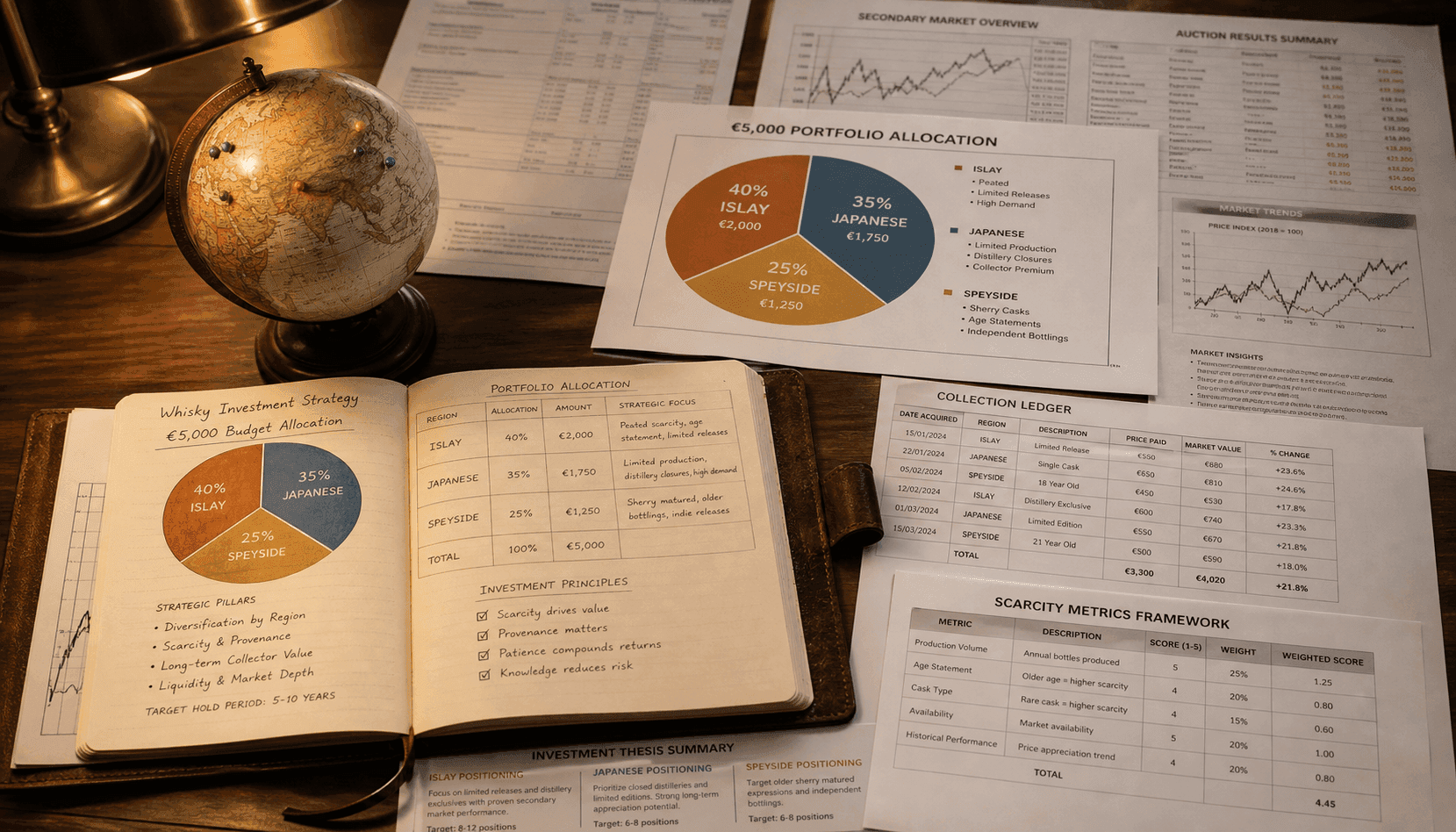
How to Allocate a €5,000 Budget
A sensible allocation framework for a €5,000 whisky investment budget divides capital across three tiers: a core holding with strong fundamentals and reasonable liquidity, a higher-risk higher-upside position in a more speculative expression, and a reserve for opportunistic purchases as the market evolves.
Core Holdings (€2,500 to €3,000)
The majority of the budget should go toward expressions with well-established secondary-market track records, strong provenance, and clear scarcity credentials. Age-stated single malts from well-known Islay distilleries, prestigious Speyside producers, or the core range of major Japanese producers represent the lowest-risk tier of whisky investment within a modest budget. These bottles are more liquid on exit and less exposed to the risk that collector interest in a niche expression fades entirely.
Opportunistic Position (€1,000 to €1,500)
A portion of the budget can be allocated to a higher-risk position: an independent bottling from a respected cask selector, a limited distillery special release with a small production run, or an expression from a distillery that is less widely known but has a growing collector following. The upside potential here is higher, but so is the illiquidity risk. Only buy expressions you would be comfortable holding for a decade if the market does not develop as anticipated.
Cash Reserve (€500 to €1,000)
Retaining a small cash reserve allows you to act on unexpected opportunities, a distillery announces a discontinuation, or a strong expression comes to auction at an attractive price, without having to liquidate existing holdings at an unfavourable time.
Tip: When building a small portfolio, resist the temptation to buy popular bottles that feel "safe" because everyone knows the name. Secondary-market value is driven by scarcity and collector demand, not brand recognition alone. A less famous bottle from a truly constrained distillery will often outperform a famous name available in large quantities.
Which Regions and Styles to Consider
Not all whisky regions offer equal investment characteristics within a modest budget. Understanding where the strongest investment cases lie helps focus research and avoid the common trap of buying what is most discussed rather than what is most scarce.
Islay Single Malts
Islay distilleries with global followings and physically constrained production sites represent some of the most reliable investment cases at the €500 to €1,500 price point per bottle. The island's small geographic footprint means capacity is genuinely limited, and international demand for peated expressions has been growing steadily for a decade. Search Islay single malts on Spiritory to see current secondary-market pricing across the range.
Japanese Single Malt
Japanese whisky remains one of the most compelling investment categories for 2026. Domestic demand in Japan has grown dramatically at the same time that international interest has surged, and the major producers cannot increase aged stock quickly. Within a €5,000 budget, one well-chosen Japanese expression, such as an age-stated release from Yamazaki or Hakushu, provides meaningful exposure to this dynamic.
Prestige Speyside
The Speyside region produces the majority of Scotch by volume, but within that, a small number of prestige distilleries, those producing at low volumes with strong international collector followings, offer credible investment cases. Focus on expressions with genuine age statements and verifiable production constraints rather than marketing-driven limited editions that are limited in name only.
Where and How to Buy
Provenance is the foundation of whisky investment. A bottle without clear provenance, including a verifiable chain of custody from distillery to buyer, is worth materially less on secondary than an identical bottle with full documentation. How you buy determines the quality of the provenance you can demonstrate when it comes time to sell.
Secondary Market Platforms
Spiritory offers a transparent bid/ask exchange with real-time pricing across a wide range of rare expressions. For a European investor, buying on Spiritory provides both clear pricing and a documented transaction record that strengthens provenance on future sale. The platform's focus on the EU market means pricing reflects the buyer base that is most likely to be on the other side of your exit trade.
Licensed Specialist Retailers
Buying from a licensed specialist retailer, particularly for new releases and distillery special editions, provides a clean purchase receipt and ensures the bottle has been stored properly from release. For investment purchases, always retain original packaging, receipts, and any accompanying documentation.
Managing Your Collection Over Time
A whisky investment portfolio requires modest but consistent maintenance. Storage conditions, insurance coverage, and periodic revaluation are the key ongoing responsibilities.
Storage
Bottles should be stored upright, away from direct light, and at a stable temperature between 15 and 20 degrees Celsius. Significant temperature fluctuations cause the liquid to expand and contract against the cork, risking evaporation and oxidation. Professional storage facilities are available but add cost; for a small collection, a dedicated cabinet in a controlled environment is sufficient.
Insurance and Documentation
Specialist whisky insurance is available through several European providers and is worth considering for any collection with a replacement value above €2,000. Maintain a digital inventory with photographs of each bottle, including the label, back label, capsule, and any accompanying box or documentation. This record is valuable both for insurance purposes and as provenance evidence when selling.
FAQ
Can I invest in whisky with less than €5,000?
Yes, though the options narrow considerably below €2,000. A single well-chosen bottle at this price point can appreciate meaningfully, but you lose the diversification benefit of a portfolio. Below €1,000, the expressions available with genuine investment credentials are limited, and exit costs relative to potential gains become more significant.
How long should I hold whisky for investment?
A minimum holding period of five years is advisable to cover frictional costs and allow scarcity dynamics to drive secondary-market appreciation. Many experienced collectors hold premium expressions for ten years or more before selling.
What are the biggest risks in whisky investing?
The main risks are: overpaying for expressions without genuine scarcity credentials, buying counterfeits through unverified channels, regulatory changes in how collectibles are taxed in your jurisdiction, and illiquidity risk if collector interest in a specific expression declines. Diversification and buying through reputable platforms mitigate most of these risks significantly.
Does whisky beat the stock market?
The top tier of the rare whisky market has historically delivered strong returns compared with equity indices over the same period, but this comparison is misleading for most investors. The returns are concentrated in a small number of genuinely scarce bottles, not the wider category. Anyone buying whisky expecting stock market-style returns across a broad portfolio will likely be disappointed.
About the author

Christopher Deutsch
I drink and collect with intention, drawn to the sherried depth of Dalmore and the balance of Yamazaki.
To the author