

Reach thousands of whisky and spirits lovers every day.


What Is Bavarian Whisky and How Does It Compare to Scotch?
 by Christopher Deutsch I drink and collect with intention, drawn to the sherried depth of Dalmore and the balance of Yamazaki.
Follow Spiritory on Google News to get our latest guides and releases delivered straight to your feed.
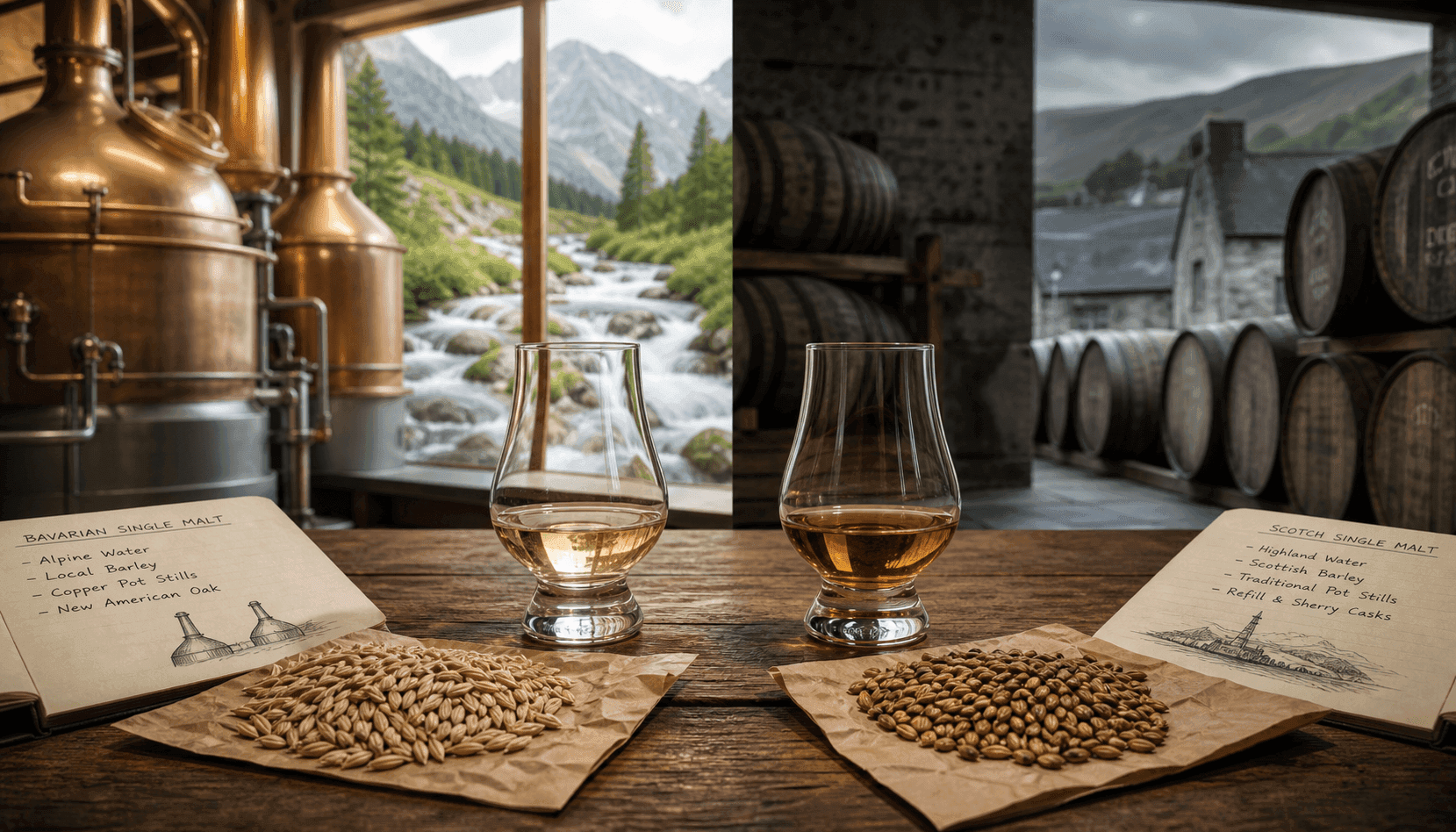
What Is Bavarian Whisky and How Does It Compare to Scotch?
Key Takeaways
Bavarian whisky is produced from 100% malted barley and must mature for a minimum of three years under German whisky law (Whisky-Verordnung), structurally similar to the rules governing Scotch single malt.
SLYRS, Germany's best-known Bavarian distillery, uses new American oak as its primary maturation cask, a choice rarely made by Scottish distilleries for their core ranges, producing a vanilla-forward character with notable sweetness.
Bavarian alpine water sources, locally grown barley, and cool mountain maturation conditions create a flavour profile noticeably different from both Speyside and Highland Scotch.
Lantenhammer, also at Schliersee, brings a precision distillation heritage from fruit schnapps production to its whisky programme, contributing a technically precise and clean house style.
Bavarian whisky cannot be labelled as Scotch whisky. It is a distinct European product with its own identity, production regulations, and an emerging collector market that is gaining international attention.
Explore Bavarian single malts alongside Scotch alternatives on Spiritory.
How Bavarian Whisky Is Produced
The fundamental production process for Bavarian single malt whisky follows the same broad steps as Scotch single malt: malted barley is mashed, fermented, distilled, and matured in oak casks. The differences lie in the specifics, particularly grain sourcing, water character, still design, and above all the cask programme chosen by each distillery, and these details are what give Bavarian whisky its distinctive character in the glass.
Malted barley and local grain sourcing
The Bavarian barley growing tradition, shaped by the region's role as one of Europe's premier brewing grain sources, provides Bavarian whisky distilleries with access to high-quality local raw material. Some distilleries work explicitly with locally sourced Bavarian barley varieties, contributing a house character distinct from Scotch producers who source grain more broadly. The quality of Bavaria's malting barley, long celebrated in the brewing world, is considered a significant raw material advantage for the region's whisky producers.
Alpine water and its influence on spirit character
SLYRS and Lantenhammer both draw on water sources influenced by the Schliersee and the broader Upper Bavarian alpine system. Alpine water is typically very soft and low in mineral content, different in character from the harder, peat-influenced waters used by some Scottish distilleries. Soft, pure water is associated with clean, delicate distillate character, allowing the grain and cask influence to speak more directly on the palate without interference from mineral complexity.
Distillation and still design
Bavarian distilleries work with copper pot stills, as do Scotch single malt producers, but still shapes and cut points vary between distilleries and influence the weight and character of the resulting new-make spirit. Lantenhammer's heritage in fruit schnapps distillation, a tradition that prizes precise, clean spirit, is visible in the technical precision of its whisky distillate. SLYRS employs copper pot stills designed specifically for single malt production with shapes that balance fruit development with structural weight.
Cask Programmes: Where Bavarian and Scotch Diverge Most
The most significant point of difference between Bavarian whisky and mainstream Scotch single malt is the use of new American oak as a primary maturation vessel. The majority of Scotch single malt is matured in ex-bourbon or ex-sherry casks, wood that has already given much of its primary flavour contribution to a previous spirit. New American oak, by contrast, delivers its full flavour potential directly to the maturing whisky from the first day of contact.
What new American oak delivers to the spirit
Charred new American oak is responsible for the vanilla, caramel, and coconut notes that define bourbon's profile. When used for single malt maturation, as SLYRS does with its core expressions, the result is a whisky with noticeably more vanilla sweetness and a softer, rounder mouthfeel than the same spirit would develop in ex-bourbon wood. The character is immediately accessible and, for many drinkers, more approachable than the more austere style of a young ex-bourbon Scotch at a comparable age.
Sherry and special cask finishes
Bavarian distilleries also work with sherry casks and a range of specialist finishes including port, rum, and wine casks, expanding the flavour vocabulary beyond what new American oak alone produces. SLYRS's sherry-influenced expressions show dried fruit, walnut, and winter spice notes alongside the signature Bavarian sweetness. These bottles attract collector interest particularly in the form of limited seasonal releases that sell out quickly at distillery level.
Maturation climate and development curves
Upper Bavaria's continental climate provides warm summers and cold winters, creating more active cask breathing than the temperate Scottish climate allows. Greater temperature variation accelerates the rate of wood interaction, meaning Bavarian whisky at three to five years of age may show wood integration more advanced than a Scottish whisky at the same age. This produces different flavour development curves rather than indicating a quality advantage, and experienced tasters learn to adjust their reference framework accordingly.
Tip: When comparing a Bavarian single malt to a Scotch of similar age, adjust your expectations for the level of cask influence. New American oak or active maturation conditions often produce more assertive wood character in younger whisky than the equivalent ex-sherry or ex-bourbon Scotch would show at the same age.
Flavour Comparison: Bavarian Single Malt vs Scotch
Tasting Bavarian whisky alongside Scotch is the most revealing way to understand the genuine differences in character. The comparison is instructive not because one style is superior, but because the points of difference illuminate what each style does uniquely well and where each sits in the broader landscape of world whisky for collectors and enthusiasts.
Sweetness and approachability
Bavarian single malt, particularly SLYRS American oak, tends to be sweeter and more immediately accessible than a comparable young Scotch matured in ex-bourbon wood. The vanilla and honey notes from new American oak sit at the front of the palate without the grain astringency that can mark young Scotch. This makes Bavarian single malt a natural introduction for drinkers approaching whisky from a sweeter spirit background, including bourbon or rum.
Complexity and layering over time
Older Scotch single malts, particularly long-aged expressions from recognised distilleries, develop a complexity that reflects decades of gradual wood interaction and the accumulation of secondary flavours. Bavarian whisky, as a younger category with less runway for extended maturation, is still developing its track record with aged expressions. Where longer-aged Bavarian expressions are available, such as SLYRS special releases with extended maturation, the complexity gain is demonstrable and the bottles attract the most serious collector attention.
Terroir and regional distinctiveness
The concept of whisky terroir, the influence of a specific place on spirit character, is increasingly taken seriously by collectors and producers alike. Bavarian whisky has a legitimate terroir claim: specific local grain varieties, distinctive alpine water, and the temperature patterns of the Upper Bavarian microclimate all contribute to a character that could not be exactly replicated elsewhere. This is the dimension of Bavarian whisky with the greatest long-term collector and cultural appeal as the category matures.
Bavarian Whisky and the Collector Market
Bavarian whisky is at an early but accelerating stage of collector market development. SLYRS limited annual releases, distillery-only bottlings, and cask-strength expressions attract attention from German collectors and are beginning to appear on the international secondary market as awareness of the category grows among serious whisky investors outside Germany.
Early release appreciation dynamics
Early releases from distilleries that subsequently establish strong reputations have historically appreciated significantly in secondary market value, a pattern observed in Scotch, Japanese, and Irish whisky and beginning to emerge in German production. Collectors with a long time horizon who identify high-quality Bavarian producers early in their development may benefit from this appreciation dynamic as international demand for the category grows.
Limited releases worth following
SLYRS produces regular limited edition releases including cask strength bottlings, specific cask finishes, and anniversary expressions that sell out quickly at distillery level. Secondary market availability on platforms such as Spiritory allows collectors who missed primary releases to acquire these expressions at current market prices with full provenance transparency.
Tip: Follow SLYRS and Lantenhammer directly for announcements of limited releases. Distillery mailing lists and specialist retailer newsletters are the fastest way to access primary market allocations before bottles move to secondary market pricing.
FAQ
Is Bavarian whisky legally protected like Scotch Whisky?
Scotch Whisky is a legally protected geographical indication under UK law and EU trade agreements. Only whisky produced in Scotland meeting specific production requirements can carry the designation. Bavarian whisky has no equivalent formal geographical indication at present, though it is subject to Germany's Whisky-Verordnung and broader EU spirits regulations. The question of formal Bavarian whisky protection has been discussed within the industry without definitive resolution.
Does Bavarian whisky contain peat?
The great majority of Bavarian single malt is unpeated. Peat is not a traditional feature of Bavarian grain drying, and the clean, sweet character of Bavarian single malt reflects an unpeated production approach. Some distilleries have experimented with peated expressions as limited releases, but these remain exceptions rather than defining features of the regional style.
How does the price of Bavarian whisky compare to comparable Scotch?
Core range Bavarian single malts, SLYRS and Lantenhammer in particular, are broadly comparable in price to similarly aged entry-level to mid-range Scotch single malts. Limited releases and special cask expressions command premiums, as they do in the Scotch market. As international demand for German whisky grows, pricing on collector-grade expressions is expected to increase from current levels.
Where can I buy Bavarian whisky outside Germany?
SLYRS has established distribution in several European markets and is available through specialist whisky retailers internationally. For secondary market bottles and collector-grade expressions, Spiritory provides access to Bavarian whisky for European collectors, with transparent pricing and buyer protection built into the platform's exchange model.
About the author

Christopher Deutsch
I drink and collect with intention, drawn to the sherried depth of Dalmore and the balance of Yamazaki.
To the author