

Reach thousands of whisky and spirits lovers every day.


What Is the Best Way to Start a Whisky Collection in Munich?
 by Christopher Deutsch I drink and collect with intention, drawn to the sherried depth of Dalmore and the balance of Yamazaki.
Follow Spiritory on Google News to get our latest guides and releases delivered straight to your feed.
What Is the Best Way to Start a Whisky Collection in Munich?
Key Takeaways
Define a focus before buying: by region, distillery, cask type, or age statement, any coherent framework is better than none.
Build relationships with one or two Munich specialists early; access to allocated releases flows from those relationships.
Munich has three retailers worth building a relationship with: Spiritory's shop in Sendling, Tara Spirits in the Altstadt, and Sieberts Whiskywelt in Pasing-Obermenzing.
Storage matters immediately: bottles should be stored upright, away from light and heat, from the day of purchase.
The secondary market, particularly Spiritory, is essential for sourcing beyond what Munich retail currently carries.
Document every purchase: provenance, price, and storage history add value if you ever sell.
A collection built around five to ten distilleries in depth is more meaningful than a hundred single bottles from a hundred different sources.
Spiritory Shop in Munich's Sendling district provides a dedicated physical location for building collector relationships and accessing curated bottles across all major distilleries and independent bottlings.
Defining a Collecting Focus
The most common piece of advice from established collectors and the most frequently ignored by newcomers is to define a focus before making significant purchases. A focused collection tells a story; an unfocused one is simply storage.
By region
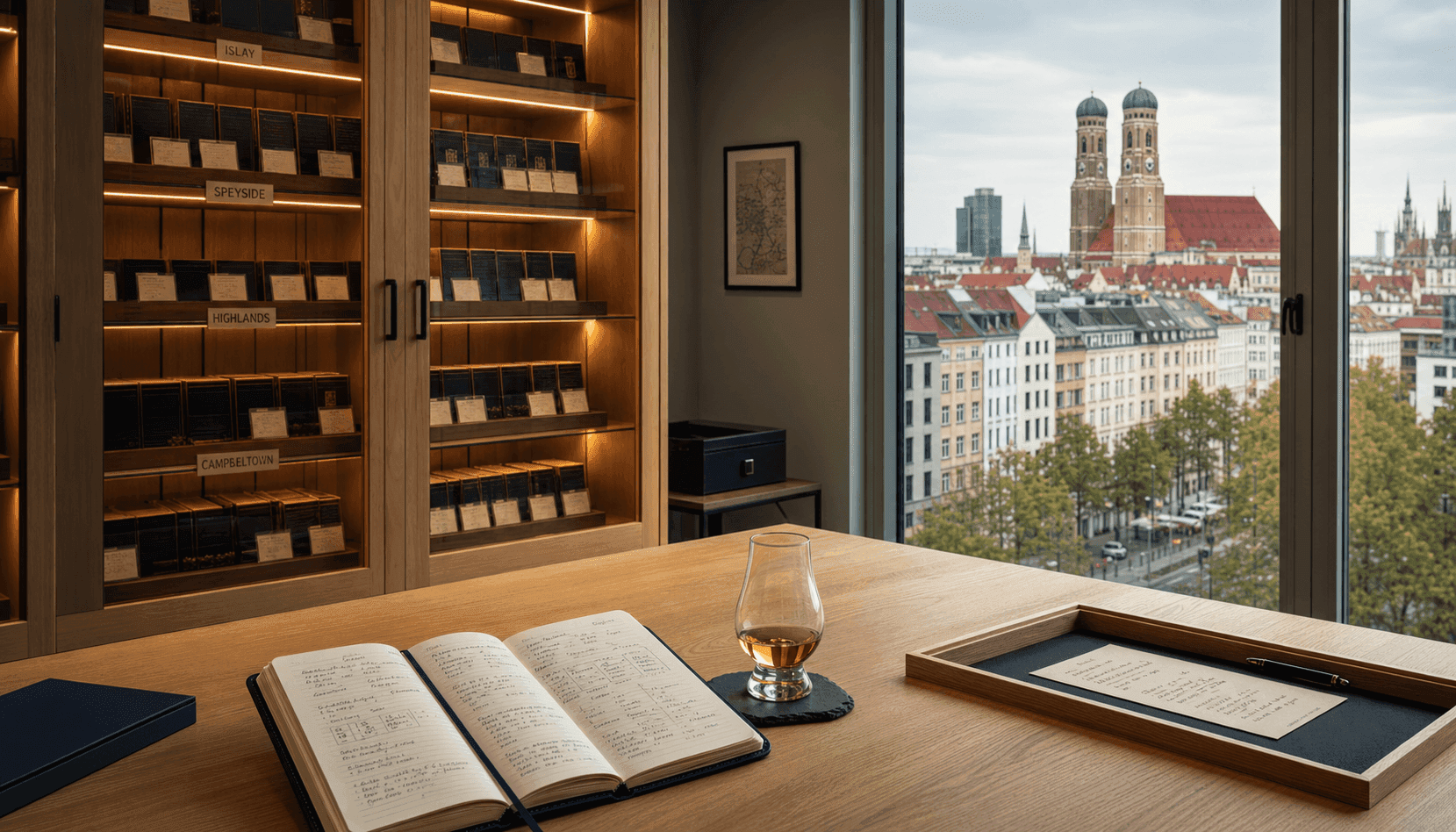
Choosing a region, Islay, Speyside, Highland, Campbeltown, gives a collection geographic coherence and allows meaningful comparison across distilleries, vintages, and cask types within that geography. An Islay collection built around multiple distilleries over time provides a genuine record of how the island's whisky production has evolved. A Speyside collection built around sherry-aged expressions creates a benchmark library for understanding that style.
By distillery
Collecting vertically within a single distillery, multiple vintages, different expressions, annual releases, is one of the most rewarding approaches for serious collectors. It requires patience and consistent access, but a vertical collection of Glenfarclas Family Casks, for example, or a deep Ardbeg library including annual releases across a decade, is both intellectually engaging and potentially valuable.
By cask type
Collecting around a specific cask type, ex-sherry, ex-bourbon, ex-wine, single cask PX, provides a different kind of coherence, one that cuts across distilleries and regions. This approach rewards buyers who have developed a sophisticated understanding of how wood influences flavour and who want to build a collection that illustrates those differences clearly.
Tip: Start with a provisional focus and allow it to evolve. Many collectors begin with a regional interest that narrows over time to one or two distilleries as their knowledge and taste mature. The goal is to have a direction, not to commit irrevocably from the first bottle.
Building the Right Relationships in Munich
In Munich's premium spirits market, access often follows relationship. Limited releases, private cask purchases, and advance notice of incoming stock are all distributed preferentially to known, regular customers at specialist retailers.
Choosing your key retailer
Identify one or two Munich specialists who carry the kind of bottles you want to collect and whose staff demonstrate genuine knowledge. Visit regularly, ask questions, discuss what you are building. A retailer who understands your focus will think of you when relevant bottles arrive. This is how allocated releases get into collector hands rather than onto the secondary market at a premium.
Tara Spirits, at Rindermarkt 16 in the Altstadt, has served this role since 1994 and carries a broad range across Scotland, Ireland, the United States, Germany, and Japan, making it a natural choice for a collector still defining a focus. Sieberts Whiskywelt, at Bodenstedtstraße 15 near Pasing station, has taken a narrower path since opening in 2018, stocking almost exclusively small-run independent Scottish bottlings; it suits collectors who already know they want to go deep on independent releases rather than broad distillery coverage.
Spiritory Shop, located at Plinganserstraße 6 in the Sendling district (open Tuesday to Saturday, 11:00–19:00), is built expressly for this relationship. The shop stocks approximately 100–150 curated bottles including featured collections from Ardbeg, The Dalmore, The GlenDronach, Redbreast, The Macallan, and Japanese whisky from Suntory, alongside a rotating selection of independent bottlings. Staff are trained to guide collectors at every level, from those placing first orders to established enthusiasts building depth in focused areas.
Joining the local community
Munich has an active whisky enthusiast community that gathers for tastings, club meetings, and festival events. These communities provide access to bottles that circulate privately, to informed opinions about which releases merit attention, and to connections with other collectors who may have bottles worth trading. Engaging with the community accelerates the learning curve significantly.
Storage: Getting This Right from the Start
The condition of stored bottles directly affects both enjoyment and value. Getting storage right from the beginning costs very little; the mistakes made through poor storage can be expensive to reverse.
Basic storage principles
All bottles should be stored upright to prevent the cork from prolonged contact with high-strength spirit, which can degrade it over time. Bottles should be kept away from direct light, UV degrades colour and can affect flavour, and away from heat sources or significant temperature fluctuations. A stable, cool, dark environment is the correct starting point. A wardrobe in a north-facing room, a basement, or a purpose-built spirits cabinet all work well.
Humidity and corks
Moderate humidity, roughly 60–70%, helps prevent corks from drying out and cracking, particularly for bottles stored for five or more years. In Munich's climate, which can be dry in winter, this is worth monitoring if bottles are stored in heated rooms. A small humidifier or a purpose-built spirits cabinet with humidity control addresses this without complexity.
Documenting the collection
Record every bottle you purchase: the expression, vintage if stated, purchase date, price paid, and where it was bought. A simple spreadsheet works. This documentation serves two purposes: it helps you track what you have and identify gaps in your focus, and it provides provenance information that significantly aids resale if you ever choose to sell through the secondary market.
Tip: Photograph the fill level of each bottle when purchased and again at regular intervals if stored long-term. This is the simplest way to demonstrate that a sealed bottle has not been tampered with and that storage conditions have been appropriate, both important for secondary market value.
Using the Secondary Market to Build Depth
No Munich collector can build a serious collection from local retail alone. Some of the most important bottles for any focused collection, older vintages, discontinued expressions, international releases never distributed in Germany, exist only on the secondary market.
Spiritory as a sourcing tool
Spiritory is the most relevant secondary market platform for Munich-based collectors. The platform lists premium and rare Scotch across all major distilleries and categories, with transparent pricing and a secure transaction framework. For collectors building vertical libraries or hunting specific expressions, it is the most efficient sourcing channel available for the German market.
Setting a budget for secondary market purchases
Secondary market prices reflect current collector demand and can move significantly above or below original retail. Setting a clear maximum for secondary market purchases as a percentage of the retail price you would have paid, or as an absolute cap per bottle, helps avoid impulse purchases at elevated prices. The secondary market is a tool for targeted sourcing, not a replacement for disciplined collecting.
FAQ
How many bottles should a new collector start with?
There is no correct number, but starting with fewer, better-chosen bottles is almost always more satisfying than buying widely. Five to ten bottles that genuinely represent your focus and that you are excited about are a better foundation than twenty randomly selected expressions. Quality over quantity applies from the first purchase.
Is whisky collecting in Munich more expensive than elsewhere in Germany?
Local retail prices in Munich are broadly comparable to other major German cities for standard expressions. Munich's stronger collector community does mean that allocated releases sell through quickly, which occasionally pushes secondary market sourcing. The advantage is access to more events, more knowledgeable retail staff, and a more active collector network.
Should I focus on investment or enjoyment?
The most satisfying collections are built around genuine personal interest, not investment thesis alone. Collections built for investment without taste preference tend to be unfocused and are often sold at suboptimal times for non-financial reasons. Collecting what you find genuinely interesting tends to produce better-curated collections that are also easier to hold through market fluctuations and better to open when the moment is right.
When is the right time to open a bottle from the collection?
There is no single answer, but the best collections are used. Keeping every bottle sealed indefinitely produces a storage unit rather than a cellar. Opening bottles for significant occasions, for comparative tastings, or simply when the moment calls for it is part of what makes collecting worthwhile. The discipline is knowing which bottles deserve longer holding and which should be enjoyed sooner.
Is there a specific shop in Munich recommended for new collectors?
Spiritory Shop, at Plinganserstraße 6 in the Sendling district, is designed explicitly for collectors at all experience levels, as is Tara Spirits in the Altstadt with its broad cross-category range. Both shops stock curated selections spanning major Scottish and Irish distilleries, Japanese whisky, and independent bottlings, and staff at both are trained to guide new collectors through their first choices. Sieberts Whiskywelt is worth visiting once you already have a sense of direction, since its focus on independent Scottish bottlings suits a more targeted collector.
About the author

Christopher Deutsch
I drink and collect with intention, drawn to the sherried depth of Dalmore and the balance of Yamazaki.
To the author