

Reach thousands of whisky and spirits lovers every day.


How Do I Sell Whisky Privately in Germany?
 by Christopher Deutsch I drink and collect with intention, drawn to the sherried depth of Dalmore and the balance of Yamazaki.
Follow Spiritory on Google News to get our latest guides and releases delivered straight to your feed.
How Do I Sell Whisky Privately in Germany?
Key Takeaways
Private individuals in Germany can sell whisky directly, through specialist platforms, or at auction without requiring a trade licence, provided the activity is not systematic and commercial in nature.
Gains on bottles sold more than twelve months after purchase are generally tax-free under German private sales rules (§23 EStG).
Spiritory (spiritory.com) is one of the most efficient channels for German collectors selling investment-grade bottles, offering transparent pricing and access to serious buyers across Europe.
Auction houses provide an alternative route for rare bottles, though seller fees and lead times vary considerably between platforms.
Accurate documentation of acquisition cost and holding period protects you in any tax assessment and supports the price you can credibly ask.
Bottles in original, undamaged condition with intact seals, original packaging, and provenance documentation command materially better prices on any channel.
Understanding Your Selling Options
German collectors selling whisky privately have several viable channels available, each with different trade-offs around pricing control, speed of sale, and effort required. Selecting the right channel depends on the value of the bottle, how quickly you want to realise proceeds, and whether you are selling a single bottle or a larger collection.
Specialist online exchanges
Platforms such as Spiritory operate as bid/ask exchanges where sellers set an asking price and buyers place bids, similar in structure to a financial exchange for spirits. This model gives sellers full control over pricing, reaches a large base of qualified buyers, and provides transparent price discovery based on real transaction data. For investment-grade bottles, this is typically the most effective route to fair market value.
Specialist auction houses
International whisky auction houses attract serious collectors and can achieve strong prices for rare or historically significant bottles. Seller fees typically range from around 9% to 15% of the hammer price, and the sale timeline from consignment to payment can run several weeks. For very rare bottles such as limited single-cask releases or distillery anniversary editions, auction can produce competitive outcomes particularly when a bottle benefits from strong provenance documentation.
Direct private sales
Selling directly to another collector removes platform fees entirely but requires finding a willing buyer, agreeing a price without a live market reference, and managing payment and logistics independently. Community platforms, specialist forums, and collector groups can facilitate introductions. This route works best for bottles with a clear, established market price where both parties can reference published data and verify the transaction is fair.
Pricing Your Bottles Realistically
Accurate pricing is the single biggest factor in how quickly a private sale completes and whether you achieve fair value. Overpriced bottles sit unsold; underpriced bottles leave money on the table. German collectors have several reliable reference points available to anchor their pricing decisions before committing to a channel.
Using exchange data as a benchmark
Live exchange platforms show current bid and ask prices for bottles actively listed, as well as recent transaction prices. Checking recent sales for the same expression, ideally in the same condition and bottle size, provides a defensible starting point for your own asking price. Spiritory's search function allows collectors to check current market data for rare and investment-grade expressions before listing a bottle.
Condition and packaging premium
Bottles in original, undamaged outer packaging with intact seals, original tissue, and full provenance documentation command a consistent premium over the same expression in loose condition. The premium varies by bottle, and for highly collectible releases it can be material. Assess your bottle's condition honestly before pricing; a damaged label or missing outer box should be reflected in the asking price rather than left for buyers to discover.
Auction results as a secondary reference
Published hammer prices from specialist whisky auctions provide a historical record of what collectors have paid for comparable bottles. Remember to adjust for the buyer's premium, typically 15% to 25% on top of the hammer price, when interpreting auction results. The total cost to the buyer was meaningfully higher than the headline figure, which affects how sellers should interpret these comparisons for their own pricing.
Tip: When comparing your bottle to recent auction results, check the condition notes and lot description carefully. A bottle described as having minor label wear may have sold at a discount to a pristine example, which your bottle may match.
Documentation and Authenticity
For investment-grade bottles, provenance documentation is as important as the bottle itself. A whisky with a clear paper trail, showing original purchase receipt, authenticated storage history, and any accompanying certificates, is both easier to sell and commands a premium over an undocumented equivalent.
What documentation to prepare
Gather the original purchase receipt or auction lot confirmation, any authentication certificate issued by the distillery or bottler, storage records if the bottle was held in professional storage, and photographs showing the current condition of the bottle, capsule, label, and outer packaging. For older bottles, distillery certificates of authenticity or signatures from the master distiller add meaningful value to the listing.
Authenticating bottles before sale
If you have acquired a bottle through the secondary market and have any doubts about its authenticity, seek an authentication opinion before listing. Capsule appearance, fill level consistency, and label details that match known releases are all worth verifying. Selling a bottle in good faith does not shield a seller from civil claims if the bottle turns out to be counterfeit, and reputable platforms often provide or facilitate authentication services for high-value listings.
Tax Implications of Private Sales
The tax treatment of private whisky sales in Germany is covered in detail in our companion article on whisky investment tax rules. In summary: profits from bottles held for more than twelve months are generally tax-free for private individuals. Gains realised within twelve months of purchase are subject to income tax on the profit, above an annual threshold of €1,000 across all such short-term private asset sales, raised from €600 with effect from 2024. This is a Freigrenze rather than an allowance: exceed it and the entire gain becomes taxable, not just the portion above the threshold.
When the twelve-month rule applies to your sale
The holding period is calculated from the date of purchase as evidenced on your acquisition receipt. Collectors who actively manage their portfolios often time sales to fall outside this window where the gain would be material, a practice that is both legal and commonly observed among serious investors in alternative assets. The key is maintaining the acquisition date documentation that supports the calculation.
Keeping records for tax purposes
Retain all purchase documentation to establish your acquisition cost and the date of purchase. This is your baseline for calculating any taxable gain and, crucially, for demonstrating that the one-year holding period has been met. In the event of a query from the Finanzamt, a clear paper trail is your strongest protection and the simplest response to any inquiry.
Shipping and Logistics for Private Sales
Once a sale is agreed, delivering the bottle safely requires attention to packaging, carrier selection, and insurance. Whisky is a fragile, high-value commodity, and inadequate packaging is the most common cause of transit damage. Most standard parcel carriers exclude alcohol from their standard damage liability policies, which makes proactive insurance essential.
Packaging standards
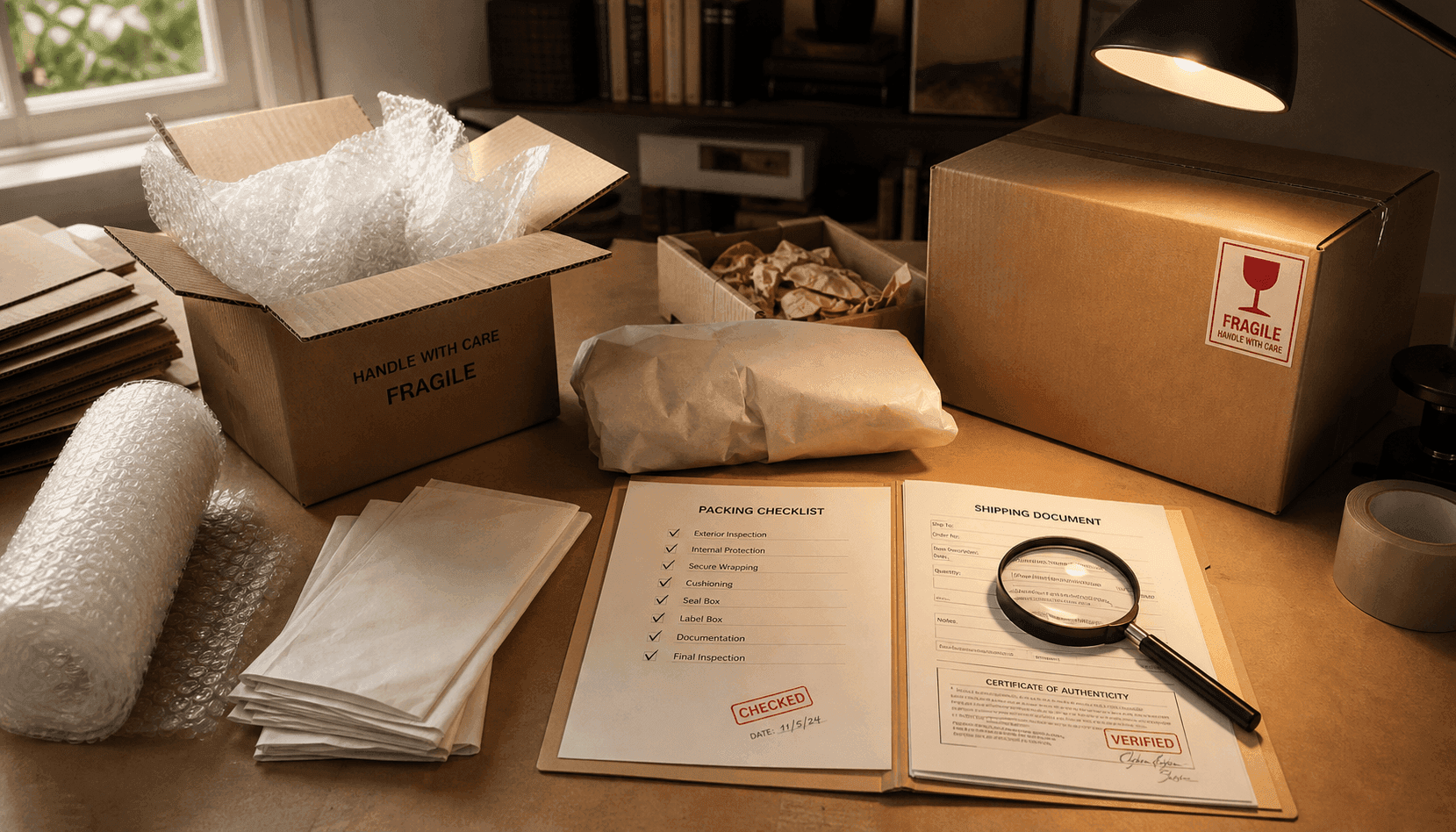
Use double-walled cardboard boxes rated for the weight of the bottle. Wrap the bottle in bubble wrap and ensure it cannot move inside the outer box by packing voids tightly with foam or paper fill. If the bottle has outer packaging, protect it separately; a damaged outer box reduces the buyer's perceived value and can generate disputes. Use fragile labels and directional arrows, though these are not a substitute for robust packing.
Insurance and carrier selection
Declare the full value of the shipment and ensure you have cover that explicitly includes alcohol and glass. Specialist art and collectibles shippers often provide better terms for high-value bottles than general parcel carriers. When selling through a platform, check whether the platform provides or mandates specific shipping and insurance arrangements, as this protects both seller and buyer in the event of transit damage.
Tip: Photograph the packed bottle before sealing the box, and photograph the sealed outer box before handover to the carrier. This documentation is invaluable in the event of a transit damage claim.
FAQ
Do I need a licence to sell whisky privately in Germany?
A private individual selling bottles from their own collection does not require a trade licence. If your activity becomes systematic and commercial in nature, buying regularly for resale rather than selling from a personal collection, you may be required to register a Gewerbe. The boundary depends on the overall pattern of activity rather than any single transaction.
Can I sell whisky that was a gift or inherited?
Yes. Inherited or gifted bottles can be sold privately in the same way as purchased bottles. For tax purposes, the holding period calculation for the one-year rule typically starts from when the original owner acquired the bottle, not from the date of inheritance or gift, though this is a nuanced area and professional advice is recommended for significant values.
What is the seller fee on Spiritory?
Spiritory charges sellers a fee of 9% on completed transactions. For German collectors, Spiritory provides access to serious buyers across Europe without the overhead of managing auction consignment logistics, and with the benefit of transparent, real-time price discovery based on actual completed sales.
How long does it typically take to sell a bottle?
On a live bid/ask exchange, a competitively priced bottle in a liquid expression can sell within days of listing. Auction houses typically run regular sale cycles meaning the time from consignment to sale can range from a few days to several weeks. Setting a realistic asking price aligned to current market data is the most reliable way to accelerate a sale on any channel.
About the author

Christopher Deutsch
I drink and collect with intention, drawn to the sherried depth of Dalmore and the balance of Yamazaki.
To the author