

Reach thousands of whisky and spirits lovers every day.


Do Whisky Medals Matter? How to Read IWSC, ISC and Other Awards
 by Janis WilczuraI'm one of Germany's leading whisky experts, featured in Handelsblatt and BILD. To me, whisky is craftsmanship and art.
Follow Spiritory on Google News to get our latest guides and releases delivered straight to your feed.
Do Whisky Medals Matter? How to Read IWSC, ISC and Other Awards
Whisky medals matter as a signal of liquid quality, but not as a signal of rarity or resale value: each medal records how a blind judging panel rated one entered sample at one competition. IWSC, the ISC, the San Francisco World Spirits Competition and the World Whiskies Awards each use their own medal ladder, so a Gold sticker from one is not the same claim as a Gold sticker from another.
Key Takeaways
A medal records the verdict of a blind panel on one entered sample, in one competition and one year.
IWSC uses a point scale, with Gold at 95 to 97 and Gold Outstanding at 98 to 100, while the ISC and San Francisco describe levels without point cutoffs.
Trophies, Supreme Champion, Best of Class, Best in Show and World's Best are narrower titles than medals.
The published criteria concern the liquid, so a medal says nothing about rarity or resale value.
Producers choose what to enter and pay to enter, so a bottle without a sticker may simply not have been submitted.
Tip: When two bottles carry stickers, compare the competition, the year and the level before the colour. A Gold from one competition and a Gold from another are separate claims.
What does a whisky medal actually measure?
A medal measures how a judging panel rated one sample, poured blind, in one competition and one year. IWSC, the ISC and the San Francisco World Spirits Competition all describe blind tasting, which means the judges do not see the brand, the packaging or the price. The San Francisco competition says so directly: judges never see the bottle, branding, packaging or price point.
The criteria these competitions publish concern what is in the glass. The San Francisco competition lists aroma, flavour, balance, texture, finish and overall quality. The World Whiskies Awards says taste and quality are the most important aspects. Nothing in those lists covers how many bottles exist, how old a distillery is or what a bottle might fetch later.
There is a business side too. Producers choose which bottles to enter, and entering costs money. The World Whiskies Awards publishes its fees, listed at £327 plus VAT for one entry judged on taste and design. A missing sticker can simply mean the producer did not enter.
How does IWSC score and award its medals?
The International Wine and Spirit Competition (IWSC) has run since 1969. According to The Whiskey Wash's coverage of the 2026 trophies, spirits are judged blind, each sample is served in a numbered glass, and each judging day is capped at 65 samples to limit palate fatigue. A member of the Spirits Judging Committee retastes every spirit awarded Gold before the result is confirmed.
IWSC scores on a 100 point scale. As reported by The Whiskey Wash, Bronze covers 85 to 89 points, Silver 90 to 94, Gold 95 to 97 and Gold Outstanding 98 to 100. Trophies are a separate stage and are open only to Gold or Gold Outstanding spirits, which committee members retaste to pick the winners.
Two 2026 trophy winners show how this works in practice. Bowmore 9 Year Old won the Single Malt Scotch Under 20 Year Old trophy with 98 points, a Gold Outstanding score. Royal Salute 21 Year Old Signature Blend won the Blended Scotch trophy with 96 points, which is Gold, and The Whiskey Wash noted that no blended Scotch reached Gold Outstanding this year. Both results were published on 9 October 2026.
How does the ISC decide its medals and trophies?
The International Spirits Challenge (ISC) states that it is judged entirely through blind tasting, with panels of industry specialists such as master blenders, distillers, buyers and consultants. Each panel uses a detailed scoring system and awards Bronze, Silver, Gold or Double Gold. The ISC pages checked for this article do not publish point cutoffs for each level, so a reader cannot translate an ISC Gold into a number the way an IWSC score can be read.
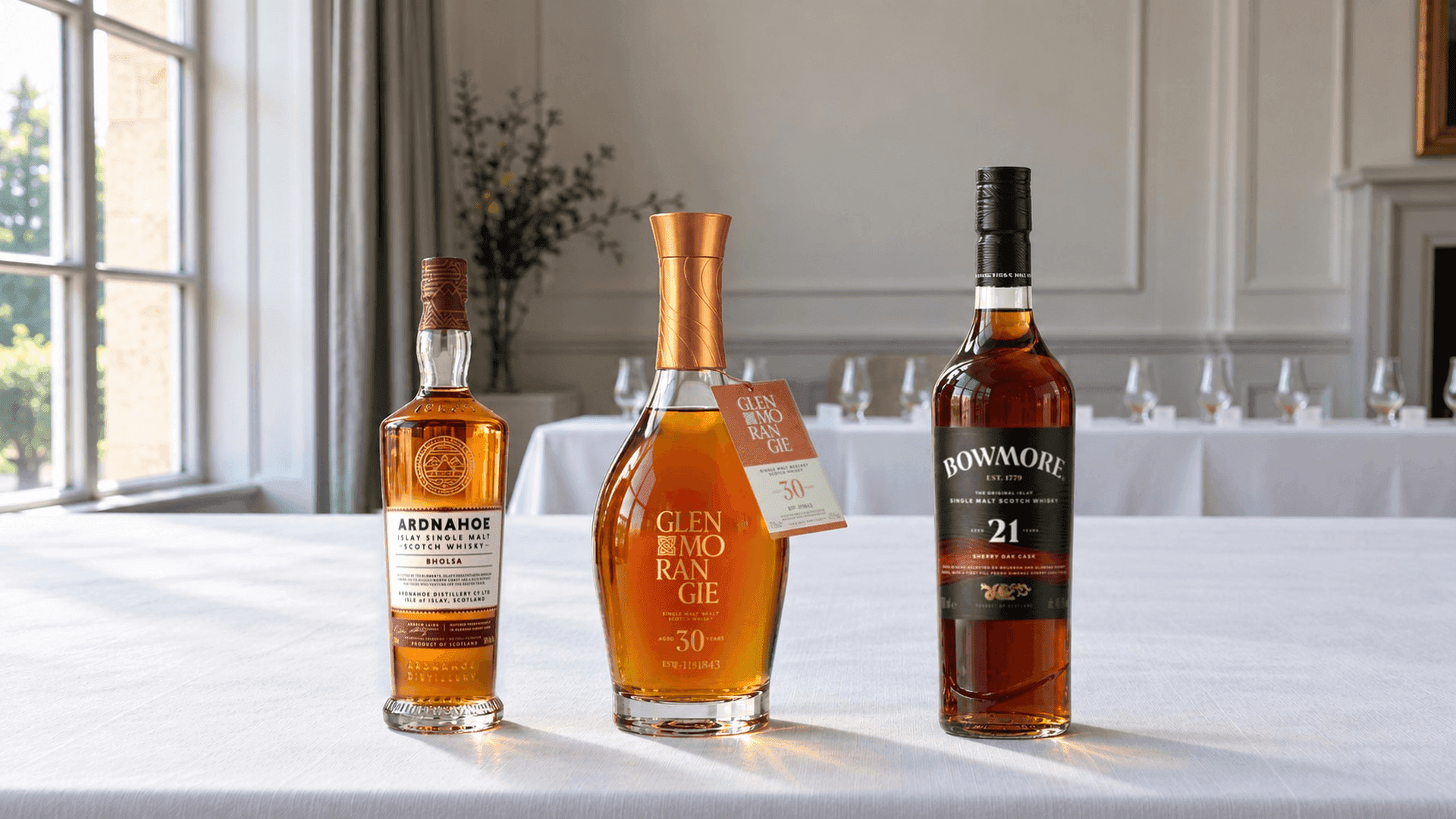
Top performers may then be reconsidered for Trophy titles. For the Supreme Champion Spirit, category chairs retaste the leading spirits blind, and the title goes to the highest scoring trophy winner. On 9 October 2026 the ISC whisky trophy winners were reported by The Whiskey Wash as Glenmorangie The Thirty Years Old, which also took Supreme Champion Spirit, Evan Williams Bottled in Bond Bourbon, Ardnahoe Bholsa, Loch Lomond 12 Year Old Inchmurrin, Rosebank Remarkable Cask Release One and Yamazaki Single Malt Whisky 25 Years Old.
That list mixes a 50% ABV Islay malt, a bourbon that The Whiskey Wash puts at about $19 and a 30 year old malt. The ISC is not ranking rarity or price, it is ranking what the panels tasted. Two of the winners are listed on Spiritory: Ardnahoe Bholsa and Glenmorangie 30 Years Old, the 43% ABV malt that Glenmorangie sells as The Thirty, matured in bourbon casks and then Burgundy red wine casks.
What do Double Gold and Best in Show mean in San Francisco?
The San Francisco World Spirits Competition is run by The Tasting Alliance, which publishes its own explanation of the ladder. A Double Gold is awarded when every judge on the panel unanimously gives the product a Gold level score. Gold medals go to products that set a benchmark within their category, Silver to excellent products with strong quality and character, and Bronze to well made products that meet professional standards.
Above that sit Best of Class, for the top performer in a category after a sweepstakes round among Double Gold winners, and Best in Show, for the single most exceptional product among all category winners. A Platinum medal requires a Double Gold in three consecutive years in the same competition.
The difference from IWSC matters on a shelf. A San Francisco Double Gold records agreement among judges, while an IWSC Gold Outstanding records a score band. The Tasting Alliance page gives no numeric scale and no figure for how many entries earn medals, so a Double Gold cannot be compared point for point with an IWSC score.
What are the World Whiskies Awards, and how are winners named?
The World Whiskies Awards judge in three rounds. In round one each whisky is tasted blind within its style to pick style winners. In round two the style winners are compared to find the best in each category. In the final round those category winners compete for the title of World's Best.
Winners can receive a medal, a country winner award and a World's Best award, which are three different things to look for on a label. The official page publishes no points system. At the ceremony on 25 March 2026 at the Waldorf in London, Bowmore 21 Years Old Sherry Oak Cask was named World's Best Single Malt, according to Whisky Magazine. It is bottled at 46.8% ABV and is listed on Spiritory as Bowmore 21 Years Old Sherry Oak Cask.
What does a medal not tell you about rarity or resale value?
A medal does not tell you that a bottle is rare. Evan Williams Bottled in Bond won an ISC trophy, and The Whiskey Wash lists it at about $19. A modestly priced bottle can win because the panel never sees the price.
A medal also does not predict resale value. The competitions judge a sample for quality. Their published criteria do not mention auction results, market demand or bottle counts. Collectors who want to understand what drives value can read How to value a whisky collection and the guide to age stated versus NAS bottles and value, which cover cask, age and demand rather than stickers.
A medal also does not tell you whether you will like the whisky. Use it as one signal alongside style, age statement and strength.
How should you read a medal sticker in a shop?
Check which competition awarded it
The name matters more than the colour. A Double Gold from San Francisco, a Gold from IWSC and a Gold from the ISC use different ladders, so compare within one competition only.
Check the year and the exact product
A medal belongs to a named product in a named year. Look for the competition year and confirm that the name on the sticker matches the name on the bottle, including the age statement. Competitions publish their results, so a winner can be checked.
Separate medals from top titles
A medal is not a trophy. Trophies, Supreme Champion, Best of Class, Best in Show and World's Best are narrower titles chosen from medal winners. A sticker that only says Gold is a lower claim than one that names a trophy.
Look for the score or the level
IWSC publishes scores, so a sticker can say 96 or 98 points. Where a sticker shows only a colour, treat it as a broad signal.
For gifts, medals help narrow a shortlist. See the best whisky gifts under 50.
Tip: Before paying extra for a medal, search the competition's own results for the exact product name and year. A different age statement or an older release on the sticker is a reason to ask the seller.
FAQ
Do whisky medals matter?
They matter as a signal about the liquid. Each medal records how a blind panel rated one sample at one competition. They do not measure rarity or resale value.
What is the difference between IWSC Gold and Gold Outstanding?
As reported by The Whiskey Wash, IWSC Gold is 95 to 97 points and Gold Outstanding is 98 to 100 points. Trophies are open only to Gold or Gold Outstanding spirits.
What does Double Gold mean at the San Francisco World Spirits Competition?
The Tasting Alliance says a Double Gold is awarded when every judge on the panel unanimously gives the product a Gold level score. Best of Class and Best in Show are chosen from there.
Are whisky medals paid for?
Producers pay a fee to enter and choose which bottles to submit. The competitions describe blind judging, and a bottle without a sticker may simply not have been entered.
Does a medal make a whisky a good investment?
No. The published criteria concern the liquid, not market value. This article is not investment advice.
- Key Takeaways
- What does a whisky medal actually measure?
- How does IWSC score and award its medals?
- How does the ISC decide its medals and trophies?
- What do Double Gold and Best in Show mean in San Francisco?
- What are the World Whiskies Awards, and how are winners named?
- What does a medal not tell you about rarity or resale value?
- How should you read a medal sticker in a shop?
- FAQ
About the author

Janis Wilczura
I'm one of Germany's leading whisky experts, featured in Handelsblatt and BILD. To me, whisky is craftsmanship and art.
To the author