

Reach thousands of whisky and spirits lovers every day.


How to Value Your Whisky Collection in 2026
 by Max RinkI’m a whisky enthusiast and aspiring writer, exploring new flavours and the stories behind every bottle.
Follow Spiritory on Google News to get our latest guides and releases delivered straight to your feed.
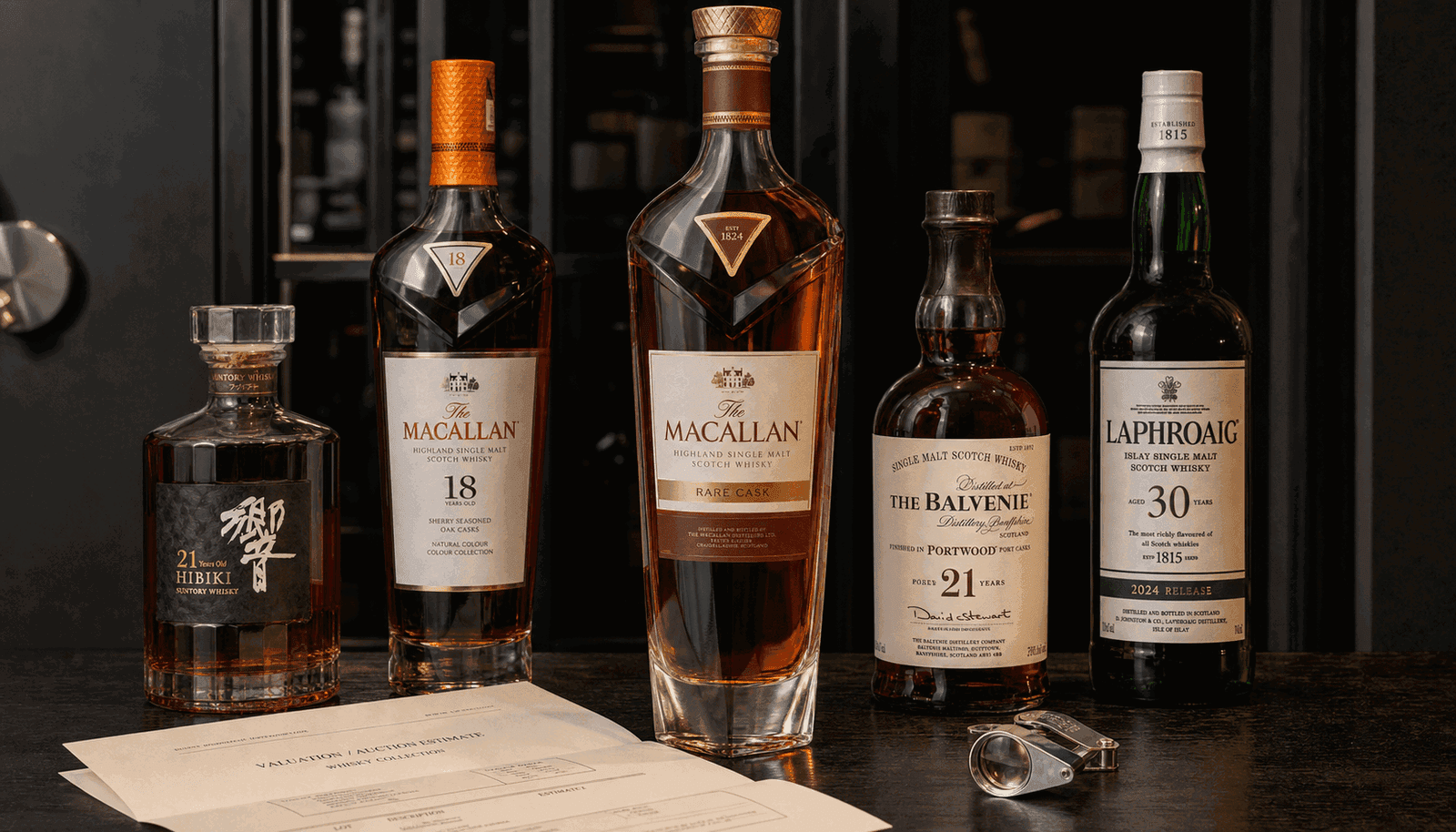
How to Value Your Whisky Collection in 2026
Most collectors have a rough idea what their collection is worth — an impression built from the prices they paid, occasional glances at auction listings, and a general sense of whether the market has moved up or down. That rough idea is almost always wrong in one direction or another. Getting an accurate valuation requires a specific methodology: sold prices, not asking prices; condition-adjusted values, not label prices; and a realistic assessment of what the secondary market would actually pay today, not what it paid two years ago.
Key Takeaways
The only reliable data point for valuation is recent sold prices — what buyers actually paid for the same bottle, in comparable condition, in the last six to twelve months.
Asking prices on secondary markets are consistently higher than final transaction prices. Using asking prices to value a collection will overstate its value.
Condition — fill level, label quality, capsule integrity, presence of original packaging — affects value significantly, sometimes by 20–40% for collector-grade expressions.
Platform matters. The same bottle may achieve different prices on Whisky Auctioneer versus Scotch Whisky Auctions versus a fixed-price marketplace. A proper valuation checks multiple platforms.
For collections above €10,000 in estimated value, a specialist written valuation from an auction house or a professional whisky appraiser is worth obtaining for insurance and estate planning purposes.
Why Asking Prices Are Misleading
The most common valuation mistake is using asking prices as the benchmark. On secondary markets and marketplaces, sellers list bottles at the price they want to receive — which is always higher than the price they will actually accept. For common bottles, the gap between asking and transaction price may be 10–20%. For less liquid expressions that have been sitting on a marketplace for months without selling, the gap can be much wider.
The asking price tells you what someone hopes to get. The sold price tells you what a buyer actually paid. These are different numbers, and only one of them is relevant for an accurate valuation. Any serious estimate of collection value must be built on sold transaction data, not on the current lowest ask at any given platform.
How to Find Accurate Sold Data
Specialist Auction Platforms
The major specialist whisky auction platforms — Whisky Auctioneer, Scotch Whisky Auctions, Whisky Hammer — publish sold prices for completed lots. Most platforms show recent results in the bottle's listing history. This is your most reliable source of market data for bottles that trade regularly at auction. Search for your specific expression, filter by sold results in the last twelve months, and note the range across multiple sales. A single data point is unreliable — look for three to five recent sold prices to establish a credible range.
Marketplace Transaction Data
Peer-to-peer marketplaces like Spiritory show completed transaction prices alongside active listings. Transaction data from a dedicated collector platform is especially useful for expressions that trade more on fixed-price platforms than in auction format — mid-range collector bottles where the buyer is less interested in the competitive bidding dynamic and more focused on availability at a fair price.
Cross-Platform Comparison
A complete valuation cross-references at least two auction platforms and one fixed-price marketplace. Prices vary by platform because the buyer bases differ — Whisky Auctioneer draws a more international audience and may achieve higher prices for rare bottles with global collector appeal, while Scotch Whisky Auctions may be stronger for mid-range Scottish expressions with a primarily UK buyer base. The range across platforms gives you a realistic picture of what the market will pay in 2026.
Condition and Its Effect on Value
Condition adjustments can be significant. A bottle with its original outer box, intact capsule, clean labels, and a fill level at or close to the neck is worth more than the same expression with a damaged label, missing box, or reduced fill — sometimes by 20–40% for collector-grade expressions where presentation quality is part of the value proposition.
How to Assess Your Bottles
Work through each bottle systematically. Check the fill level first — hold the bottle upright against a plain background and note whether the fill reaches the neck, falls partway into the shoulder, or is lower. A fill level at the very base of the neck or lower on a bottle less than thirty years old is a significant condition issue. For older bottles, some fill reduction is expected and accepted by the market.
Check labels for toning, staining, tears, or missing text. Check the capsule or wax seal for integrity. Note whether the original box, tube, or tin is present. If you have provenance documentation — purchase receipts, certificates of authenticity — note those too. Then compare your condition assessment to the sold prices you have found: auction results typically describe condition, and you can use those descriptions to calibrate where your specific bottle sits relative to the comps.
Tip: Take a consistent set of photographs of each bottle — front label, back label, fill level, capsule, and original packaging — before starting the valuation process. These photos are useful for insurance documentation and will be needed if you decide to list the bottle for sale.
Getting a Professional Valuation
For collections with an estimated value above €10,000, a written professional valuation is worth commissioning. The major specialist auction houses — Whisky Auctioneer, Scotch Whisky Auctions — offer valuation services. Independent whisky appraisers also operate in the market. A professional valuation is typically required by insurers for specific coverage of collector bottles, and is essential for estate planning purposes.
A professional valuation will provide a written report with individual bottle assessments, condition notes, current market value estimates, and comparable transaction data supporting each valuation. The cost varies by collection size and the extent of the report, but for a collection of genuine collector value, the cost of an accurate valuation is well justified relative to the risk of being under-insured or mis-pricing a sale.
For guidance on what to do once you have a valuation and are considering selling, see How to Sell Whisky at Auction in 2026 and Where Can I Sell Whisky Online Safely?
FAQ
How often should I update my collection valuation?
Once a year is a reasonable cadence for most collectors. The whisky market can shift meaningfully in twelve months — new releases from key distilleries, changes in collector interest driven by international press coverage, or broader market conditions can all move prices in either direction. If a specific bottle in your collection receives significant press coverage or wins a major award, check the current sold prices immediately rather than waiting for the next annual review.
Does a bottle's original retail price affect its secondary market value?
No. The secondary market prices bottles on current supply and demand, not on what they originally cost. A bottle bought at €60 retail five years ago may be worth €40 today if demand has not developed, or €180 if the distillery has become more sought-after. The original purchase price is irrelevant to the current market value. The only relevant data point is what a buyer paid for the same bottle recently.
What happens if I cannot find sold data for a bottle I own?
If a bottle does not appear in auction results or marketplace transaction history, it is either very rarely traded or commands insufficient collector interest to generate secondary market activity. Both are important signals. A bottle with no secondary market trade history is difficult to value precisely and may be difficult to sell at your estimated price. In this case, contact a specialist auction house directly for an informal estimate — their specialists deal with this category regularly and can give a realistic guide price based on comparable expressions.
About the author

Max Rink
I’m a whisky enthusiast and aspiring writer, exploring new flavours and the stories behind every bottle.
To the author