

Reach thousands of whisky and spirits lovers every day.


Does Bavaria Make Whisky? 5 Bavarian Whiskies to Try This Oktoberfest
 by Christopher Deutsch I drink and collect with intention, drawn to the sherried depth of Dalmore and the balance of Yamazaki.
Follow Spiritory on Google News to get our latest guides and releases delivered straight to your feed.
Does Bavaria Make Whisky? 5 Bavarian Whiskies to Try This Oktoberfest
Yes, Bavaria makes whisky, and has done since 1983, when Fleischmann's Blaue Maus distillery in Franconia produced Germany's first single malt. Three Bavarian distilleries, SLYRS, St. Kilian and Lantenhammer, list bottles on Spiritory, and five of them are set out below alongside what makes Bavaria's whisky different from Scotch.
Key Takeaways
Bavaria has made whisky since 1983, when Fleischmann's Blaue Maus distillery in Eggolsheim, Franconia, produced Germany's first single malt whisky, and the distillery still calls itself the country's oldest.
Upper Bavaria's whisky story began in 1999, when Florian Stetter distilled the first single malt in the copper stills of the Lantenhammer family distillery in Schliersee, eight years before he opened his own SLYRS distillery nearby in Neuhaus am Schliersee.
SLYRS matures some of its whisky at altitude, with casks kept near the summit of the Stümpfling mountain and in the Wendelstein cave, and its Bavarian Peat expression is made with mountain spring water from the Alps.
St. Kilian Distillers, founded in 2012 in Rüdenau, Lower Franconia, describes itself as Germany's largest whisky distillery, running two 6,000 litre copper stills imported from Scotland.
Bavaria's brewing heritage shows up directly in some bottlings: SLYRS finishes its Oktoberfest Edition for several months in casks from Bavarian craft breweries, and Lantenhammer has done the same with Paulaner's Wiesn beer for its SILD range.
For a wider comparison with Scotch, see What Is Bavarian Whisky and How Does It Compare to Scotch?
Tip: Oktoberfest tents pour beer, not whisky, so plan a Bavarian whisky tasting for before or after a visit to the Wiesn rather than during it, and pace a flight of two or three drams rather than all five in one sitting.
SLYRS Classic Set the Standard for Bavarian Whisky
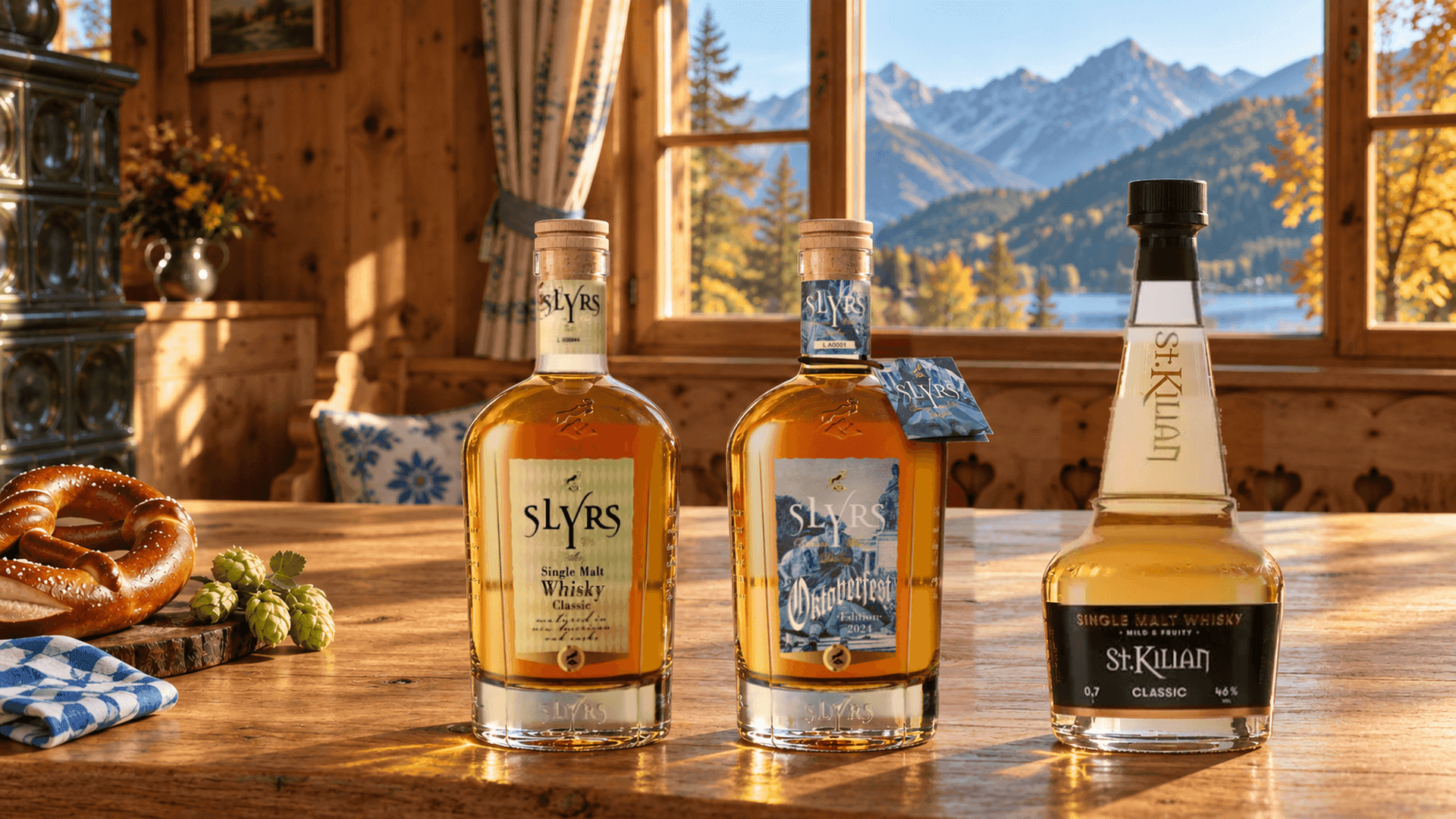
SLYRS traces back to a bet that trained brewer and master distiller Florian Stetter made with fellow distillers on a 1994 study trip to Scotland, and by 1999 he was distilling whisky in the copper stills of his family's Lantenhammer distillery by Lake Schliersee. In 2007 he built a dedicated distillery in nearby Neuhaus am Schliersee, and SLYRS Single Malt Whisky Classic is the bottle SLYRS itself says set the standard for German whisky. It is bottled at 43% ABV and matured in new American white oak casks, with SLYRS crediting regional raw materials and a long maturation for its marzipan, walnut and apricot character. The first 1,600 bottles went on sale in 2002 and sold out within days, and SLYRS did not build its own distillery until 2007, so those early years of whisky making happened inside a working fruit brandy distillery rather than a purpose built whisky house.
SLYRS Oktoberfest Edition Finishes in Bavarian Beer Casks
Each year SLYRS releases a limited Oktoberfest Edition that matures first in American white oak, then finishes for several months in casks that previously held strong, characterful beers from Bavarian craft breweries. The SLYRS Single Malt Whisky Oktoberfest Edition is bottled at 45% ABV, and the beer cask finish is a direct link between Bavaria's brewing culture and its whisky rather than a marketing flourish, since the same idea shows up at Lantenhammer, which has finished a SILD whisky in casks from Paulaner's Wiesn beer. SLYRS matures the base whisky for several years in American oak before the beer cask finish, so the beer influence sits on top of a whisky that is already fully formed rather than replacing its usual character.
St. Kilian Classic Mild and Fruity Comes From Germany's Largest Whisky Distillery
Andreas Thümmler founded St. Kilian Distillers in 2012 in Rüdenau, a village in Lower Franconia, and production began in 2016 under master distillers David F. Hynes and Mario Rudolf on two 6,000 litre Forsyth copper stills imported from Scotland. St. Kilian describes itself as Germany's largest whisky distillery. St. Kilian Classic Mild and Fruity, the unpeated half of its permanent core range, is bottled at 46% ABV from whisky matured 70 percent in ex bourbon casks and 30 percent in Pedro Ximénez and Oloroso sherry casks, giving it apricot, peach and creamy vanilla notes. St. Kilian's own history page ties its name and Rüdenau location to a legend about Irish monks and a local spring, the Ottilienbrunnen, and today the distillery calls Rüdenau home to just 760 residents, a small setting for what it describes as the country's biggest whisky operation.
St. Kilian Peated Rich and Smoky Proves Bavaria Can Do Smoke
St. Kilian Peated Rich and Smoky uses heavily peated barley malt from the Scottish Highlands with a phenol level of 80 ppm, matured in the same split as the Classic, 70 percent ex bourbon casks and 30 percent Pedro Ximénez and Oloroso sherry casks. The peat itself travels from Scotland, but the distilling, maturing and bottling happen in Rüdenau, and the result is grilled apricot and toffee alongside the peat smoke, bottled at 46% ABV. St. Kilian describes the finish as warming, with dark toffee and ashy smoke underpinned by dry oak spice, a reminder that not every ingredient in a Bavarian whisky needs to be Bavarian for the result to feel distinctly regional.
SILD Heritage 28 Honours Where Bavarian Whisky Began
Lantenhammer was founded as a fruit brandy distillery in Hausham in 1928 and moved to nearby Schliersee in 1935. It was in that Schliersee distillery's copper stills that Florian Stetter made his first Bavarian single malt in 1999, years before SLYRS had a distillery of its own, and Lantenhammer returned to Hausham in 2014. SILD Heritage 28 Bavarian Pure Malt Whisky is Lantenhammer's own tribute to that start, matured in handcrafted white oak casks under master distiller Tobias Maier and bottled at 42% ABV. Lantenhammer itself was founded in 1928 by Amalie and Josef Lantenhammer as a small distillery for fruit brandies, and whisky remains only one part of a range that still includes those original fruit spirits, gin, rum and liqueurs. For more on the distillery that made SLYRS a household name in Bavaria, see What Is SLYRS Whisky and Why Is It So Popular in Bavaria?
Tip: If you can only try one Bavarian whisky style this Oktoberfest, start with a cask finished expression such as the Oktoberfest Edition or SILD Heritage 28, since cask time does as much to shape the flavour as the base spirit does.
FAQ
Does Bavaria make whisky?
Yes. Fleischmann's Blaue Maus distillery in Eggolsheim, Franconia, produced Germany's first single malt whisky in 1983, and Upper Bavaria's whisky story began in 1999 when Florian Stetter distilled the first single malt at what is now the Lantenhammer distillery before founding SLYRS in 2007.
What makes Bavarian whisky different from Scotch?
The method is largely the same, malted barley, copper stills and oak maturation, but the setting differs. SLYRS matures casks at altitude near the Stümpfling mountain and in the Wendelstein cave, and more than one Bavarian producer finishes whisky in casks that previously held Bavarian beer, a direct link to the region's brewing heritage.
Is peated whisky made in Bavaria?
Yes. St. Kilian Peated Rich and Smoky is distilled and matured in Rüdenau from heavily peated barley malt imported from the Scottish Highlands, bottled at 46% ABV alongside the distillery's unpeated Classic Mild and Fruity.
Which is the oldest Bavarian whisky distillery?
Fleischmann's Blaue Maus distillery in Eggolsheim, Franconia, has distilled single malt whisky since 1983 and calls itself Germany's oldest single malt whisky distillery. Bavaria's Alpine whisky tradition, associated today with SLYRS and Lantenhammer, began later, in 1999.
Where can I buy these bottles?
All five are listed on Spiritory, a bid and ask marketplace for whisky and spirits based in Munich that ships within the EU. Availability depends on what collectors are selling at the time, and buyers pay a 3% buyer protection fee plus shipping.
- Key Takeaways
- SLYRS Classic Set the Standard for Bavarian Whisky
- SLYRS Oktoberfest Edition Finishes in Bavarian Beer Casks
- St. Kilian Classic Mild and Fruity Comes From Germany's Largest Whisky Distillery
- St. Kilian Peated Rich and Smoky Proves Bavaria Can Do Smoke
- SILD Heritage 28 Honours Where Bavarian Whisky Began
- FAQ
About the author

Christopher Deutsch
I drink and collect with intention, drawn to the sherried depth of Dalmore and the balance of Yamazaki.
To the author