

Reach thousands of whisky and spirits lovers every day.


Which Macallan Bottle Is Worth Buying Right Now?
 by Christopher Deutsch I drink and collect with intention, drawn to the sherried depth of Dalmore and the balance of Yamazaki.
Follow Spiritory on Google News to get our latest guides and releases delivered straight to your feed.
Which Macallan Bottle Is Worth Buying Right Now?
Key Takeaways
Macallan's core range (12, 15, 18-year-old expressions) offers solid quality and accessibility. These are genuine Macallan products at market prices that have corrected from speculative peaks. Good entry points for collectors unfamiliar with the brand.
Limited annual releases (Rare Cask, Estate Reserve, rare wood editions) command premiums above core range but are allocated scarce. Secondary-market premiums develop quickly for well-regarded releases.
Older secondary-market bottlings (1970s–1990s from independent bottlers or distillery releases) offer character depth unavailable in modern core expressions. Value depends on bottling credibility and market context.
Macallan's pricing reflects brand prestige, sherry-cask sourcing cost, and collector demand. Not all Macallan at any given price point delivers proportional value relative to other distilleries' offerings.
Market volatility has corrected speculative Macallan pricing from 2020–2023 peaks. This is a buyer's market for genuine collectors, though prices remain high relative to pre-2010 norms.
Strategic Macallan collecting involves understanding cask type, age statement, bottler reputation (for secondary-market bottles), and your own palate preference before committing significant capital.
Macallan's Core Range: Entry Points and Value
The 12-Year-Old Sherry Oak
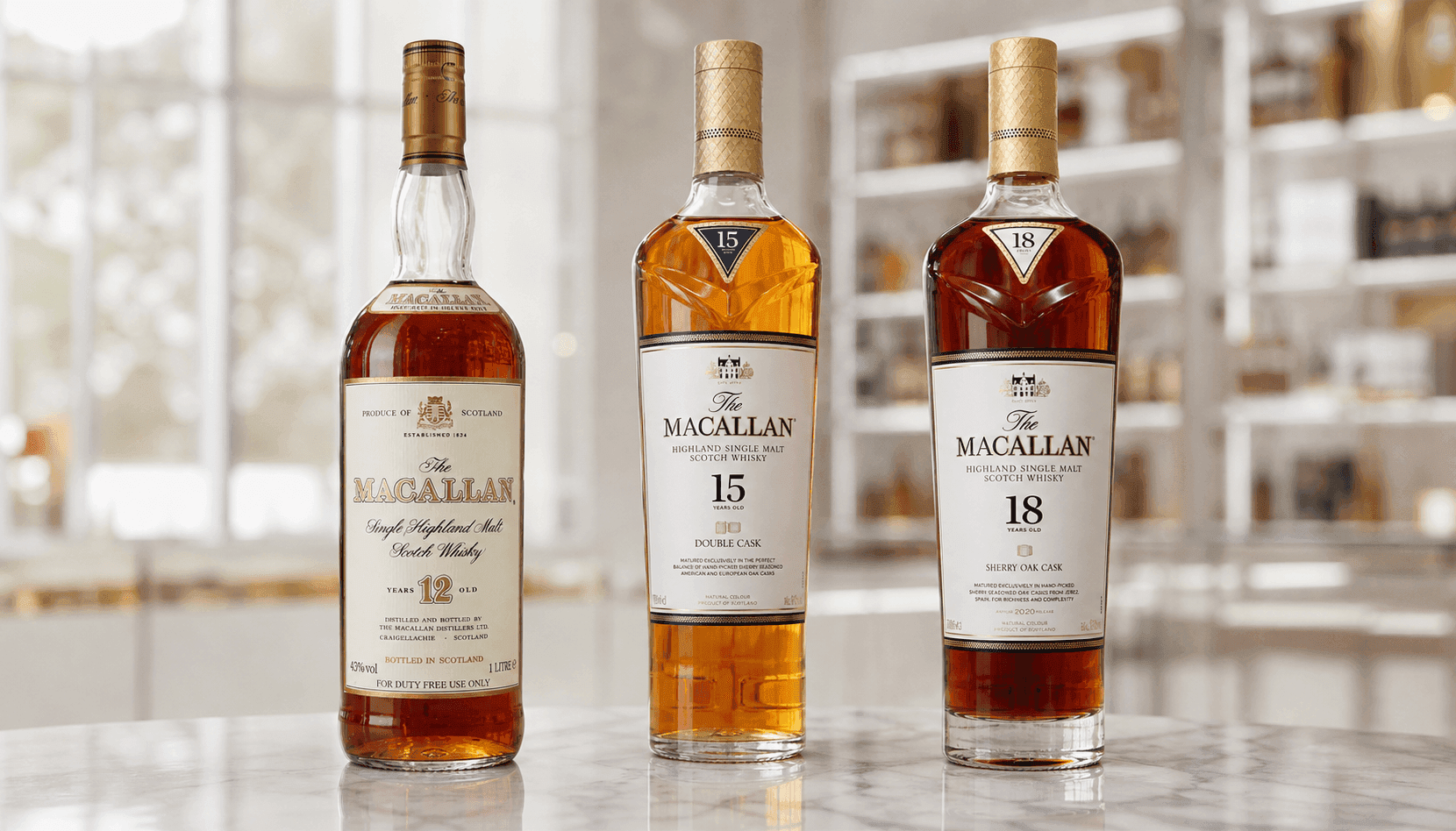
Macallan 12-Year-Old Sherry Oak is the brand's entry-level expression and widely available at competitive market pricing. It's a genuine Macallan, sherry-cask matured, polished, recognisable. If you've never tasted Macallan and want to understand what collectors pursue, this is a logical starting point.
Value assessment: the 12 is solid, well-made, and worth the price if you enjoy sherry-matured whisky. However, it's not dramatically better than similarly-priced 12-year-olds from Highland Park or Balvenie. You're paying partly for Macallan prestige, partly for genuine quality. This is acceptable if you value brand recognition; it's a less efficient use of capital if you're optimising for flavour-per-pound.
The 15-Year-Old Double Cask
The 15-Year-Old Double Cask (ex-bourbon and sherry) offers a bridge between core and premium. It's positioned at mid-range market pricing. It's aged longer than the 12, adding complexity, but it's not the prestige statement that a 25+ year-old carries.
Strategic value: the 15 is a good second Macallan if you've enjoyed the 12. It offers measurable quality increase for reasonable cost increase. Secondary-market appreciation has been steady over recent years, making it a hold-it-and-appreciate bottle rather than a speculative flip.
The 18-Year-Old Sherry Oak
The 18-Year-Old Sherry Oak crosses into prestige territory at premium market pricing. It's significantly older, richer, and more complex than the 12 or 15. For collectors genuinely passionate about Macallan's sherry-cask profile, the 18 is a logical aspirational purchase.
Value consideration: you're paying a significant premium over the entry expression for 6 additional years of maturation and cask-driven complexity. That premium is justified if you taste the difference and genuinely prefer the older expression. If you're buying the 18 solely because it costs more and carries more prestige, you may be overpaying relative to equally complex whiskies from other distilleries at lower price points.
Tip: Before committing to an 18-year-old at premium pricing, taste it side-by-side with other 18-year-old or older sherry-matured whiskies (Highland Park 25, Balvenie DoubleWood 17). Your palate preference may favour another distillery, potentially giving you better value.
Limited Editions and Annual Releases
Rare Cask and Estate Reserve
Macallan releases limited annual editions like Rare Cask and Estate Reserve at premium retail pricing depending on edition and availability. These expressions are bottled in limited quantities, sometimes 5,000–15,000 bottles globally, creating allocation scarcity. Secondary-market premiums develop quickly for well-regarded releases as initial scarcity becomes apparent and collector demand peaks.
Strategic consideration: limited editions offer appreciation potential if the release is well-received and genuinely limited. However, they carry higher risk than core-range expressions. A limited edition that critics praise will appreciate; one that underperforms (less complex than expected, controversial flavour profile) may flatline or depreciate. Secondary-market premiums are driven by collector sentiment, not by production guarantees.
Sherry Oak vs. Double Cask Limited Editions
Macallan releases both sherry-oak and double-cask limited editions. Sherry-oak editions typically command higher secondary-market premiums because sherry maturation is more expensive and perceived as more distinctive. If you're betting on limited-edition appreciation, sherry-oak is a safer choice than double-cask, all else equal.
Annual Release Patterns and Timing
Macallan releases new limited editions quarterly or semi-annually. Enthusiasts and traders closely track these releases and predict which will appreciate. Newer releases often experience secondary-market premiums 3–6 months after launch as allocation scarcity becomes apparent and initial owners begin trading. If you're interested in flipping limited editions for short-term appreciation, research the specific release's critical reception and scarcity before committing. If you're holding for long-term value, buy releases you genuinely enjoy and hold them 5+ years.
Secondary-Market Macallan: Vintage Bottles and Value
1970s–1990s Macallan: Appreciation and Risk
Macallan bottles from the 1970s and 1980s, particularly sherry-cask expressions from independent bottlers or distillery releases, have appreciated significantly. Vintage Macallan from this era, sourced from reputable independent bottlers (Cadenhead's, Gordon & MacPhail, Signatory), commands premium secondary-market prices depending on age, cask details, and provenance.
Value assessment: these bottles have genuine appreciation track records. They're rare, they're sought by collectors, and they represent a period when Macallan was less marketed globally and secondary-market prices were lower. However, valuation risk is real. You're relying on:
Bottle authenticity (fakes exist, particularly for prestige bottlings)
Provenance (where has the bottle been stored, has it been opened or topped, what's the condition of label and level)
Bottler reputation (an independent bottler's credibility affects resale potential)
Current market sentiment (secondary-market prices for older Macallan can fluctuate with investor interest)
Evaluating Provenance and Condition
When buying secondary-market vintage Macallan, request detailed information: bottler, cask number, distillation and bottling dates, ABV, proof of authenticity (auction house certification or retailer guarantee). Examine photos for label condition, fill level (lower fill levels suggest longer storage, which can affect flavour), and cork condition. Reputable auction houses and retailers provide extensive provenance documentation; take that seriously. Unmarked, undocumented bottles carry higher fraud risk.
Pricing Rationale for Older Bottles
Vintage Macallan from the 1980s commands significantly higher prices than modern 18-year-old bottlings. The older bottle is significantly older, independently bottled, and extremely scarce. The modern 18-year-old is officially bottled and produced in larger quantities. The price difference reflects rarity and time in the market, not necessarily superior quality. Taste them if possible before committing to the older bottle based on price alone.
Strategic Macallan Collecting: Building a Portfolio
Entry Strategy: Core Range First
Start with a core-range expression (12 or 15-year-old) to understand Macallan's flavour profile and assess your own palate fit. This entry investment teaches you whether you genuinely enjoy the distillery's sherry-cask character. If you do, you can confidently invest in more expensive bottles. If you don't, you've limited capital exposure and learned a valuable lesson.
Layering In Limited Editions
Once you've confirmed your interest in Macallan, selectively add limited editions to your collection. Buy editions that genuinely appeal to you, not every release. A well-curated collection of 3–4 limited editions held 5+ years will likely appreciate. Chasing every release spreads capital thin and increases your exposure to underperforming editions.
Older Bottles as Capstone Holdings
Secondary-market vintage Macallan is expensive and carries authentication risk. Consider these bottles as capstone holdings for advanced collectors with established palate knowledge and portfolio depth. A 1980 Macallan is a meaningful acquisition once you've built a core collection and understand your Macallan preferences deeply.
Diversification and Context
Even if you're passionate about Macallan, diversify your collection across regions and distilleries. Macallan shouldn't exceed 30–40% of your overall whisky holdings, to avoid concentration risk and to build breadth of knowledge. This also prevents you from overpaying for Macallan relative to equally quality whiskies from other distilleries.
FAQ
Is Macallan overpriced?
Relative to production cost, yes, Macallan charges a significant premium for brand prestige and collector demand. Relative to other prestige distilleries (Highland Park, Balvenie), Macallan pricing is in line with market norms. Core Macallan expressions (12, 15, 18) are fairly priced for quality and age; limited editions command premiums that may or may not be justified by flavour improvement. Your question depends on your perspective: if you value collector recognition and secondary-market liquidity, Macallan is worth the premium. If you're optimising for flavour-per-pound, you may find better value elsewhere.
Should I buy Macallan as a pure investment or as a drink?
Both approaches are valid. If you're buying to hold and potentially sell later, focus on limited editions and older secondary-market bottles with proven appreciation. If you're buying to drink and enjoy, focus on core-range expressions at fair current prices. Ideally, buy bottles you'd genuinely enjoy consuming, with appreciation as a secondary benefit. This removes the pressure of pure investment timing and lets you enjoy the whisky regardless of market conditions.
What's the minimum budget to collect Macallan meaningfully?
Core-range bottles start at entry-level pricing. A meaningful collection of 3–4 core and limited editions requires a moderate budget. Older secondary-market bottles command premium pricing. You can collect Macallan at any budget level, but meaningful diversification within the brand requires a consistent collecting commitment.
How do I avoid counterfeit Macallan?
Buy from reputable retailers or auction houses with authentication guarantees. Avoid unmarked bottles or those with unclear provenance. Request detailed photos including labels, cork, and fill level. For premium-priced bottles, prioritise certified sales from auction houses over private sales. Ask the seller for documentation of their purchase and proof of authenticity. If a deal seems too good to be true, it likely is.
When is now a good time to buy Macallan?
Secondary-market prices have corrected from 2020–2023 speculative peaks. For core expressions, current pricing is reasonable relative to quality. For limited editions, timing depends on release-to-release sentiment. For older secondary-market bottles, prices fluctuate with investor interest. If you've decided you want Macallan in your collection, now is a reasonable time, prices are more sustainable than speculative peaks, but not rock-bottom. Collect with a long time horizon and don't expect rapid returns.
About the author

Christopher Deutsch
I drink and collect with intention, drawn to the sherried depth of Dalmore and the balance of Yamazaki.
To the author