

Reach thousands of whisky and spirits lovers every day.


How Is Scotch Whisky Different from German Whisky?
 by Christopher Deutsch I drink and collect with intention, drawn to the sherried depth of Dalmore and the balance of Yamazaki.
Follow Spiritory on Google News to get our latest guides and releases delivered straight to your feed.
How Is Scotch Whisky Different from German Whisky?
Key Takeaways
Scotch whisky is produced in Scotland under the Scotch Whisky Regulations 2009, one of the most detailed spirit regulations in the world. German whisky is produced under the German Whisky-Verordnung, a distinct framework with different rules on grain, equipment, and production method.
Both categories require a minimum of three years maturation in oak casks; Scotch mandates casks of no more than 700 litres in Scotland, while the German rules are somewhat less prescriptive on cask origin.
German distilleries including SLYRS, Blaue Maus, Spreewood, Lantenhammer, and Huppmann produce distinctive expressions shaped by local grains, Alpine climate, and fruit spirit tradition.
Scotch benefits from centuries of unbroken tradition and a global secondary market of extraordinary depth; German whisky is a modern category of growing quality with its own collector appeal.
Flavour profiles differ significantly: Scotch ranges from delicate and floral to intensely peated; German whisky is typically non-peated, often fruit-forward, and shaped by the high temperature variation of Alpine maturation.
Legal Definitions and Production Rules
The most fundamental difference between Scotch and German whisky is the regulatory framework that governs each. These rules determine not only where and how the whisky is produced, but also what producers can and cannot add, which grain types are permitted, and how the finished product may be described.
The Scotch Whisky Regulations 2009
Scotch whisky is defined by the Scotch Whisky Regulations 2009, which represent one of the most comprehensive spirit regulations in existence. Key requirements include: production exclusively in Scotland from water and malted barley (for single malt) or other malted cereals (for grain and blended categories); fermentation using only yeast; distillation to no more than 94.8% ABV; maturation for a minimum of three years in oak casks not exceeding 700 litres, held in excise warehouses in Scotland; bottling at no less than 40% ABV; and no addition of any substance other than water and plain caramel colouring (E150a). The regulations also define five protected categories: Single Malt, Single Grain, Blended Scotch, Blended Malt, and Blended Grain, each with its own production and labelling rules.
The German Whisky-Verordnung
German whisky is produced under the Whisky-Verordnung, which aligns with Scotch in requiring a minimum three-year maturation in oak casks. The German framework is somewhat less prescriptive in other areas: there is more flexibility in the choice of grain varieties, yeast strains, and cask origin than Scotch rules permit. This has allowed German distillers to experiment more freely using locally grown heritage cereal varieties, sourcing casks from wine producers or fruit spirit operations, and developing production styles that reflect their regional context rather than conforming to a predefined category template.
Geographic Indication
Scotch whisky carries a Protected Geographical Indication (PGI) backed by UK law and recognised internationally. The word "Scotch" is legally reserved for whisky produced and matured in Scotland. German whisky produced in Germany is a wholly distinct category with its own identity: it cannot use the Scotch designation, nor does it seek to. The two categories exist in parallel, each defined by its own geography and tradition.
Tip: When comparing the two categories, resist the hierarchy instinct. German whisky is not an approximation of Scotch; it is a distinct product shaped by different conditions. The more useful comparison is between what each specific bottle does well, not which category ranks higher in prestige.
Key German Distilleries and Their Characters
Germany's whisky sector is concentrated in Bavaria but includes producers across multiple regions. The distilleries currently defining the category each bring a distinct identity shaped by local ingredients, regional climate, and the production philosophy of their founders.
SLYRS: Bavaria's Best-Known Whisky Brand
SLYRS is the most internationally recognised name in German whisky. Founded in 1999 at Schliersee in the Bavarian Alps, the distillery produces a classic single malt style using locally grown Bavarian barley, with maturation in new American oak casks as the core expression supplemented by a range of cask finishes including Sauternes, Port, and Marsala. The Alpine climate at Schliersee, with its pronounced seasonal temperature variation, accelerates the interaction between spirit and wood compared to the more temperate conditions of the Scottish Highlands, producing whiskies that are often described as approachable, fruit-forward, and expressive of their oak at a relatively young age. SLYRS expressions are the most accessible entry point into the German whisky collecting category.
Blaue Maus: History and Collectability
Blaue Maus in Franconia holds the distinction of being the world's oldest private single malt distillery in Germany, with a history that pre-dates the modern German whisky scene by a considerable margin. Known for small production volumes, distinctive bottling formats, and a loyal collector following, Blaue Maus has built a secondary market reputation among German enthusiasts who prize the combination of rarity and historical provenance that older releases from this distillery offer. Bottles from the distillery's early years are among the most sought-after in German whisky collecting.
Spreewood: Rye Character from Brandenburg
Spreewood, based in Brandenburg, has built a clear identity around rye-forward production, an unusual position in the German whisky market, where single malt barley-based expressions dominate. The distillery's rye whisky carries the characteristic spice, earthiness, and slightly grainy texture associated with the grain, positioning it closer in flavour profile to certain American or Canadian rye styles than to typical German single malt. For collectors interested in breadth across spirit styles, Spreewood represents a genuinely distinctive German option.
Lantenhammer and Huppmann
Lantenhammer, also based in Schliersee, brings a fruit spirit heritage to its whisky production. The distillery is primarily known as a schnapps producer, and that tradition of precision distillation and aromatic clarity informs its approach to whisky. Huppmann, a Bavarian distillery, rounds out a picture of a domestic sector shaped by regional character, artisanal scale, and production philosophy rooted in the broader German spirits tradition rather than in any imitation of the Scottish model.
Flavour Profiles: Scotch vs German Whisky
The flavour differences between the two categories emerge from a combination of raw materials, distillation method, cask selection, and the climate in which the spirit matures. Each of these factors produces a different result in Germany than in Scotland and the cumulative effect is two meaningfully distinct flavour traditions.
What Makes Scotch Flavour Distinctive
Scotch whisky encompasses an extraordinary range of flavour from the delicate floral and stone fruit character of a Lowland single malt to the dense, maritime peat smoke of Islay at its most expressive. The common thread across the best Scotch is the effect of long maturation in a temperate, humid climate: slow, even extraction from wood that produces layers of secondary and tertiary complexity over years and decades. Peat is perhaps the most globally distinctive flavour marker in the Scotch category: used in the malting of barley in Islay and parts of the Highlands, it produces a spectrum of smoky, medicinal, and maritime flavours that are absent from virtually all German whisky production.
What Makes German Whisky Flavour Distinctive
German whisky is defined in large part by what it is not: non-peated, produced from locally grown cereals often with distinctive regional character, and matured in a climate that interacts differently with the cask. Bavarian barley, grown at altitude in mineral-rich soil, carries a flavour character that differs from Scottish malting barley in subtle but detectable ways. The Alpine temperature variation (hotter summers, colder winters) accelerates the annual cycle of wood expansion and contraction, producing more active cask influence per year of maturation. The fruit spirit heritage of many Bavarian distillers manifests in attention to ester expression and aromatic clarity that is characteristic of the domestic tradition.
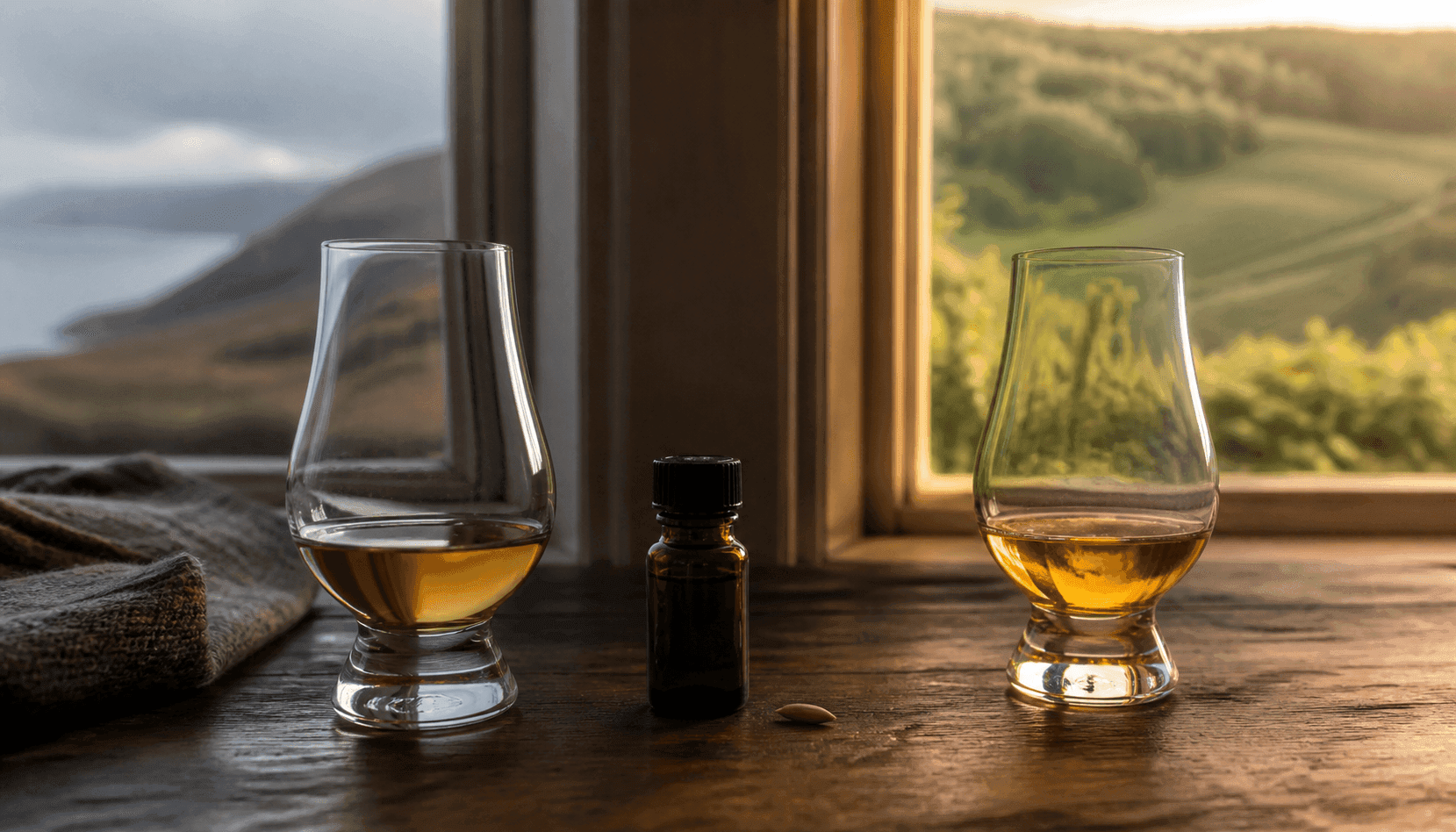
Tip: Tasting Scotch and German whisky side by side is the most instructive way to understand the differences. A classic Speyside expression alongside a SLYRS Bavarian single malt shows the contrast clearly: both are non-peated, both are accessible, but the character of the grain, the cask interaction, and the spirit texture differ in ways that reward attention.
Collectability and the Secondary Market
In the current market, Scotch whisky retains the dominant position in the collector and investment category by a wide margin. The depth of its history, the global scale of demand, the presence of distilleries that have operated continuously for 150 or more years, and the existence of now-closed distilleries whose bottles can never be replenished collectively give Scotch a provenance and market depth that German whisky, as a modern category with a history measured in decades rather than centuries, cannot yet match.
German Whisky as a Collector Category
German whisky collecting is a growing niche with its own internal logic. Blaue Maus releases, in particular, attract collector interest for their rarity and the practical difficulty of locating older expressions in good condition. Limited single cask bottlings from SLYRS and small-scale Bavarian producers have found buyers among collectors interested in documenting the development of the category. The secondary market for German whisky is thin compared to Scotch, which means that genuinely rare early releases command prices that reflect real scarcity. For collectors with a historical perspective on category development, early German expressions offer a distinct and potentially interesting long-term position.
FAQ
Can German whisky be labelled as Scotch?
No. Scotch is a Protected Geographical Indication. Only whisky produced in Scotland in full compliance with the Scotch Whisky Regulations 2009 may be described as Scotch. German whisky produced in Germany is a distinct category and may not use the Scotch designation under any circumstances.
Does German whisky use peat?
Very rarely. Peat is not part of the German whisky tradition, and the overwhelming majority of German expressions are non-peated. A small number of producers have released limited peated experiments, but these are exceptions rather than category-defining features. Collectors seeking peated character should look to Islay and other Scottish production regions.
Is German whisky worth collecting?
The collector case for German whisky rests on genuine rarity, provenance, and the early-mover advantage of engaging with a category while it is still forming its identity. Blaue Maus releases and older SLYRS limited editions have demonstrated real secondary market demand. The category lacks the global depth of Scotch but offers something Scotch cannot: a record of German distilling's emergence, in bottles that may be difficult to find in ten or twenty years.
Where can I buy German whisky online?
German whisky is stocked by specialist retailers and is increasingly available on the secondary market. Spiritory lists German expressions alongside Scottish, Irish, and Japanese bottles, allowing collectors to explore the domestic category within the same authenticated marketplace used for international acquisitions.
Which is better value for money Scotch or German whisky?
The question depends on what the buyer values. For depth of secondary market liquidity, global recognition, and the widest possible range of aged expressions, Scotch offers more at every price point. For distinctiveness, regional character, and the satisfaction of engaging with an early-stage collector category, German whisky can offer genuine interest at more accessible prices. The two categories are complementary rather than competitive for any collector willing to explore both.
About the author

Christopher Deutsch
I drink and collect with intention, drawn to the sherried depth of Dalmore and the balance of Yamazaki.
To the author