

Reach thousands of whisky and spirits lovers every day.


From Beer Halls to Bottle Shops: Munich's Emerging Whisky Scene
 by Max RinkI’m a whisky enthusiast and aspiring writer, exploring new flavours and the stories behind every bottle.
Follow Spiritory on Google News to get our latest guides and releases delivered straight to your feed.
From Beer Halls to Bottle Shops: Munich's Emerging Whisky Scene
Key Takeaways
Munich's whisky scene has grown from a niche collector interest into a visible component of the city's premium drinks culture over the past decade.
Tara Spirits (Altstadt, since 1994) and Sieberts Whiskywelt (Pasing-Obermenzing, since 2018) anchor the specialist retail side of the scene, alongside Spiritory's shop and marketplace.
The demographic driving this growth is largely the same generation that has driven craft beer, specialty coffee, and natural wine appreciation across European cities.
German whisky collectors have a distinctive focus on independent bottlings, Scotch single malts, and Japanese expressions, with growing interest in domestic German producers.
Spiritory, founded in Munich, represents the clearest expression of this scene's commercial maturity: an international premium spirits marketplace that grew from a German collector community.
The Oktoberfest period accelerates this dynamic, bringing an international visitor base to a city that now has genuine whisky infrastructure to receive them.
Munich's whisky scene is likely to continue growing in visibility and depth. The foundations, including collector community, specialist retail and domestic production, are established.
In July 2026, Spiritory opened its first physical shop in Sendling, materialising the shift from online trading to established physical retail and signalling the scene's evolution from niche collecting to integrated urban infrastructure.
The Historical Context: Why Beer Dominated So Completely
The Reinheitsgebot and Bavarian grain identity
Bavaria's 1516 beer purity law, the Reinheitsgebot, established a cultural and legal framework around grain-based fermented drinks that shaped the region's relationship with alcohol for centuries. Beer was not just the preferred drink; it was the institutionally supported drink, produced by breweries with centuries of history, embedded in civic life, and consumed in venues, beer halls and beer gardens, that were as much social infrastructure as drinking establishments. For whisky, an imported luxury associated with Scotland, Ireland, or the United States, to penetrate this culture required not just consumer preference change but a genuine shift in how Munich's affluent, food-and-drink-literate population thought about premium spirits.
The role of international business culture
Munich's status as a hub for international business, home to major global corporations, a significant expatriate professional population, and a thriving financial services sector, created an early audience for premium international spirits that predated the broader German consumer market's engagement with whisky. Business entertaining, international travel, and exposure to UK and North American whisky culture through professional networks brought single malt Scotch and premium bourbon into Munich's corporate hospitality culture years before either became a mainstream consumer category in Germany. This early business-culture adoption seeded the specialist retail sector that later served a wider collector audience.
How the internet changed the German collector market
The development of specialist whisky media, both established publications and the online communities, forums, and reviewing platforms that proliferated through the 2000s and 2010s, gave German collectors access to the same information networks as their UK and Japanese counterparts. Whisky Advocate, Malt Maniacs, Serge Valentin's Whiskyfun, and subsequently the social media ecosystem around single malt appreciation reached Munich's collector community as readily as they reached Edinburgh or Osaka. The information gap that had previously made UK and Japanese buyers more sophisticated than German buyers closed rapidly, and the collector market followed.
The Munich Collector Community Today
Demographic profile and purchasing patterns
Munich's active whisky collector community is largely composed of professionals in their thirties to mid-fifties, with the disposable income to engage with the premium end of the market and the drink knowledge to make informed choices. This demographic overlaps significantly with the natural wine and craft beer communities, and the same intellectual approach, provenance, production method, terroir, the value of authenticity over marketing, applies across all three categories. Within whisky, the Munich collector tends toward single malts over blends, independent bottlings over distillery standard releases, and older or allocated expressions over current wide-distribution stock.
The role of whisky societies and tasting groups
Munich's whisky societies and regular tasting group meetings provide the social infrastructure that sustains collector communities in most major cities. These groups, some affiliated with national organisations, others independently organised, meet regularly to taste through a theme or category, share bottle splits on expensive expressions that would be prohibitive to purchase individually, and exchange information about retail availability and secondary market pricing. The social dimension of these groups is as important as the tasting itself; they create the networks through which specialist retail knowledge, distillery visit reports, and auction intelligence circulate efficiently within the collector community.
Two shops anchor this specialist retail side of the scene: Tara Spirits in the Altstadt, running since 1994 with a broad range across Scotland, Ireland, the US, Germany, and Japan, and Sieberts Whiskywelt in Pasing-Obermenzing, open since 2018 and focused tightly on independent Scottish bottlings. Tasting groups and collector societies routinely reference both shops when discussing where to source specific bottles.
The independent bottler focus
One of the most distinctive characteristics of the Munich collector community relative to UK or American collector communities is its strong orientation toward independent bottlings. German importers have historically maintained excellent relationships with Scottish independent bottlers, making expressions from Gordon and MacPhail, Signatory, and various Scandinavian independents more readily accessible in Munich than in many UK cities outside of specialist London or Edinburgh retail. This market orientation has shaped the community's aesthetic, a preference for cask-strength, unfiltered, single-cask expressions over polished, consistently presented distillery standard releases, that distinguishes the German collector sensibility.
Spiritory: Munich's Contribution to the Global Market
How Spiritory reflects the scene's maturity
The founding of Spiritory as a Munich-based international premium spirits marketplace represents the commercial culmination of the German collector market's development. A platform of this kind, curating and trading premium bottles across European markets with logistics, authentication, and pricing infrastructure, could only emerge from a collector community sophisticated enough to support it. That it emerged from Munich rather than London, Edinburgh, or Tokyo is a signal of how far the German market had developed from its early business-culture whisky adoption to a genuine independent commercial force.
What Spiritory offers the scene
For Munich's collector community, spiritory.com provides access to expressions that the local retail market cannot reliably stock: UK market exclusives, Japanese allocations, auction-sourced rarities, within a European logistics framework that removes the friction of cross-border purchasing. For international collectors discovering Munich through Oktoberfest or other routes, Spiritory provides a credentialled entry point to the European premium spirits market with the kind of authentication and buyer protection that was previously available only through established UK or Japanese auction houses.
Spiritory's Own Shop in Sendling
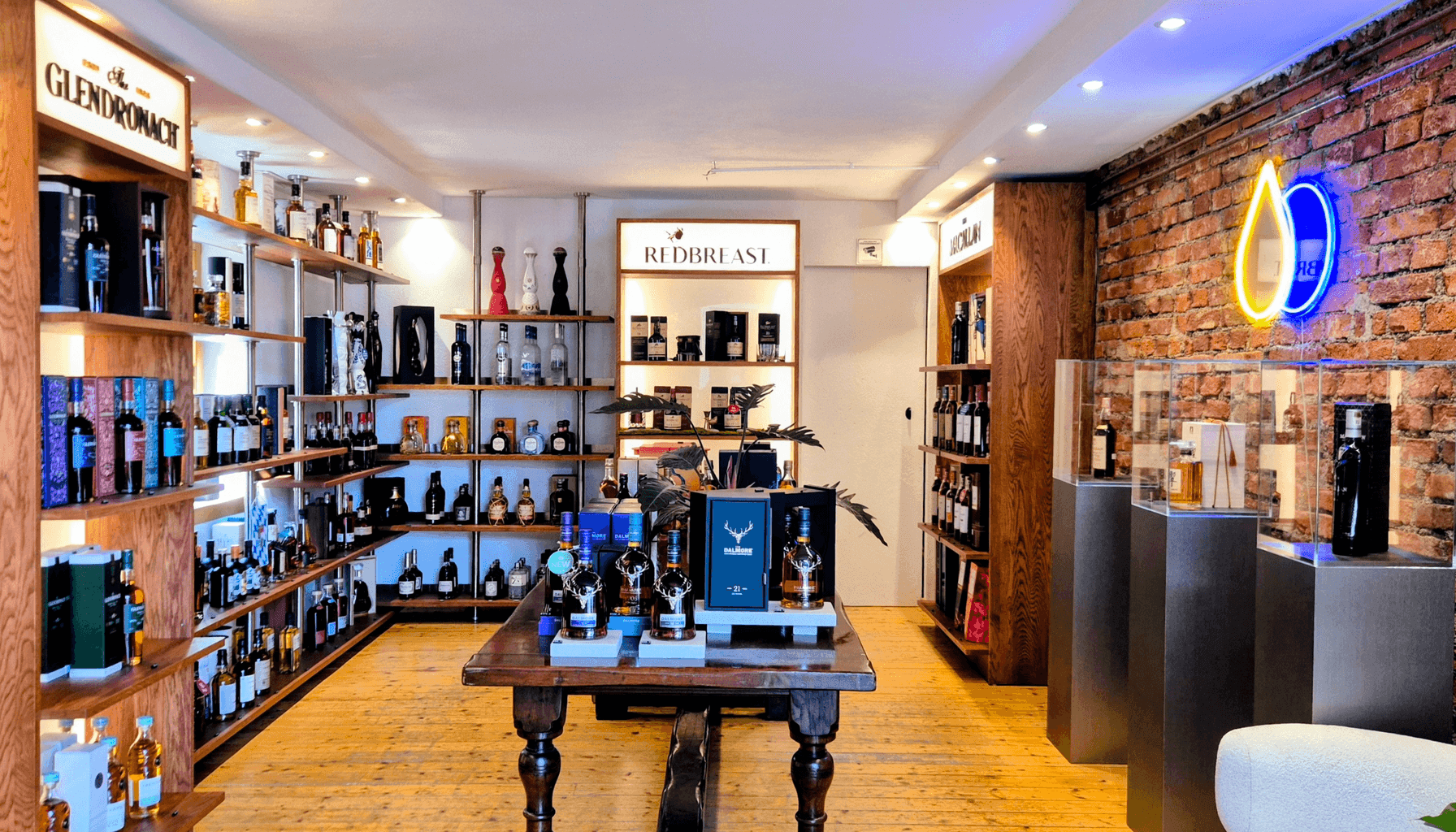
The company's shift from online marketplace to physical retail reflects this maturity. Located at Plinganserstraße 6 in Munich's Sendling district, Spiritory Shop opened in July 2026 as the company's first physical location. The shop stocks approximately 100–150 curated bottles, with featured brands including Ardbeg, The Dalmore, The GlenDronach, Redbreast, The Macallan, and Suntory expressions (Yamazaki, Hakushu, Hibiki). Operating Tuesday to Saturday, 11:00–19:00, the shop welcomes collectors of all levels. For Munich's whisky community, the shop represents clear evidence that the shift from beer halls to bottle shops, the central thesis of this article, is now a structural reality. A collector's forum or society meeting can exist online; a physical shop requires conviction that a local market can sustain premium retail infrastructure.
Tip: Munich's whisky scene is most visible through its specialist retail community rather than its bar scene, which is smaller and less well-developed than comparable cities. Researching specialist retailers and their current stock in advance of a visit will reveal more of the scene's depth than exploring bars would, and the retail community's connections to the collector and tasting group networks provide a more complete picture of what Munich's whisky culture actually looks like from the inside.
German Whisky: The Production Dimension
SLYRS and the Bavarian template
SLYRS at Schliersee established that Bavarian single malt could be produced to a standard that merited international attention, and the distillery's consistent quality over more than two decades has given the scene a production anchor that collector communities in other German cities lack. For Munich's whisky community specifically, SLYRS functions as a local pride expression: something that embodies Bavarian craft and provenance in the same spirit that the city's best breweries embody Bavarian brewing tradition.
The next generation of German producers
The craft spirits movement that accelerated across Germany in the 2010s has produced dozens of smaller whisky producers in regions across the country. Many of these producers are too small or too new to have established a collector-grade reputation, but the quality trajectory across the category is upward, and Munich's specialist retailers are increasingly stocking domestic German expressions alongside their Scotch and Japanese inventory. Within a decade, German domestic whisky is likely to represent a more significant proportion of the Munich collector's purchases than it does today.
FAQ
Is Munich's whisky scene accessible to a visitor who is new to whisky collecting?
Yes. The specialist retail community in Munich is generally welcoming to new collectors and the staff at the best shops are more interested in introducing people to the category than in gatekeeping it. Tara Spirits, with its broad cross-category range, and Spiritory Shop in Sendling are both explicitly welcoming to newcomers, making either a good starting point for visitors arriving without prior knowledge. Sieberts Whiskywelt's narrower focus on independent Scottish bottlings suits visitors who already know roughly what they're looking for.
How does Munich's whisky scene compare to cities like Hamburg or Berlin?
Munich's scene is more developed than most other German cities because of the combination of its affluent consumer base, its international business culture, and the presence of Munich-based businesses like Spiritory that have built infrastructure for the premium spirits market. Hamburg has a strong maritime and international trade background that supports premium spirits appreciation; Berlin's scene is more diverse and bar-culture-oriented. Munich's collector market depth is, however, among the most established in Germany.
Are there regular whisky events or festivals in Munich outside of Oktoberfest?
Munich's whisky societies and specialist retailers organise regular tastings and smaller events throughout the year. Larger whisky festivals in the German-speaking market, notably the Whisky Fair in Limburg and the Munich Whisky Festival, attract collectors from across the country and provide concentrated access to producers, importers, and expressions that are not widely available in standard retail. Tracking the calendars of Munich's specialist retailers is the most reliable way to stay informed about these events.
About the author

Max Rink
I’m a whisky enthusiast and aspiring writer, exploring new flavours and the stories behind every bottle.
To the author