

Reach thousands of whisky and spirits lovers every day.


Is Your Whisky Coloured? E150a and Natural Colour Explained
 by Janis WilczuraI'm one of Germany's leading whisky experts, featured in Handelsblatt and BILD. To me, whisky is craftsmanship and art.
Follow Spiritory on Google News to get our latest guides and releases delivered straight to your feed.
Is Your Whisky Coloured? E150a and Natural Colour Explained
E150a is plain caramel, the only colouring that Scotch and EU whisky rules allow, and it may be used only to adjust the colour of the finished whisky. A bottle with natural colour has had none added, but that is a voluntary claim by the producer, because neither the Scotch Whisky Regulations 2009 nor Regulation (EU) 2019/787 requires natural colour to be declared.
Key Takeaways
E150a is plain caramel, the only colouring that Scotch and EU whisky rules allow, and it may only be used to adjust colour.
The Scotch Whisky Regulations 2009 and Regulation (EU) 2019/787 both limit additions to water and plain caramel.
In Germany the LMZDV requires "mit Farbstoff" on prepackaged drinks above 1.2 percent alcohol, unless the additive is named in an ingredient list.
Producers use it for batch consistency. Whether it changes taste is disputed between producers.
"Natural colour" is a voluntary claim, and silence on the label does not confirm either answer.
Colour says something about the cask but little about age.
Tip: Look for the producer's own wording on colour, such as "natural colour" or "ohne Farbstoff", and check it on the brand's website. A label that says nothing is simply unconfirmed.
What Is E150a and Why Do Producers Use It?
E150a is plain caramel, also called spirit caramel or, in German, Zuckerkulör. It is a brown food colouring made by heating sugar under controlled conditions. In the debate "Spirit caramel: friend or foe?" of 8 February 2016, Adam Hannett of Bruichladdich described it as made by "cooking sugar until it changes its chemical structure". It is a colouring, not a sweetener.
The main reason is consistency. Whisky from different casks and different years varies in colour, and a producer who bottles the same brand many times a year wants each bottle to look like the last one. In that same 2016 debate, Dr Nick Morgan, then of Diageo, defended caramel as a way to correct predictable colour variations, and said: "You can't taste it, you can see it." Critics see it differently, and their view comes below.
What Do the Scotch Whisky Regulations 2009 Allow?
For Scotch, the rule sits in the definition itself. Regulation 3(1)(h) of the Scotch Whisky Regulations 2009, published on legislation.gov.uk (check the site for the current wording), says that no substance may be added to Scotch Whisky except water, plain caramel colouring, or water and plain caramel colouring. Regulation 3(1)(g) adds that the whisky must retain the colour, aroma and taste derived from its raw materials and its maturation.
So caramel is allowed, but nothing else is. No flavouring, no sweetener and no other colour can be added. The regulation permits caramel but does not require a producer to use it. That is why the phrase "natural colour" on a bottle is a choice a distillery makes and not a legal category.
What Does EU Law Say About Colouring Whisky?
Regulation (EU) 2019/787 on spirit drinks, published on EUR-Lex (eur-lex.europa.eu), sets the same limit for whisky sold in the EU. Annex I, category 2 (whisky), says the final distillate may have only water and plain caramel (for colouring) added. Point (d) of that category repeats it in stricter terms: whisky may not be sweetened or flavoured, or contain any additives other than plain caramel (E 150a) used for adjusting the colour.
Article 4 of the regulation defines caramel as the food additives E 150a to E 150d, and the whisky category then names only E 150a. The practical result is that a product sold as whisky in the EU can be adjusted with E 150a and with no other additive. Check EUR-Lex for the current consolidated text.
What Must a Label Say in Germany?
German food additive labelling is set in the Lebensmittelzusatzstoff-Durchführungsverordnung (LMZDV), published on gesetze-im-internet.de, where you should check the current wording. Section 5, paragraph 1, number 1 requires food with added colours to carry the words "mit Farbstoff". Paragraph 5 applies this to prepackaged drinks with more than 1.2 percent alcohol by volume, so it covers whisky.
There is an exception. Under paragraph 3, number 1, the phrase can be left out if the label carries an ingredient list that meets the EU food information rules and names the additive. In that case the colour would appear in the list, for example as Zuckerkulör, the German name for E 150a, or by its E number.
Most whisky labels do not carry such a list, and the EU rules explain why. Under Article 16(4) of Regulation (EU) 1169/2011, the food information regulation published on EUR-Lex, the mandatory ingredient list and nutrition declaration do not apply to beverages with more than 1.2 percent alcohol by volume, without prejudice to other Union provisions that require them. Because a list is not required, a producer who has added caramel to a bottle sold in Germany will normally use "mit Farbstoff". If the label shows neither "mit Farbstoff" nor an ingredient list naming the colour, read the back label closely, and see our guide on how to read a whisky label for the other claims that sit in small print. This section describes the rules as published and is not legal advice.
Does Caramel Change the Taste?
This is disputed, and it helps to keep the voices apart. Supporters say the amounts are too small to matter, and Morgan's line, "You can't taste it, you can see it", is the clearest version. In the same 2016 debate, Hannett replied "we strongly dispute this" on the question of whether caramel can be tasted, and said Bruichladdich would rather celebrate batch differences than mask them with caramel. He also argued that darkening a whisky can make drinkers assume it is older.
Treat the taste argument as an open debate between producers, not as a proven fact in either direction. What is not in dispute is the legal limit: only E150a, and only to adjust colour.
How Do You Spot Natural Colour on a Label?
Look for the producer's own words. Common wordings include "natural colour", "no added colouring", "colouring free" or, on German labels, "ohne Farbstoff". These are voluntary claims, so they sit on the front or back label, or in the product description on the brand's website.
If a label says "mit Farbstoff", or lists Zuckerkulör or E 150a, colour was added.
If a label says nothing about colour, it is not confirmed either way. Silence is not proof of natural colour.
Colour is separate from filtration. A bottle can be non chill filtered and still be coloured, which is why some distilleries state both.
Dark does not mean coloured, and pale does not mean natural. You cannot judge it by eye.
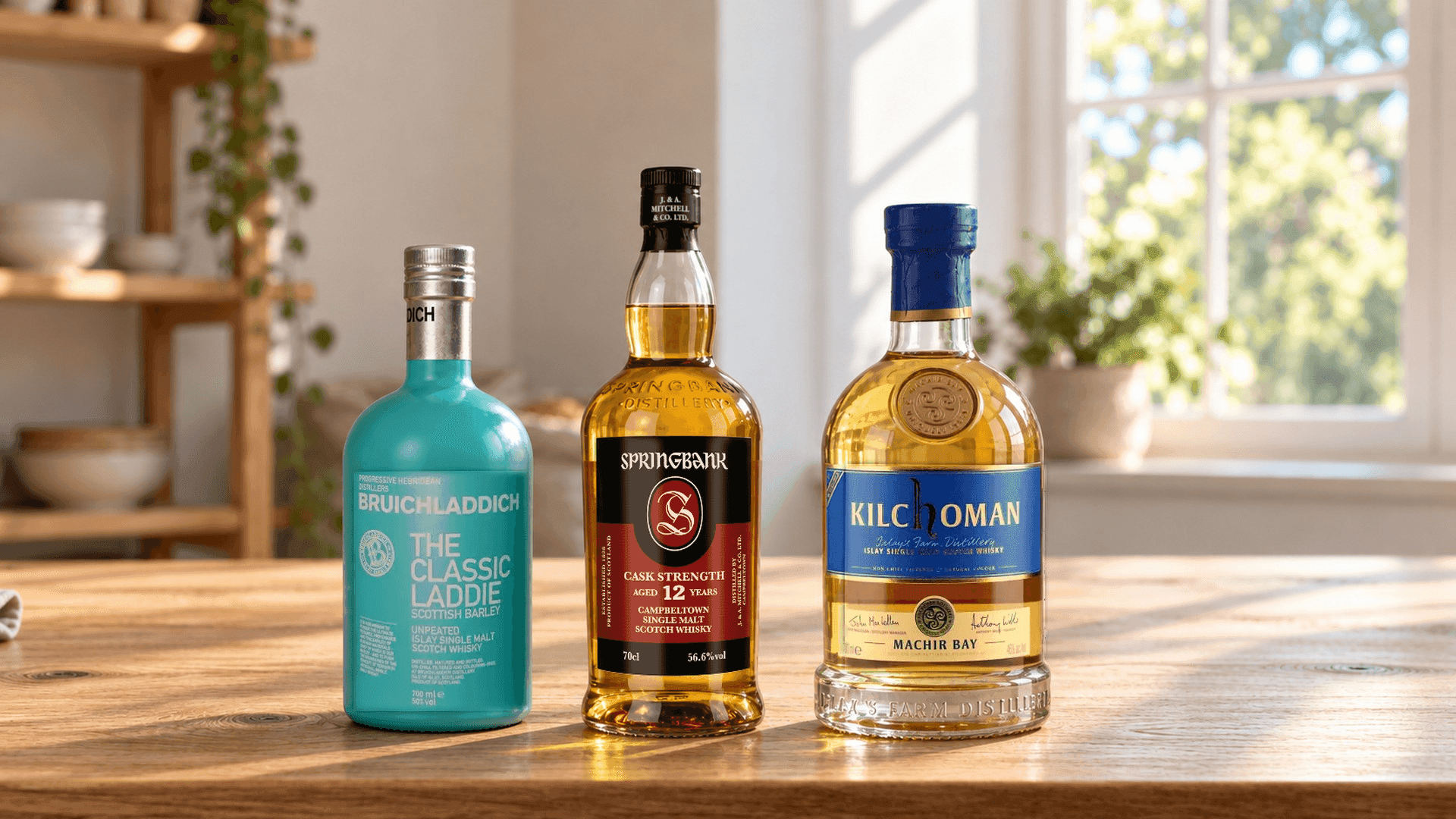
The most reliable check is the distillery's own product page, which is what the three bottles below are based on.
What Can Colour Tell You About Cask and Age?
Less than most people think. Colour does come from the cask, so a deep amber can point to an active sherry cask or a long stay in oak. Kilchoman, for example, wrote in February 2025 that it had introduced more active sherry casks to Machir Bay, "giving the whisky a noticeably darker colour", while the 90 percent bourbon and 10 percent oloroso sherry profile stayed unchanged. Colour moved because the casks were different, not because anything was added.
But colour cannot reliably show age. Cask activity matters as much as time, and caramel can darken a whisky, which is the age concern Hannett raised in 2016. For a fuller picture of how wood shapes a whisky, read How Do Whisky Cask Types Affect Flavour and Value? Use the age statement, the cask type and the producer's claims on the label, and treat the colour as a hint only.
Which Bottles Do the Distilleries Say Have No Added Colour?
Each distillery below makes a statement about colour on its own website. The wording differs, so read each note, and check the label of the bottle you buy.
Bruichladdich The Classic Laddie is described on Bruichladdich's product page as non chill filtered and colouring free, bottled at 50 percent. It suits a reader who wants an unpeated Islay malt with a clear statement on colour.
Kilchoman Machir Bay is a peated Islay malt. A Kilchoman news page from October 2019, announcing its 2010 Vintage release, says that bottling has "no chill filtration or colouring (as with all Kilchoman bottlings)". That is a general statement from the distillery and not a Machir Bay product claim, and the current Machir Bay page does not repeat it, so check the label of the bottle you buy.
Springbank 12 Years Old Cask Strength Batch 29 is a Campbeltown cask strength malt. Springbank's process page says the distillery does not add artificial colouring or chill filter at bottling. That is a statement about its general practice, and it speaks of artificial colouring without naming caramel, so check the label of the batch.
Tip: Do not choose a whisky by its shade. If natural colour matters to you, read the label and the distillery's product page, and ask the seller when a label is unclear.
FAQ
Is E150a legal in whisky?
Yes. Both the Scotch Whisky Regulations 2009 and Regulation (EU) 2019/787 permit plain caramel (E 150a) in whisky for adjusting colour, and nothing else besides water. Check legislation.gov.uk and EUR-Lex for the current wording.
What does "mit Farbstoff" mean on a whisky bottle?
It is the wording the LMZDV requires for food with added colours. On a whisky it normally means plain caramel was used. The phrase can be replaced by an ingredient list that names the additive, for example as Zuckerkulör. Whisky above 1.2 percent alcohol by volume does not need an ingredient list under Article 16(4) of Regulation (EU) 1169/2011, which is why "mit Farbstoff" is the usual wording.
Is natural colour the same as non chill filtered?
No. Natural colour means no colouring was added. Non chill filtered describes filtration. A label may claim one, both or neither.
Does a darker whisky always contain caramel?
No. Dark colour can come from active sherry casks, as Kilchoman wrote about Machir Bay in 2025. You cannot tell added colour from cask colour by eye.
Does caramel colouring change how whisky tastes?
Producers disagree. In a 2016 debate, Nick Morgan, then of Diageo, said you cannot taste it, while Adam Hannett of Bruichladdich disputed this. The question remains open.
- Key Takeaways
- What Is E150a and Why Do Producers Use It?
- What Do the Scotch Whisky Regulations 2009 Allow?
- What Does EU Law Say About Colouring Whisky?
- What Must a Label Say in Germany?
- Does Caramel Change the Taste?
- How Do You Spot Natural Colour on a Label?
- What Can Colour Tell You About Cask and Age?
- Which Bottles Do the Distilleries Say Have No Added Colour?
- FAQ
About the author

Janis Wilczura
I'm one of Germany's leading whisky experts, featured in Handelsblatt and BILD. To me, whisky is craftsmanship and art.
To the author