

Reach thousands of whisky and spirits lovers every day.


Glenfarclas vs GlenDronach: A Collector's Comparison (2026)
 by Janis WilczuraI'm one of Germany's leading whisky experts, featured in Handelsblatt and BILD. To me, whisky is craftsmanship and art.
Follow Spiritory on Google News to get our latest guides and releases delivered straight to your feed.
Glenfarclas vs GlenDronach: A Collector's Comparison (2026)
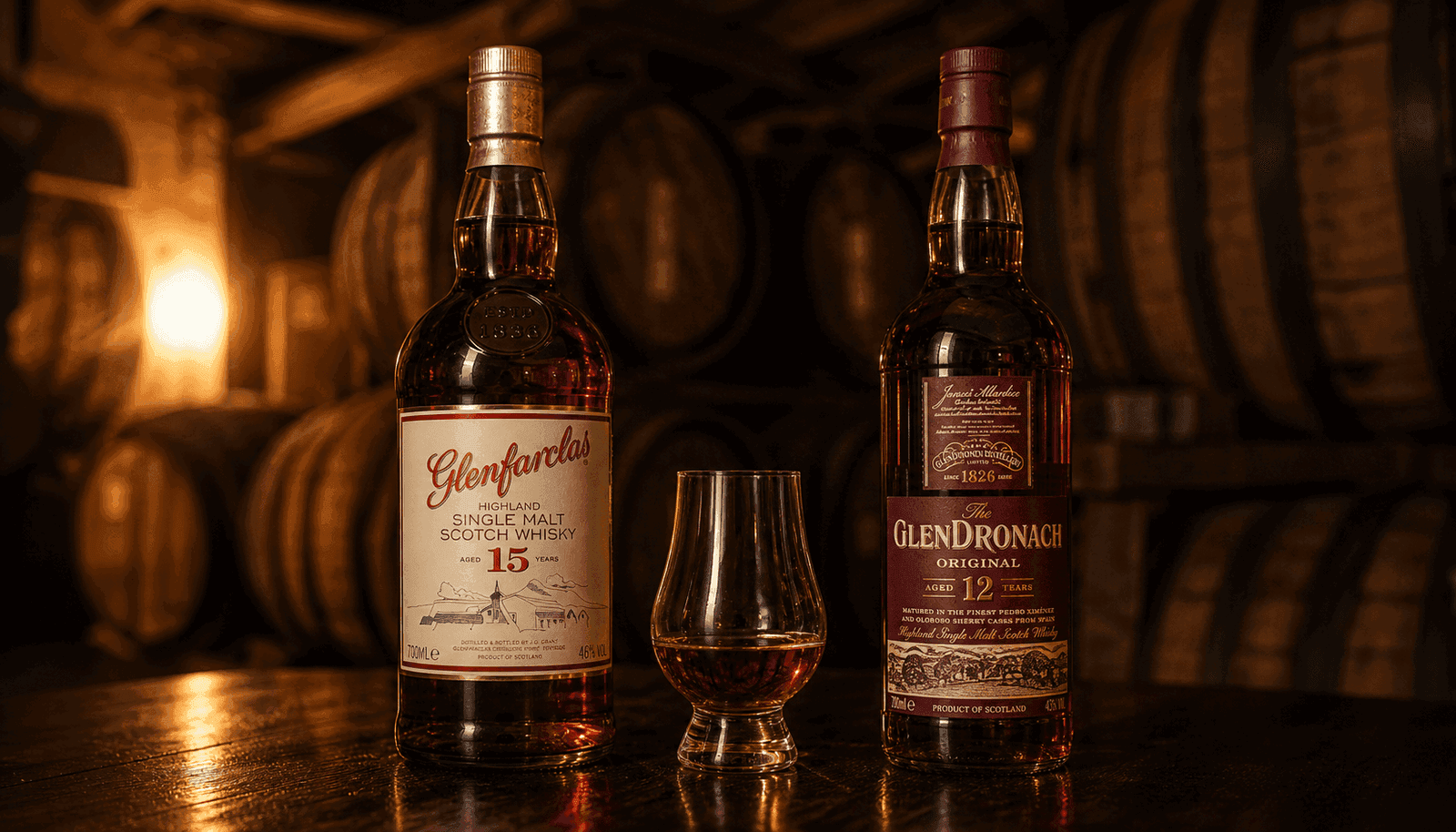
Glenfarclas and GlenDronach are the two names most serious collectors reach for when they want heavily sherry-matured Scotch whisky. Both rely overwhelmingly on Spanish oak sherry casks. Both have age statement ranges that run into the decades. Both have established secondary market records and genuine collector followings. The decision between them is a question of style, ownership history, and which expressions within each range offer the strongest collector story in 2026.
Distillery Origins and Ownership
Glenfarclas is a Speyside distillery near Ballindalloch, operated by the Grant family since 1865. It is one of the very few remaining independently family-owned distilleries in Scotland, and that independence has shaped every aspect of how the whisky is made and sold. The Grant family has never sold to a multinational and has maintained the same production philosophy across six generations. The distillery still uses direct-fired copper pot stills — a production method the vast majority of Scottish distilleries have moved away from in favour of steam-heated systems. Glenfarclas produces no blended Scotch under its own brand: its entire focus is the single malt range.
GlenDronach is a Highland distillery in Forgue, Aberdeenshire, founded in 1826. The contemporary collector story begins in 2008, when Billy Walker and his business partners acquired the distillery from Allied Distillers. Walker had previously transformed BenRiach, and he applied the same approach at GlenDronach: intensive cask management, selective release of older stock, and a commitment to sherry maturation that distinguished the range from the wider Highland category. In 2016 the distillery was sold to Brown-Forman, the American spirits company. The quality trajectory Walker established has continued under new ownership, but the older and vintage stock from the Walker and pre-Walker eras carries the most established collector value.
Style and Production Philosophy
Both distilleries work predominantly with Pedro Ximénez and Oloroso sherry casks. The results differ in important ways. Glenfarclas produces a spirit that, despite heavy sherry influence, retains a Speyside fruitiness and brightness — the direct-fired stills contribute a cereal and toffee note that lifts the sherried character rather than overwhelms it. At 15 and 17 years old, Glenfarclas shows dried fruits, Christmas cake, and a long finish without the density that characterises the heaviest expressions in the range.
GlenDronach is denser and darker. The spirit character is heavier, contributing more chocolate, walnut, and tobacco-leaf notes alongside the dried fruits from the sherry wood. At 12 years old, the GlenDronach Original is one of the most intensely sherried whiskies available at its price point. The 15 Revival and 18 Allardice add depth and complexity with age. The single cask vintage releases — drawn from specific casks laid down in specific years — represent the most extreme expression of this rich, concentrated character and are the primary collector targets within the range.
The Core Collector Ranges Compared
Glenfarclas
The Glenfarclas Family Casks series — individual cask releases from each distillery year going back to the 1950s — is the apex of the collector range. These are single cask bottlings at cask strength from specific production years, limited to the number of bottles each cask yields. The Family Casks from the 1950s and 1960s represent whisky that cannot be produced again, and their secondary market prices reflect this. The standard age statement range — Glenfarclas 15, 17, 21, 25 — provides collectors with accessible entry points before stepping into the Family Cask tier. The 105 expression, one of the oldest commercially available cask strength whiskies in Scotland at 60% ABV, is also worth tracking for its historical significance and consistent availability. Find available expressions on Spiritory.
GlenDronach
The GlenDronach 12 Year Old Original is the accessible entry point to a range that has real collector credentials at its upper end. The 15 Revival and 18 Allardice are the key standard expressions for serious collectors. Above those, the Parliament 21 Year Old represents the top of the ongoing range. The vintage single cask releases — bottled from casks laid down in specific years and sold in numbered limited batches — are the primary driver of secondary market attention. These appear at auction, appreciate over time, and are the expressions that define GlenDronach's collector reputation. The Billy Walker-era single cask releases from 2008 to 2016 have particular collector value as the distillery's transformation under that ownership is well documented and clearly reflected in the liquid. Find available expressions on Spiritory.
Secondary Market Performance
Both distilleries have documented secondary market activity, but the patterns differ. Glenfarclas Family Casks from the 1950s, 1960s, and 1970s command significant premiums at auction — these are irreplaceable expressions from a period when the distillery's output was smaller and the surviving stock is limited. The ongoing standard range appreciates modestly: Glenfarclas 15 and 17 are widely available at retail and the secondary premium for them is limited by their continued production.
GlenDronach's secondary market activity is concentrated in the vintage single cask releases. The older the vintage, the more limited the supply, and the higher the secondary price relative to the original release cost. Some pre-2010 vintage single casks have appreciated substantially since their original release. The standard range — 12, 15, 18 — shows less secondary market movement than the vintage single casks, reflecting the difference in scarcity between a widely available ongoing expression and a numbered cask release.
Which Should You Choose?
The choice depends on what you are optimising for. If you want the clearest value proposition at the accessible end of the sherry-matured category, Glenfarclas 15 and 17 are benchmarks — sherry-matured single malts of genuine quality at prices that consistently undervalue the liquid. If you want the most established collector story with documented vintage single cask appreciation, GlenDronach is the stronger position: the vintage single cask programme has a track record of secondary market performance that Glenfarclas's equivalent, the Family Casks, matches but requires a significantly larger entry price.
For a collection that includes both, the obvious structure is Glenfarclas standard range for depth of age statement exposure at accessible prices, and GlenDronach vintage single casks for the specific cask-level collector story. The two are complementary rather than competing — different distillery characters, different collector dynamics, and a coherent sherry-maturation thesis that holds across both.
Tip: The Glenfarclas 105 — cask strength, 60% ABV, widely available, priced well below comparable single cask expressions — is one of the best-value introductions to cask strength sherried whisky available. It is a drinking expression rather than a collector target, but it represents the Glenfarclas house style at its most direct.
FAQ
Which is better value — Glenfarclas or GlenDronach?
At equivalent age statements, Glenfarclas is generally better priced relative to quality. The Glenfarclas 15 Year Old in particular represents exceptional value for a heavily sherry-matured Speyside with a genuine age statement. GlenDronach's standard range is also well priced, but the most compelling collector value within the GlenDronach range comes from the vintage single casks, which are significantly more expensive. For collectors working within a budget, Glenfarclas's standard range offers more quality per euro at most price points.
Is GlenDronach still as good since the sale to Brown-Forman?
Quality has been maintained under Brown-Forman ownership. The sherry maturation programme established under Billy Walker has continued, and the vintage single cask releases have kept coming. The question for collectors is whether the older Walker-era stock, now diminishing, will be replaced by equally interesting material as the current ownership's own sourced and matured casks come to bottling age. The consensus among specialist buyers is that recent releases remain strong, but the most historically significant vintage casks from the Walker era are the most established collector positions.
Does Glenfarclas still use direct-fired stills?
Yes. Glenfarclas continues to use direct gas-fired copper pot stills — a production method the vast majority of Scottish distilleries have moved away from in favour of steam-heated systems. The direct firing adds a slight caramelisation and complexity at the spirit level that contributes to the distinctive Glenfarclas character. It is a genuine production difference, not a marketing claim, and a reason why Glenfarclas expressions at the same age as comparable expressions from steam-heated distilleries often taste distinctly different.
About the author

Janis Wilczura
I'm one of Germany's leading whisky experts, featured in Handelsblatt and BILD. To me, whisky is craftsmanship and art.
To the author