

Reach thousands of whisky and spirits lovers every day.


Did Halloween Begin in Scotland and Ireland? Samhain and the Whisky Countries
 by Janis WilczuraI'm one of Germany's leading whisky experts, featured in Handelsblatt and BILD. To me, whisky is craftsmanship and art.
Follow Spiritory on Google News to get our latest guides and releases delivered straight to your feed.
Did Halloween Begin in Scotland and Ireland? Samhain and the Whisky Countries
Halloween grew out of the Gaelic festival of Samhain, kept at the start of winter on 1 November with the main events on the night of 31 October, and Scotland and Ireland are where the best recorded customs such as guising and carved turnip lanterns come from. Historians do warn that the link between ancient Samhain and modern Halloween is looser than popular retellings suggest, and the version the world knows today took shape after those customs crossed the Atlantic.
Key Takeaways
Samhain was a Gaelic seasonal marker for the end of harvest and the start of winter. Halloween is the eve of Samhain, which is why 31 October carries the festivities.
Guising, children dressing up and going door to door, is described by Historic Environment Scotland as the original form of trick or treating.
Turnips, called tumshies in Scots, were carved as lanterns in Scotland and Ireland long before pumpkins. The National Museum of Ireland calls the pumpkin an American development of the same idea.
Scholars such as Ronald Hutton and Dimitra Fimi caution against presenting Samhain as a simple pagan ancestor of Halloween, and the link with the dead is described as a Christian development.
Two 2026 festivals keep the old themes alive, the Púca Festival in County Meath and the Samhuinn Fire Festival in Edinburgh.
Three bottles from Ireland and Scotland close this guide, each chosen for a clear reason tied to the story.
Tip: When you read that Halloween is 2,000 years old, look for the source. The records that survive are medieval Irish texts and later folklore, so the careful claim is that Halloween has Gaelic and Christian roots, not that every custom is ancient.
What Was Samhain, and When Was It Kept?
The National Museum of Ireland describes Halloween as the eve of Samhain, which falls on 1 November. Samhain was one of four seasonal markers in the traditional Irish calendar and signalled the onset of winter, with the main festivities held on the night of 31 October. Historic Environment Scotland gives a matching picture for Scotland, where Samhainn was a Celtic festival marking the end of the harvest, celebrated on 1 November with festivities starting the night before.
The Scottish heritage body also notes how the church calendar entered the picture. All Hallows Day moved from 13 May to 1 November, and Samhainn was possibly assimilated on purpose in the 8th century. The name Hallowe'en came to mean the night before. So the date already blends a Gaelic seasonal tradition with a church one.
How Sure Are Historians That Samhain Is the Origin of Halloween?
Less sure than most articles admit. Dimitra Fimi, writing on the origins of Halloween, accepts that Samhain was a time of agricultural importance, when the summer ended and livestock came off the pastures. She notes that each thread of the pagan argument has been vigorously challenged, and states that the Halloween association with the dead is a Christian development.
She also cites the historian Ronald Hutton on the medieval Irish tales. Samhain appears often in them, but Hutton notes that gathering important legendary characters for a feast, "with time on their hands", is a natural way to begin a tale. In Fimi's reading, the feast itself does not invite the supernatural. Fimi adds that there is no evidence whatsoever for the popular claim that the Irish new year began on 1 November.
For a reader this is useful. It means the safe statement is that Halloween has Gaelic and Christian roots and that Scotland and Ireland preserved many of its best documented customs. It does not mean every detail dates back thousands of years.
What Was Guising in Scotland?
Guising is the Scottish custom of dressing up and going from house to house on Halloween night. Historic Environment Scotland calls it the original form of trick or treating. In its account, parents disguised their children to stop roaming fairies and spirits from taking them, and children could play tricks on neighbours or go door to door telling jokes in return for treats.
The same source lists other customs from the night. Bonfires, known as samhnagan, were lit to protect people from evil spirits, and on the islands communities competed to build the biggest fire. Couples placed nuts on the fire, where steady burning promised a good match and hissing a turbulent one. Robert Burns wrote a poem called Halloween that touches on a divination game, in which people pulled up a kale stalk with their eyes closed, and soil on the roots was a sign of a wealthy partner.
Ireland had its own versions. The National Museum of Ireland describes guising, bobbing for apples, bonfires on 31 October and fortune telling games, such as the barmbrack cake that hid objects predicting the future, with a ring for marriage or a coin for wealth.
Why Did Scots and Irish Families Carve Turnips?
Long before pumpkins, the lantern of the night was a hollowed out turnip. Historic Environment Scotland says turnips, called tumshies in Scots, were carved with frightening faces to scare off fairies and ghosts, with candles inside so the faces could be seen from a distance.
The National Museum of Ireland shows a "ghost turnip" from its National Folklife Collection at its Country Life branch in County Mayo. The museum says people believed the spirits of the dead moved through the countryside that night, and scary masks and lanterns were made to match. Clodagh Doyle, Keeper of the National Folklife Collection, points to the setting as part of the effect. In her words, "Before electricity, the countryside was a very dark place, adding to the scariness of the festival."
The museum also tells the story of the Púca, a figure from Irish folklore. Children were told that on this night the Púca spat on wild fruits such as berries and apples, which discouraged them from eating damaged ones.
How Did These Customs Reach North America?
They travelled with people. The York University historian Nicholas Rogers, author of Halloween: From Pagan Ritual to Party Night, follows the holiday from its Celtic and Christian origins to its arrival in North America as an Irish and Scottish festival. In other words, emigrants from the two countries carried the night with them, and it later became a wider North American holiday.
The turnip is the clearest object lesson. The National Museum of Ireland says that the pumpkin that is prevalent today is an American development of the idea of the carved turnip. The lantern changed in North America while its purpose stayed much the same.
Guising followed a similar path. The National Museum of Ireland notes that modern trick or treating descends from the old custom of guisers visiting houses in costume.
Where Can You See the Old Traditions in 2026?
Two festivals draw directly on the history. The Púca Festival runs from 29 October to 1 November 2026 in Trim and Athboy in County Meath, according to Discover Ireland and the festival's own site. It presents Samhain as Ireland's ancient Halloween through folklore, food, music and fire performances. The festival site describes the Lighting of the Samhain Fire as a free event held as the sun sets, but does not give a 2026 date, so check the programme before you travel. The festival presents Athboy as the birthplace of Halloween, which is a tourism claim and, as the historians above show, a simplification.
In Edinburgh, the Beltane Fire Society holds the Samhuinn Fire Festival on Calton Hill on Saturday 31 October 2026, with gates open at 6.30pm and last entry at 9pm. The society was formed in 1988, so this is a modern performance built on the old theme of summer giving way to winter. Tickets are sold only through the society's official box office partner, so use the link on the society's own page.
Which Scottish and Irish Bottles Fit This History?
Whisky has no documented place in Samhain customs, so these picks are an editorial link and not a tradition. Each one is chosen for a reason tied to the story above. For bottles built around dark names, see Spiritory's guide to bottles with dark names.
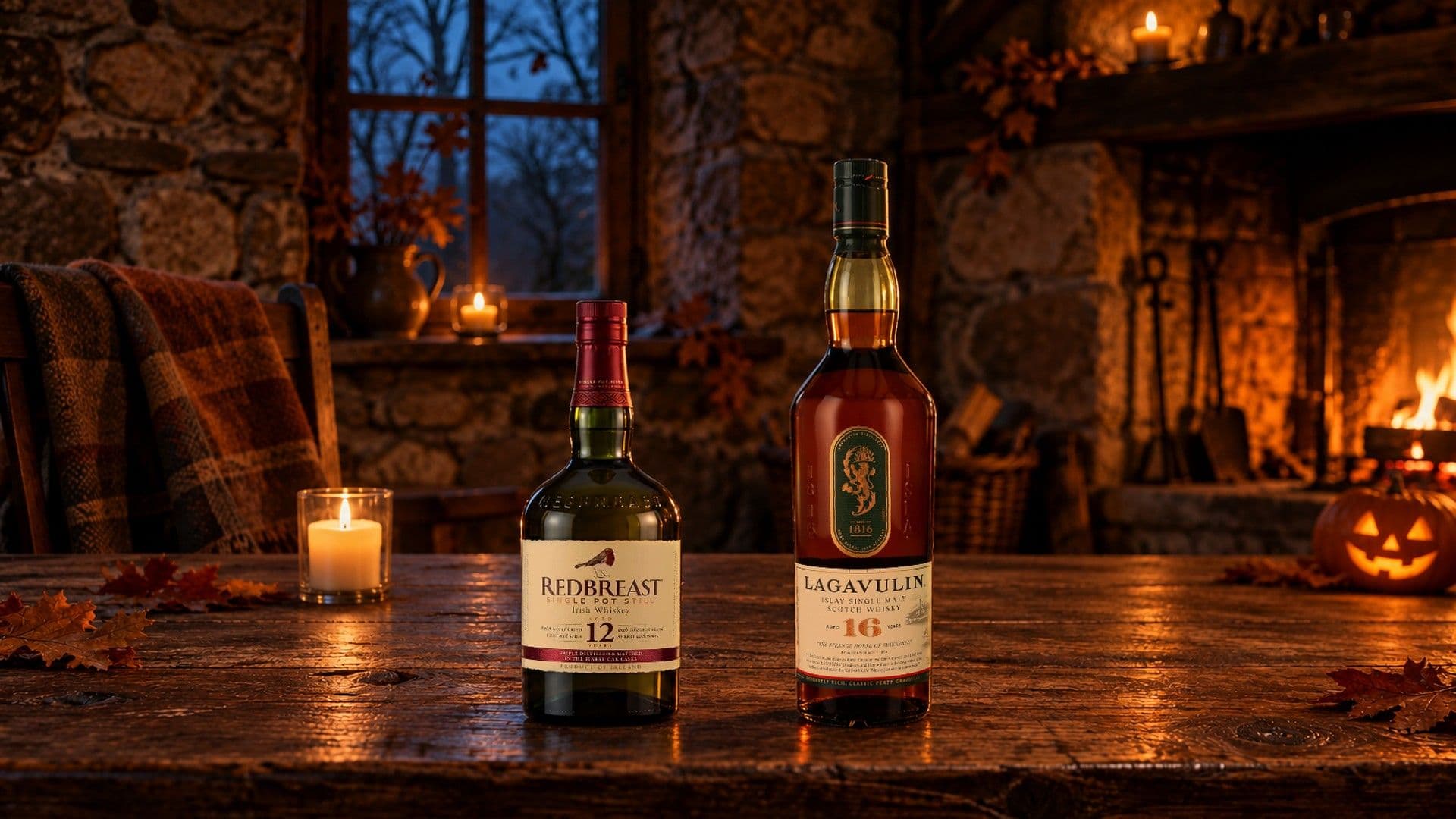
Redbreast 12 Years Old, the Irish Pot Still Choice
Redbreast 12 Years Old is a single pot still Irish whiskey from the Midleton distillery, bottled at 40%. Irish Distillers describes it as triple distilled and matured in bourbon seasoned American oak and oloroso sherry seasoned oak. It suits readers who want the Irish side of this story in a glass, in a style that is specific to Ireland. Spiritory's listing mentions dried fruit and malt extract.
Lagavulin 16 Years Old, the Smoke of the Bonfires
Lagavulin 16 Years Old is an Islay single malt aged 16 years and bottled at 43%. ScotchWhisky.com dates legal distilling at Lagavulin to 1816. Its peat smoke is an obvious parallel to the samhnagan, the protective bonfires described by Historic Environment Scotland, though that is a comparison and not a historical link. It suits anyone who likes a smoky, maritime whisky. If peat is new to you, read what peated means in whisky first.
Edradour 13 Years Old 2010 Halloween 2024, a Release Made for the Date
Edradour 13 Years Old 2010 Halloween 2024 is the name on Spiritory's listing, a 13 year old Highland whisky distilled in 2010 and released for Halloween 2024, at 46.6%. Trade listings, including whisky.com and the drinks site About Drinks, sell the same release as the Ballechin Halloween Limited Edition, Ballechin being the peated style made at Edradour. They describe it as matured in bourbon casks, not chill filtered and limited to 666 bottles. Spiritory's listing describes a meaty body with sea salt, citrus and ashy smoke. It suits collectors who want a bottle made specifically for the date, from a Highland distillery near Pitlochry.
Tip: If you plan to taste a bottle that connects to this history, choose the one that matches the part you find most interesting. A smoky Islay malt echoes the bonfires, while a rich Irish pot still whiskey suits a quieter evening of stories.
FAQ
Did Halloween really begin in Ireland and Scotland?
Its best documented roots are Gaelic and Christian. Samhain was a seasonal marker in the Irish calendar, Halloween is the eve of Samhain, and customs such as guising and carved turnips are recorded in Scotland and Ireland. Historians caution that a direct line from ancient Samhain to modern Halloween is hard to prove.
What is guising?
Guising is the Scottish custom of children dressing up and going door to door for treats or to perform a joke, song or poem. Historic Environment Scotland calls it the original form of trick or treating.
Were turnips used before pumpkins?
Yes, in Scotland and Ireland. Scots called them tumshies. The National Museum of Ireland says the pumpkin is an American development of the carved turnip, which followed emigrants to North America.
When is Samhain?
The National Museum of Ireland places Samhain on 1 November, with Halloween as its eve on 31 October. Historic Environment Scotland gives the same date for Samhainn in Scotland.
Is there a whisky tradition linked to Samhain?
No documented one. The bottles in this guide are an editorial choice based on country, style and theme, and are not part of the historical customs.
- Key Takeaways
- What Was Samhain, and When Was It Kept?
- How Sure Are Historians That Samhain Is the Origin of Halloween?
- What Was Guising in Scotland?
- Why Did Scots and Irish Families Carve Turnips?
- How Did These Customs Reach North America?
- Where Can You See the Old Traditions in 2026?
- Which Scottish and Irish Bottles Fit This History?
- FAQ
About the author

Janis Wilczura
I'm one of Germany's leading whisky experts, featured in Handelsblatt and BILD. To me, whisky is craftsmanship and art.
To the author