

Reach thousands of whisky and spirits lovers every day.


How to Build a Whisky Investment Portfolio in 2026
 by Max RinkI’m a whisky enthusiast and aspiring writer, exploring new flavours and the stories behind every bottle.
Follow Spiritory on Google News to get our latest guides and releases delivered straight to your feed.
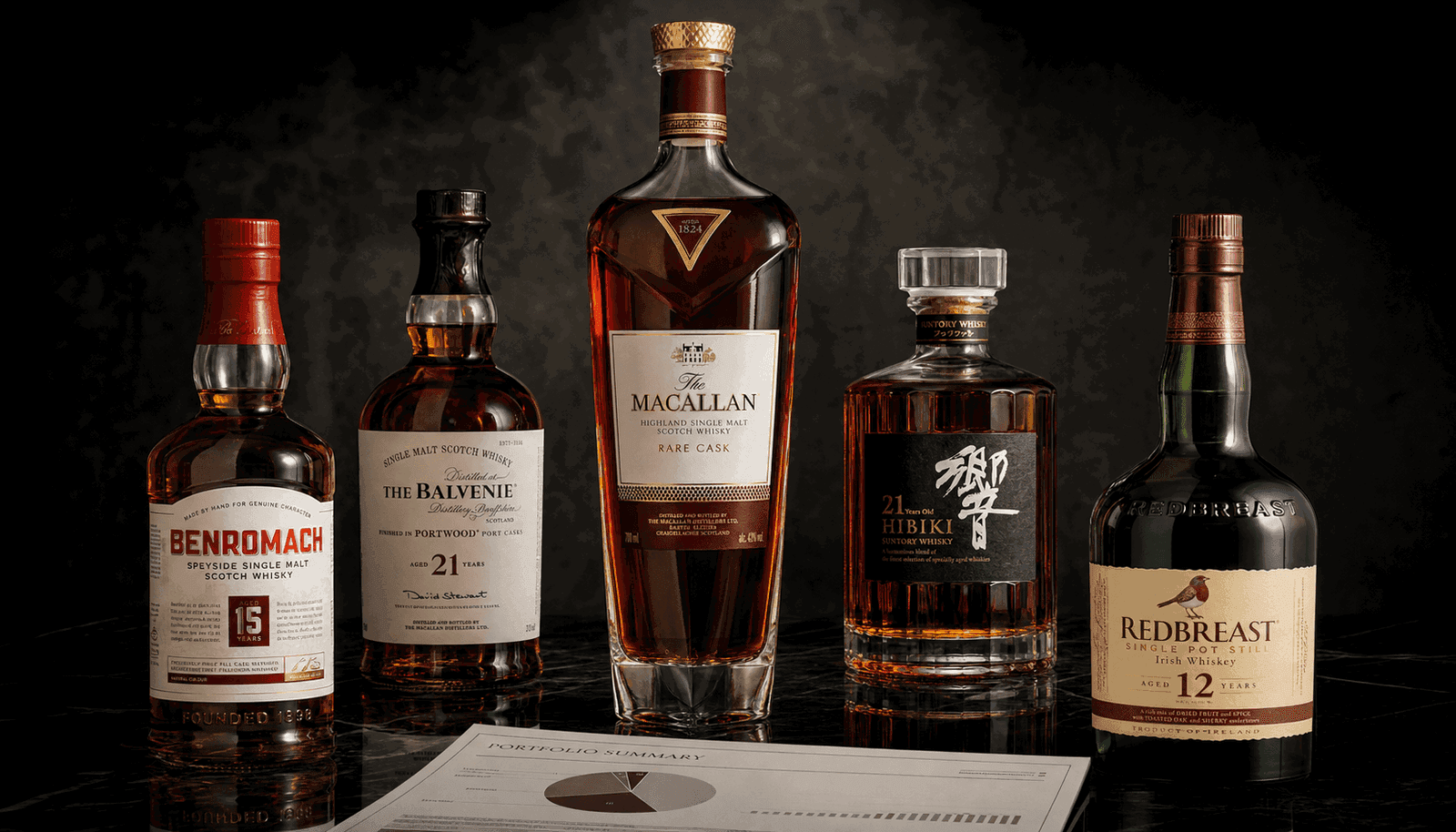
How to Build a Whisky Investment Portfolio in 2026
A whisky investment portfolio is not a collection of bottles you happen to have bought over the years. It is a deliberately constructed set of positions across different tiers, categories, and time horizons, built with an explicit view on liquidity needs, storage costs, and exit strategy. Most whisky buyers who describe themselves as investors are actually collectors — they buy what they like and hope prices go up. That is a fine approach to building a cellar. It is not a portfolio. The distinction matters when you eventually want to sell.
Key Takeaways
A portfolio requires deliberate allocation across tiers — entry-level positions that maintain liquidity, mid-range positions for medium-term appreciation, and premium positions held for the long term.
Category diversification reduces concentration risk: a portfolio built entirely on one distillery, one region, or one style is exposed to factors that affect only that category.
Storage and insurance are real costs that erode returns. Factor 1–2% of portfolio value per year into any return projection before making purchase decisions.
Liquidity is lower than most investors assume. Even established auction platforms require 30–60 days to move a significant position, and price is not guaranteed until the hammer falls.
The strongest collector positions are built at retail, at release. Buying on the secondary market after a price has already moved captures less upside than buying the bottle when it first becomes available.
The Three Tiers of Whisky Investment
Tier 1: Entry Level (€50–200 per bottle)
The entry tier serves two purposes in a portfolio. First, it provides liquidity — these are the bottles that can be sold quickly without needing a specialist sale or a specific motivated buyer. Second, it builds category knowledge. Buying across the entry tier of Scotch, Irish, Japanese, and American whisky categories over time creates the reference base needed to evaluate mid-range and premium positions correctly.
Entry-tier positions should prioritise bottles with established secondary market activity — expressions that appear regularly at auction and trade with enough frequency to give a clear picture of market pricing. The GlenDronach 12 Year Old Original, the Springbank 10 Year Old, and comparable accessible expressions from established distilleries are good benchmarks for this tier.
Tier 2: Mid-Range (€200–1,000 per bottle)
The mid-range tier is where most meaningful portfolio appreciation happens. These are expressions with a credible scarcity story — limited releases, age-statement expressions above 18 years, independent bottler single casks with documented provenance — that have not yet reached full secondary market recognition. The goal at this tier is identifying the specific bottles within a quality release programme that are most likely to appreciate: those with the clearest supply constraint, the strongest distillery track record, and the most specific cask or vintage story.
Springbank's annual limited releases, Ardbeg special editions, GlenAllachie's extended maturation series, and mid-range Gordon and MacPhail cask releases are all examples of the kind of expression that belongs in this tier. Buy at retail when possible. The best positions in this tier are taken before the secondary market sets the price.
Tier 3: Premium (€1,000+)
The premium tier is the highest-risk, highest-potential-reward portion of a portfolio. These are positions in expressions with established auction records and documented appreciation — closed distillery bottlings (Port Ellen, Brora, Rosebank), very old age statements from respected producers, trophy single casks from Gordon and MacPhail's Generations or Rare Old series, and rare releases from distilleries with a proven track record of secondary market premium.
At this tier, provenance documentation matters significantly. A bottle with a purchase receipt, original packaging, and a clear chain of custody commands a premium over the same expression without documentation. Storage conditions also matter more at this tier: a premium expression that has been stored incorrectly is worth less, full stop.
How to Allocate Across Categories
Category diversification in whisky means spreading allocation across regions and styles, not just price points. A portfolio concentrated entirely in Islay single malts is exposed to any factor that specifically affects Islay supply or collector demand. A portfolio spread across Islay, Speyside, Highland, Irish, and Japanese positions is more resilient.
The practical allocation for a portfolio built for medium-term appreciation might look like this: 40% in established Scotch single malts from distilleries with long secondary market track records, 30% in limited editions and annual releases from distilleries with consistent collector demand, 20% in emerging categories — Irish single pot still, independent bottler releases, new-wave distilleries — bought early in the collector cycle, and 10% in premium closed distillery or very aged expressions for long-term holding.
The 20% emerging category allocation is the highest-risk portion and deserves the most careful selection. The potential upside is greatest here precisely because the market has not yet fully priced these positions. The risk is that the market never does — not every distillery builds a collector following, and not every category transitions from enthusiast interest to secondary market premium.
Liquidity, Storage, and Costs
Whisky is an illiquid asset relative to publicly traded securities. Even the most active auction platforms require 30–60 days from listing to cash in hand. For entry-tier bottles on active platforms like Spiritory, liquidity is faster — a listed bottle at or near market price can sell within days. For premium tier expressions, finding the right buyer at the right price can take a full auction cycle.
Storage costs are a genuine drag on returns. Professional whisky storage in a climate-controlled facility runs approximately 1–2% of portfolio value per year when insurance, handling, and storage fees are combined. For a €10,000 portfolio, that is €100–200 per year before any appreciation. Factor this into every purchase decision: a bottle that appreciates 5% per year in market value but costs 2% per year to store properly delivers a 3% net return, not 5%.
Insurance for a collector portfolio is not optional. Standard household contents policies do not adequately cover specialist collections. A dedicated collector insurance policy covering the full replacement value of each bottle at current secondary market prices is the correct approach. Review the insured values annually — particularly for mid-range and premium positions that may have appreciated since the policy was written.
When to Buy and When to Sell
The strongest purchase timing is at retail, at release. This is the point at which the market price has not yet been set by secondary market competition. For a limited edition that will trade above retail within six months, buying at retail captures the full gap between release price and secondary market price. Buying on the secondary market after the price has moved captures whatever appreciation happens after that point — which may be less than the initial move.
The sell decision is harder. For expressions with a strong and continuing supply story — a distillery that is still producing, an annual limited release series that will continue — the appreciation potential is bounded by what the market will pay for the same expression in future years. For expressions where the supply story is definitively closed — a closed distillery, a single cask with no further production, a specific vintage that cannot be replicated — the appreciation case is theoretically open-ended, but so is the risk of market condition changes.
Tip: A useful discipline is to set a target return at purchase — if you are buying with the expectation of 30% appreciation, note that target and when you expect to realise it. Review each position annually against that target. If a position has met its target ahead of schedule, selling and redeploying into a new position is more disciplined than holding indefinitely hoping for further gains.
For guidance on valuing your collection accurately before any sale decision, see How to Value Your Whisky Collection in 2026.
FAQ
How much do I need to start a whisky investment portfolio?
A meaningful whisky portfolio can be started from €2,000–5,000. Below that level, the transaction costs of buying and selling relative to the portfolio value make it difficult to achieve meaningful net returns. The entry-level tier of the portfolio can be built from individual bottles in the €50–200 range, which allows some diversification across distilleries and categories even at a modest total investment. At this starting level, the focus should be entirely on established expressions with proven secondary market activity, not on speculative positions in new distilleries or limited editions without a track record.
Is whisky a safer investment than stocks?
Whisky and stocks carry different risk profiles rather than one being straightforwardly safer than the other. Whisky is illiquid, subject to storage and insurance costs, and dependent on a specialist buyer market. Stocks are liquid, have no storage costs, and trade on regulated markets with price discovery. The returns profile for rare whisky, when achieved, can be attractive — but the liquidity premium you sacrifice is real. Whisky is best treated as an alternative asset within a diversified portfolio, not as a replacement for mainstream investment vehicles.
Should I buy whole cases or individual bottles?
Individual bottles are more liquid — a single bottle is easier to sell than a full case, which requires a buyer committing to a larger total outlay. Full original cases (OC, Original Case, typically 6 or 12 bottles) command a premium at auction over equivalent individual bottles because they represent the complete original packaging and maximum provenance. For premium tier positions, buying a full case if affordable preserves optionality: you can sell individual bottles as needed while retaining case packaging for a future single-lot sale. For the entry and mid-range tiers, individual bottles are the more practical approach.
About the author

Max Rink
I’m a whisky enthusiast and aspiring writer, exploring new flavours and the stories behind every bottle.
To the author