

Reach thousands of whisky and spirits lovers every day.


10.10.2025

100% Islay Whiskies: From Seed to Sip
100% Islay Whiskies: From Seed to Sip
Introduction to 100% Islay Whiskies
The concept of 100% Islay whiskies represents a fascinating evolution in the whisky world, where provenance and local identity take centre stage. Unlike typical Islay single malts, which often use barley sourced from mainland Scotland, these whiskies are crafted entirely from barley grown on the island itself, capturing a true sense of place. The recent release of Kilchoman’s 100% Islay 2025 Edition—a nine-year-old single malt distilled and matured wholly on Islay—has reignited enthusiasm among collectors and enthusiasts for this provenance-led approach.
This dedication to local barley and production highlights not only the island’s unique terroir but also the commitment to controlling every stage of whisky making within Islay’s boundaries. For those interested in exploring expressions that embody the island’s character from seed to bottle, understanding what ‘100% Islay’ means is essential. This guide will delve into the defining features, production nuances, flavour profiles, and practical tips for appreciating and acquiring these distinctive whiskies.
What Does '100% Islay' Mean?
Within the framework of Scotch whisky regulations, a single malt must be produced at one distillery using malted barley, water, and yeast, distilled in copper pot stills, matured in Scotland for at least three years in oak casks no larger than 700 litres, and bottled at a minimum of 40% ABV. However, the ‘100% Islay’ designation goes beyond these legal requirements by adding a geographic specificity that is not mandated but increasingly valued.
A whisky labelled as 100% Islay means every grain of barley used was grown exclusively on the island of Islay rather than sourced from mainland Scotland or elsewhere. This is significant because most Islay distilleries typically rely on malted barley from Port Ellen Maltings, which processes barley grown mainly in eastern Scotland’s lighter soils with higher yields. In contrast, Islay’s harsher climate—with its Atlantic winds, abundant rainfall averaging 191 days per year, and shorter growing season—results in smaller yields and grain size. These factors reduce spirit output per tonne by around 20–30 litres of pure alcohol compared to mainland barley.
Only a few distilleries like Kilchoman and Bruichladdich have invested heavily in tracking and distilling exclusively Islay-grown barley. Kilchoman stands out as Scotland’s only single-farm single malt producer, where all stages—from sowing and malting to maturation and bottling—occur within one farm on Islay. This meticulous control strengthens claims about authenticity and terroir influence while offering consumers a whisky that truly embodies its island origin.
The Production Process of 100% Islay Whiskies
Barley Cultivation
Islay’s barley cultivation is both a challenge and an art due to the island's unique conditions. Kilchoman’s Rockside Farm spans approximately 2,300 acres on the northwest coast of Islay, with about 400 acres dedicated to growing barley. The farm produces up to 440 tonnes annually—enough to supply roughly 30% of Kilchoman’s core range needs plus all their 100% Islay releases.
Barley varieties have evolved over time: the initial releases used Optic barley known for its large grain size and high enzyme content; later editions incorporated Publican barley with tropical fruit notes; most recently Concerto has been introduced, bringing citrus and pear character alongside Publican’s pineapple hints. Farmers sow spring barley after migratory geese leave in mid-April; harvesting occurs early September before weather deteriorates.
The climate poses natural constraints—heavy rainfall, strong Atlantic winds, and a short growing season limit yield to about two to two-and-a-half tonnes per acre versus twice that on mainland farms. These factors make local barley more expensive and less abundant but contribute distinct flavours that reflect the island terroir.
Malting and Distillation
Kilchoman employs traditional floor malting—a rarity nowadays—to convert starches into fermentable sugars. After harvest storage at ambient temperature prevents premature germination until needed. Then batches of two to four tonnes are soaked (steeped) for two days to increase moisture content from around 12% to over 40%, mimicking natural spring rainfall.
The wet grain is spread by hand over malting floors for four to five days with frequent turning to maintain even temperature and oxygen flow. This careful process develops enzymes like alpha- and beta-amylase crucial for fermentation. Germination is halted when shoots reach three-quarters grain length by transferring malt to kilns.
Kilning uses local peat fires burning for 10–15 hours to achieve phenol levels near 20 parts per million—half the intensity typical in Kilchoman’s core range—allowing floral sweetness and citrus notes from the barley to shine alongside gentle smoke. Malt is then dried further using fan heaters before milling into grist.
The grist mixes with hot water in mash tuns extracting sugars into wort. Yeast ferments this over about 60 hours producing wash at roughly 8% ABV. Double copper pot still distillation yields new-make spirit at around 70% ABV which is diluted before filling into mostly first-fill ex-bourbon barrels sourced from American distilleries like Buffalo Trace.
Maturation occurs in dunnage warehouses on site where mild maritime climate fosters slow interaction between spirit and oak over nine years or more. Angel’s share evaporation runs near 2%, lower than drier regions’ typical rates.
Flavor Profiles of 100% Islay Whiskies
Tasting Notes
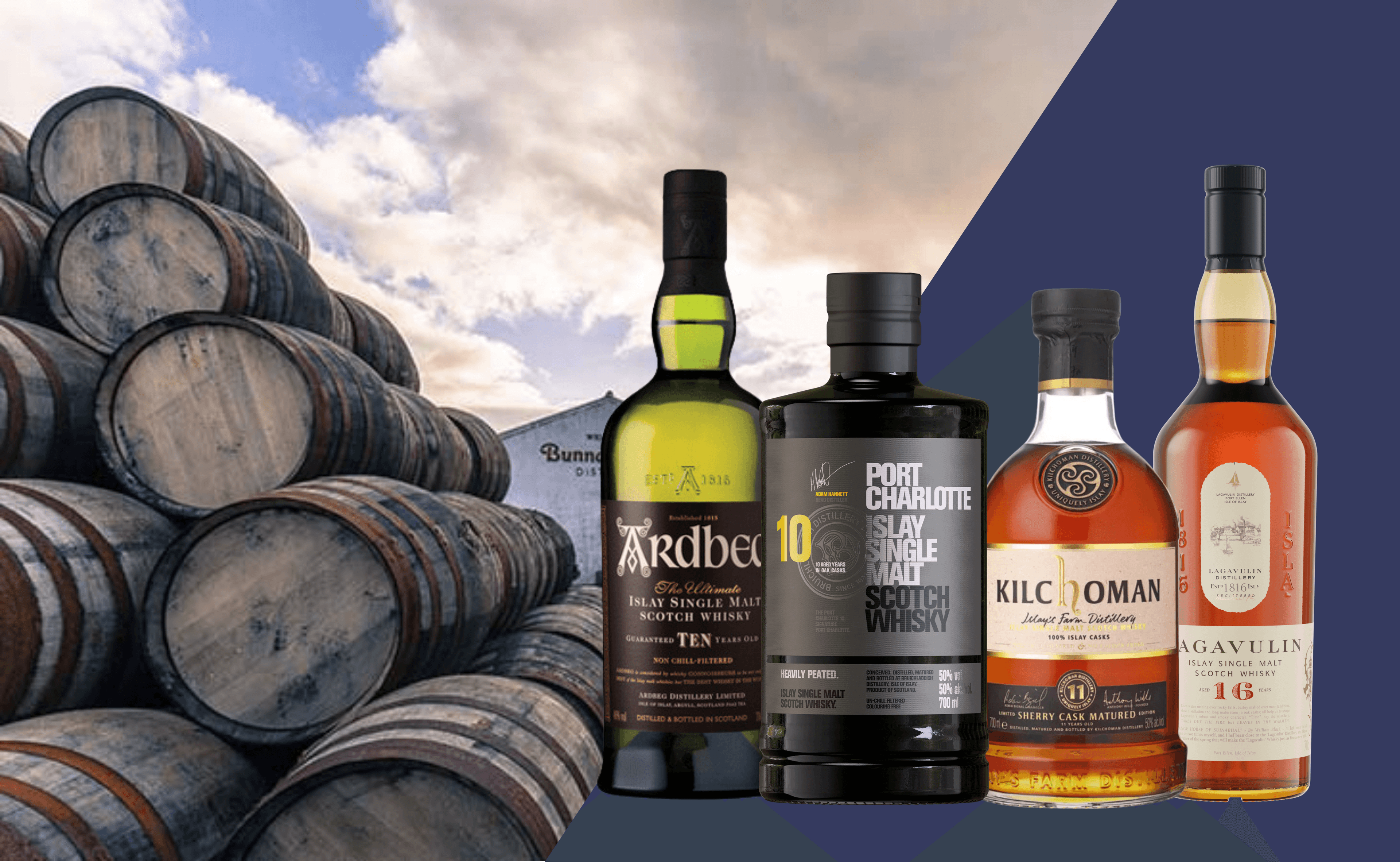
One-hundred-percent Islay whiskies often reveal a cleaner, more grain-forward profile compared to heavily peated southern Islay styles like Lagavulin or Ardbeg. The peat smoke character here is milder—more akin to a beach bonfire with subtle iodine hints rather than intense medicinal or tarry notes.
Tasting notes typically include floral peat aromas balanced by honeyed sweetness, vanilla, citrus peel, malted grain sweetness reminiscent of golden syrup or biscuit, along with white pepper or ginger spice touches on the palate. The finish tends towards wet pebbles, sea salt brine, and lingering gentle smoke.
Barley variety influences nuances: Laureate malt lends cereal and biscuit flavours; Concerto brings candied citrus and pear; Publican adds tropical pineapple notes. These subtle differences combine with yeast strain selection and fermentation length to create evolving flavour complexity across vintages.
This moderate peat intensity situates these whiskies between heavily peated southern coast expressions exceeding 45 ppm phenols and lighter northern coast styles like Bunnahabhain which emphasise fruit without smoke. It makes them approachable for newcomers while satisfying peat aficionados seeking maritime character framed rather than overwhelmed by smoke.
Market Dynamics and Investment Potential
The market for 100% Islay whiskies balances rarity with steady demand among collectors who value transparent provenance combined with regional character distinctiveness. Retail prices generally remain stable between £70–£80 at release; however early editions aged four or five years have appreciated notably on secondary markets due to scarcity.
Limited bottle numbers ensure these releases do not flood the market but maintain appeal among enthusiasts building vertical tasting libraries that document vintage variation linked closely to weather cycles and barley varietal shifts. Distillery exclusives finished in Madeira hogsheads or Moscatel barriques attract additional collector interest thanks to unique wood influence experiments.
While secondary market values softened broadly after peaks in 2021–2022 due to economic shifts affecting whisky auctions globally, limited-edition Islays have shown resilience relative to other regions—a trend reinforced by Kilchoman’s growing reputation as older stocks mature beyond twenty years.
Spiritory provides a valuable platform offering transparent pricing data alongside authentication support that reduces friction for buyers navigating this niche segment confidently.
This renewed interest reflected by releases like Kilchoman’s latest annual edition underscores how provenance-led bottlings continue shaping collector preferences today.
Future Outlook for 100% Islay Whiskies
Looking ahead, challenges such as climate variability may impact barley yields on Islay due to unpredictable weather patterns affecting harvest quality or forcing supplementation from mainland sources occasionally—potentially disrupting annual release continuity maintained since 2011 by Kilchoman.
Debates continue around how much terroir truly influences whisky flavour given transformative effects during malting and distillation; nevertheless scientific studies confirm chemical distinctions persist from field-level differences even if perceptibility varies among consumers.
Market fluctuations remain another uncertainty as economic conditions influence collector appetite alongside supply dynamics—though transparent provenance models help insulate value somewhat compared to blended or less traceable offerings.
Nonetheless, controlling every production phase onsite creates an authentic narrative resonating strongly with modern consumers demanding transparency about origins—a trend likely encouraging other distilleries toward similar approaches despite resource intensity limiting scale expansion.
For enthusiasts exploring this category or investors eyeing long-term potential via platforms like Spiritory’s marketplace offering trusted provenance verification—the future holds promise balanced with prudent watchfulness over environmental impacts and market trends alike.
FAQs
What sets 100% Islay whiskies apart from other single malts?
100% Islay whiskies distinguish themselves by using only locally grown barley harvested entirely within Islay combined with full production—from malting through maturation—on the island itself. This contrasts with typical single malts that often source mainland malted barley processed off-site. This approach emphasises provenance-driven flavour profiles reflecting local terroir influences such as climate and soil unique to Islay farms like Kilchoman’s Rockside Farm.
How can I be sure a bottle labelled '100% Islay' is authentic?
Authenticity can be verified by checking for intact seals; clear labelling including batch codes; distillation and bottling dates consistent with official records; plus purchasing through reputable retailers or trusted online marketplaces like Spiritory that provide provenance documentation and authentication support reducing counterfeit risk significantly compared to ultra-rare vintage bottles.
Are these whiskies suitable for newcomers who dislike heavy peat?
Yes—many 100% Islay whiskies feature moderate peat levels around twenty phenol parts per million resulting in smoky notes akin to gentle beach bonfires rather than intense medicinal peat found in some southern coast expressions. Their balanced floral sweetness combined with citrus fruitiness makes them approachable while still delivering classic maritime character appreciated by seasoned peat lovers alike.
Where is the best place to buy limited editions like Kilchoman's annual release?
Direct purchases at Kilchoman’s distillery visitor centre on Islay offer exclusive access along with specialist whisky retailers across Europe including online platforms such as Spiritory where you can find verified listings ensuring quality assurance backed by transparent pricing data suited for collectors or investors seeking fair value acquisition options.
Does climate change threaten future production of 100% Islay whiskies?
Potentially yes—as weather volatility increases risks affecting crop yields due to wetter harvest seasons or shortened growing windows influenced by migratory bird patterns impacting sowing schedules. Distilleries closely monitor these factors since any disruption could affect supply continuity; however ongoing adaptation strategies aim at sustaining this unique heritage style despite environmental challenges ahead.
Enjoy responsibly — please drink in moderation. Legal drinking age applies. Not for sale to minors.
About the author

Spiritory Team
Spiritory is a team of dedicated Whisky, Rum and Spirits Enthusiast. Our passion for the product, craftmanship and art of producing the finest spirits in the world will be represented in every article we write on our blog-page. Our goal is to produce content which is interesting to read and for a broad base of consumers, enthusiasts, investors and collectors.