

Reach thousands of whisky and spirits lovers every day.


Why Does Whisky Taste Different in Every Country?
 by Janis WilczuraI'm one of Germany's leading whisky experts, featured in Handelsblatt and BILD. To me, whisky is craftsmanship and art.
Follow Spiritory on Google News to get our latest guides and releases delivered straight to your feed.
Why Does Whisky Taste Different in Every Country?
Key Takeaways
Grain choice is the first and most influential variable: malted barley produces aromatic, complex spirits; corn produces full-bodied, sweet spirits; rye produces spicy, dry spirits.
Distillation method, pot still vs. column still, still shape, cut points, determines how much grain-derived character survives into the new make spirit.
Climate drives maturation rate: hotter climates accelerate wood extraction; cooler climates allow for slower, more gradual development over longer periods.
Cask tradition is partly shaped by availability: Scotland's access to American bourbon barrels explains why ex-bourbon wood dominates Scotch maturation.
Legal frameworks codify national styles and prevent category dilution, which is why each country's whisky tastes consistent within its category.
Explore whiskies from Scotland, Japan, and Ireland on Spiritory.
Grain: The First Flavour Variable
Grain is where national whisky identity begins. Every whisky-producing nation has settled on a primary grain based on what grew locally and what the local climate and soil supported, and that choice has downstream consequences for everything that follows.
Malted Barley
Malted barley is the grain of Scotland, Ireland, and increasingly Japan. Malting, the controlled germination and drying of barley, activates enzymes that convert starches to fermentable sugars and generates a range of aromatic precursors that survive distillation. The result is a new make spirit with inherent complexity: biscuity, slightly fruity, with a clean cereal character that serves as a receptive base for years of cask maturation. Scotland's cool, wet climate proved hospitable to barley, and the grain became the foundation of its whisky tradition.
Corn and the American Tradition
America's primary whisky grain is corn, which thrives in the fertile plains of Kentucky and the broader Midwest. Corn ferments into a spirit that is naturally sweeter and fuller-bodied than malted barley, with less inherent aromatic complexity. The Bourbon Act effectively locked corn into the American tradition, bourbon must contain at least 51% corn, and the industry built its flavour identity around the interaction between corn-heavy new make spirit and the powerful oak extraction of new charred barrels.
Rye and Other Grains
Rye whisky, historically dominant in the northeastern United States and Canada, produces a spicier, drier spirit than corn. Its flavour is often described as assertive and angular compared to bourbon's roundness. Irish whiskey traditionally uses a combination of malted and unmalted barley distilled in pot stills, which produces a heavier, oilier spirit than Scotch pot still malt, a style called pure pot still that is unique to Ireland.
Water, Yeast, and Fermentation
Water and yeast contribute less to final flavour than grain or cask, but they are not negligible, and national traditions have evolved around local conditions.
Water
Scottish distilleries draw water from local burns and springs, many running through peat beds or granite formations that influence mineral content. Hard water, high in calcium and magnesium, is generally preferred for fermentation because it supports yeast activity. The water source is frequently cited as part of a distillery's identity, though the actual impact on finished whisky flavour is more subtle than the marketing sometimes implies. Kentucky's limestone-filtered water is notably iron-free, which prevents certain off-notes during fermentation, and this geological accident has contributed to the smoothness associated with Kentucky bourbon.
Yeast and Fermentation Length
Different yeast strains produce different ester profiles, the aromatic compounds responsible for fruity, floral, and spicy notes in new make spirit. Scottish distilleries typically use commercial distilling yeasts alongside proprietary strains developed over decades; some American craft distillers and Japanese producers use multiple yeast strains to build complexity during fermentation. Longer fermentation times generally produce more fruity, complex new make spirit at the cost of efficiency, a trade-off that each distillery resolves according to its own priorities.
Tip: When comparing whiskies from different countries, taste them against each other rather than in isolation. The contrast between a Speyside single malt and a Kentucky bourbon makes the grain, cask, and climate differences immediately legible in the glass.
Still Design and Distillation Method
The shape and size of the still, and the method of distillation, determine how much character survives from the fermented wash into the new make spirit.
Pot Stills and Batch Distillation
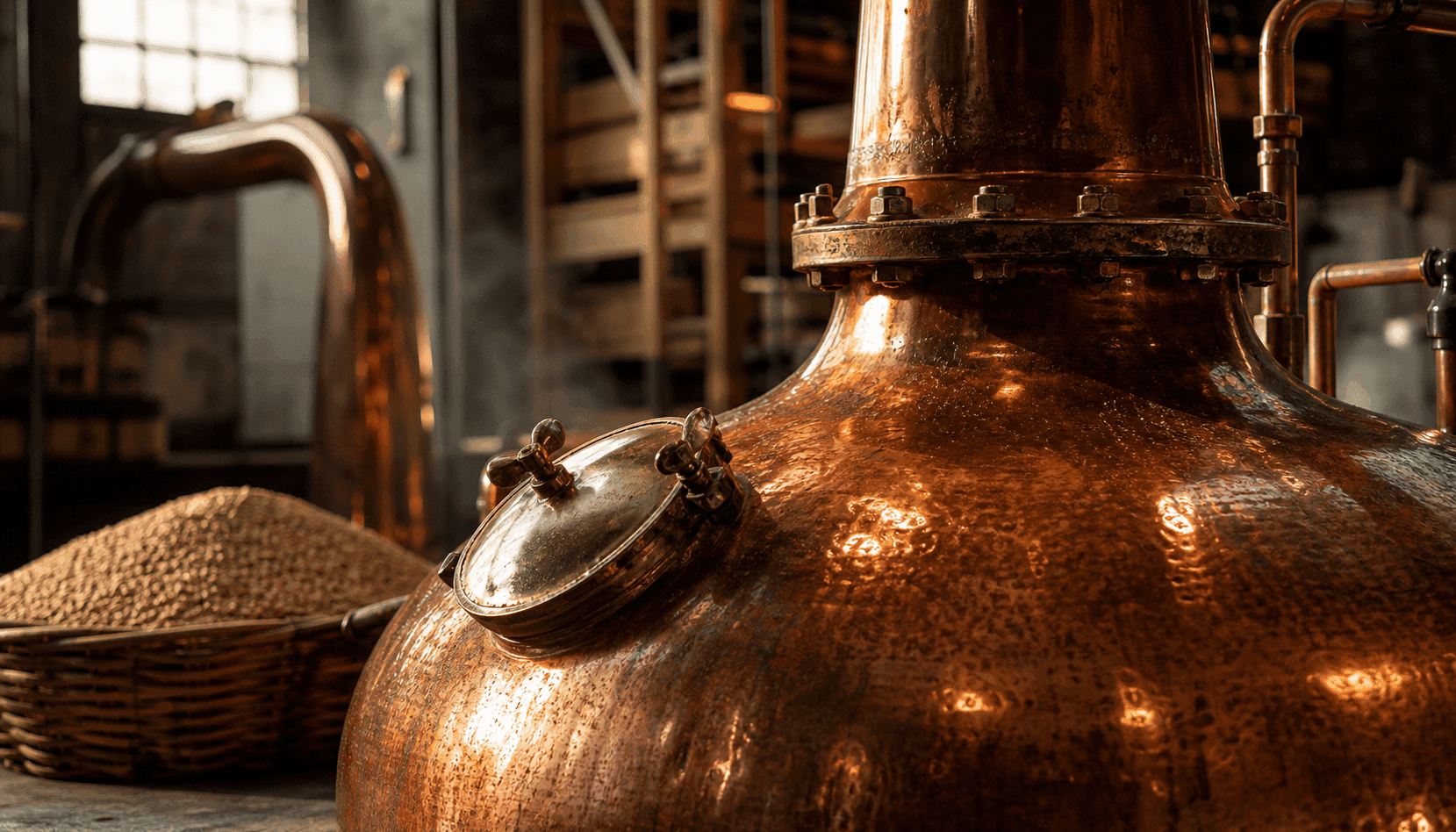
Copper pot stills, used for Scotch single malt and Irish pure pot still whiskey, produce a spirit that retains much of the fermentation-derived character of the wash. Taller, narrower stills with longer necks produce lighter, more delicate spirits by allowing heavier congeners to condense and fall back into the still before they can escape; shorter, squatter stills produce heavier, more robust spirits. The classic Scotch single malt identity, its aromatic complexity, its range from light and floral to rich and heavy, is largely a product of the enormous variety of pot still shapes used across Scottish distilleries.
Column Stills and Continuous Distillation
American bourbon uses a column still (also called a continuous still or Coffey still) for the first distillation, which produces spirit more efficiently than pot stills but at a higher degree of purity. The bourbon regulations cap distillation at 80% ABV to preserve grain character, and a second distillation in a pot still (the "doubler" or "thumper") is typically used to refine the spirit further. The result is a new make spirit that is cleaner than most pot still spirits but retains enough corn and grain character to be distinctively American.
Japanese Distillation
Japanese distillers imported Scottish pot still technology in the early twentieth century and developed their own approach to still design, often maintaining multiple still shapes within a single distillery to produce a range of new make spirits that can be blended in-house. This self-sufficiency in blending components distinguishes Japanese distilleries structurally from Scottish ones, where the industry norm is for distilleries to exchange casks with each other for blending purposes.
Maturation Climate and Cask Tradition
Climate and cask tradition interact to produce the most visually legible differences between national whisky styles. The colour of a whisky, much of its flavour, and its apparent age relative to its actual age are all heavily determined by where and how it matured.
Scotland: Cool, Damp, Slow
Scotland's maritime climate produces gradual maturation, the angel's share averages around 2% per year, and spirit may spend decades in cask developing complexity without over-oaking. The tradition of using previously filled casks (primarily ex-bourbon and ex-Sherry) means that the wood is less aggressive than new oak, giving the spirit time to develop its own character before the wood begins to dominate. This is why Scottish single malts can be bottled at twenty, thirty, or fifty years of age and remain balanced.
America: Continental Extremes
Kentucky's continental climate with hot summers and cold winters drives aggressive wood extraction. Bourbon matures much faster than Scotch relative to actual age, a well-made eight-year-old Kentucky bourbon can show oak complexity that would take a Scottish single malt fifteen or twenty years to develop. The new charred oak requirement amplifies this, producing the characteristic vanilla-caramel-spice profile that defines the category regardless of which distillery produced it.
Japan and Tropical Whisky Nations
Japan's four distinct seasons and relatively humid climate produce maturation outcomes that differ from both Scotland and America, slower than American conditions but with more seasonal variation than Scotland. Indian and Taiwanese whiskies, matured in tropical climates, develop at rates that can be three to five times faster than Scottish equivalents, which is why they can produce surprisingly complex expressions with only five to eight years in cask. The trade-off is a different flavour profile, more oxidative, sometimes more tannic, than cool-climate equivalents.
A Country-by-Country Flavour Guide
Each national whisky tradition produces a recognisable flavour signature, though variation within each country can be wide.
Scotland
The broadest and most varied national whisky tradition. Unpeated Speyside single malts: fruit, honey, floral notes, gentle oak. Heavily peated Islay malts: smoke, brine, seaweed, medicinal character. Highland expressions: broad, often combining fruit, spice, and moderate smoke. The connecting thread is malted barley character, a slightly biscuity grain note that persists through all regional variation.
Ireland
Irish whiskey is characterised by its lightness and approachability. Triple distillation in pot stills produces a particularly smooth spirit. Pure pot still Irish whiskey, made from a combination of malted and unmalted barley, has a distinctive spicy, oily character unlike anything produced in Scotland. Blended Irish whiskey, which dominates global sales, is deliberately gentle and easy to drink.
United States
Bourbon leads with sweetness: vanilla, caramel, toasted oak, and a corn-driven fullness. Rye whiskey is drier and spicier. Tennessee whiskey (filtered through charcoal before cask entry) is softer than standard bourbon. American single malt brings Scotch-influenced grain complexity to the American landscape.
Japan
Japanese whisky prioritises balance, restraint, and elegance. The flavour profiles often echo Speyside Scotch but with a distinctive precision and delicacy, less assertive than their Scottish inspirations. Heavily peated Japanese expressions are rarer but exist, as do heavily sherried expressions from distilleries with access to Spanish oak.
FAQ
Is Japanese whisky just imitation Scotch?
No. Japanese whisky began by importing Scottish techniques and equipment in the 1920s, but decades of development have produced a genuinely distinct style, more precise, more restrained, often more delicately balanced than the Scottish originals that inspired it. The best Japanese single malts are not inferior copies; they are original expressions of Japanese craft applied to a Scottish framework.
Why does Scotch taste smoky but bourbon does not?
Scotch can be smoky because some Scottish distilleries dry their malted barley over peat smoke, which introduces phenolic compounds into the grain that survive distillation and maturation. Bourbon does not use peated barley, so no smoke enters the production process. The toasty, caramelised character of bourbon comes from the charred oak barrel, not from the grain.
Why is Irish whiskey generally lighter than Scotch?
Irish whiskey is often triple-distilled, one more distillation pass than most Scotch single malt, which produces a lighter, purer new make spirit with fewer of the heavy congeners that contribute robust, complex character. Combined with the traditional Irish use of unpeated barley and predominantly lighter cask fills, the result is a consistently approachable, smooth spirit.
Can I tell which country a whisky comes from by tasting it?
Experienced tasters can often identify broad national origin, the sweetness of American bourbon, the maltiness of Scotch, the lightness of Irish whiskey, the delicacy of Japanese malt, but single expressions from any country can confound expectations. The best approach is comparative tasting across national styles, which makes the differences legible through contrast rather than analysis.
About the author

Janis Wilczura
I'm one of Germany's leading whisky experts, featured in Handelsblatt and BILD. To me, whisky is craftsmanship and art.
To the author