

Reach thousands of whisky and spirits lovers every day.


Why Was Campbeltown Once Called the Whisky Capital of the World?
 by Janis WilczuraI'm one of Germany's leading whisky experts, featured in Handelsblatt and BILD. To me, whisky is craftsmanship and art.
Follow Spiritory on Google News to get our latest guides and releases delivered straight to your feed.
Why Was Campbeltown Once Called the Whisky Capital of the World?
Campbeltown earned the name whisky capital of the world in the second half of the 19th century, when this small Argyll port on the Kintyre peninsula packed around 30 licensed distilleries within a short walk of its harbour, an extraordinary concentration of distilling for a single small town. A deep water harbour that shipped casks straight to Glasgow, the Clyde and the United States gave the town a trading advantage few rivals could match.
Key Takeaways
Campbeltown held around 30 licensed distilleries at its peak in the second half of the 19th century, though the exact figure varies by source since distilleries opened and closed throughout the century.
A deep water harbour connected the town directly to Glasgow, the Clyde and the United States, while local coal from the Drumlemble mine and barley from Kintyre farms let distillers produce whisky at an industrial scale.
The industry collapsed within about fifteen years, brought down by United States Prohibition, falling quality as producers cut corners, a damaging reputation known in some quarters as stinking fish, and the 1923 closure of the Drumlemble coal mine.
Only Springbank, licensed in 1828, and Glen Scotia, founded in 1832, survived the collapse; both paused production at times but returned, and both are still distilling today.
Glengyle, founded in 1872 and closed in 1925, reopened in 2004 under Springbank's owner, J & A Mitchell, producing a single malt called Kilkerran because the company does not hold the Glengyle brand name.
Campbeltown remains one of five whisky producing areas named in the Scotch Whisky Regulations 2009, alongside Highland, Lowland, Speyside and Islay.
Tip: If an old whisky label simply says Campbeltown, without naming Springbank, Glen Scotia or Glengyle, it most likely comes from one of the distilleries that closed in the 1920s rather than one still active today.
How Campbeltown Became the Whisky Capital of the World
Campbeltown sits on a natural harbour at the foot of the Kintyre peninsula, and that harbour is where its whisky boom began. Ships could load casks directly for Glasgow and the Clyde, and from there on to London and across the Atlantic to the United States, giving Campbeltown a trading route that inland distilleries could not easily match.
The town also had what a distillery needs close at hand. Coal from the local Drumlemble mine powered the stills, barley grew on the surrounding Kintyre farms, and the nearby hills supplied peat and water. Licensing reforms in the 1820s, which made legal distilling more attractive than the illicit stills long operated in the area, brought a wave of new distilleries in the years that followed. According to Scotch Whisky magazine, as many as 29 distilleries were established in Campbeltown between 1823 and 1844 alone, and whisky was made at some 35 sites across the town over its history, though not all of them operated at the same time.
By the second half of the 19th century, Campbeltown was widely described as the whisky capital of the world. Around 30 distilleries is the figure most often cited for the town's peak, though counts vary since new distilleries kept opening even as older ones closed. The writer Alfred Barnard, who toured Scotland's distilleries in the mid 1880s, is generally said to have recorded 21 working in Campbeltown at the time, still more whisky production packed into one small town than anywhere else in the country.
Why the Boom Collapsed in the 1920s and 1930s
Campbeltown's decline had several causes that arrived at once. As demand grew in the early 20th century, some producers cut corners to keep up, rushing production and reusing casks that should have been discarded, and the quality of Campbeltown whisky suffered as a result. Its heavy, oily style also fell out of favour as blenders increasingly turned to the lighter, fruitier malts coming out of Speyside.
The town's whisky also picked up an unflattering reputation, known in some quarters as stinking fish. Writers on the subject have found no solid evidence that Campbeltown whisky was ever actually stored in barrels that had held herring, and the nickname may have started as a jibe from rival distillers elsewhere in Scotland, but the reputation itself did real damage to sales regardless of where it came from.
Two external blows made things worse. United States Prohibition, in force from 1920 to 1933, closed off a market Campbeltown had relied on for decades. Locally, the Drumlemble coal mine that had powered the town's stills closed in 1923, removing one of the resources that had made large scale whisky production possible there in the first place. Most of Campbeltown's distilleries closed within a few years of each other during the 1920s, and by the mid 1930s the industry that had once dominated Scotch whisky production had almost entirely disappeared.
How Springbank and Glen Scotia Survived the Collapse
Two distilleries survived Campbeltown's collapse over the long run. Springbank, licensed in 1828, closed for several years in the late 1920s as the crisis deepened and returned to production in the 1930s, but the Mitchell family's company, J & A Mitchell, never gave up the site. Glen Scotia, founded in 1832, went through its own closures and changes of ownership over the following decades but always returned to distilling, and both companies are still making whisky in Campbeltown today.
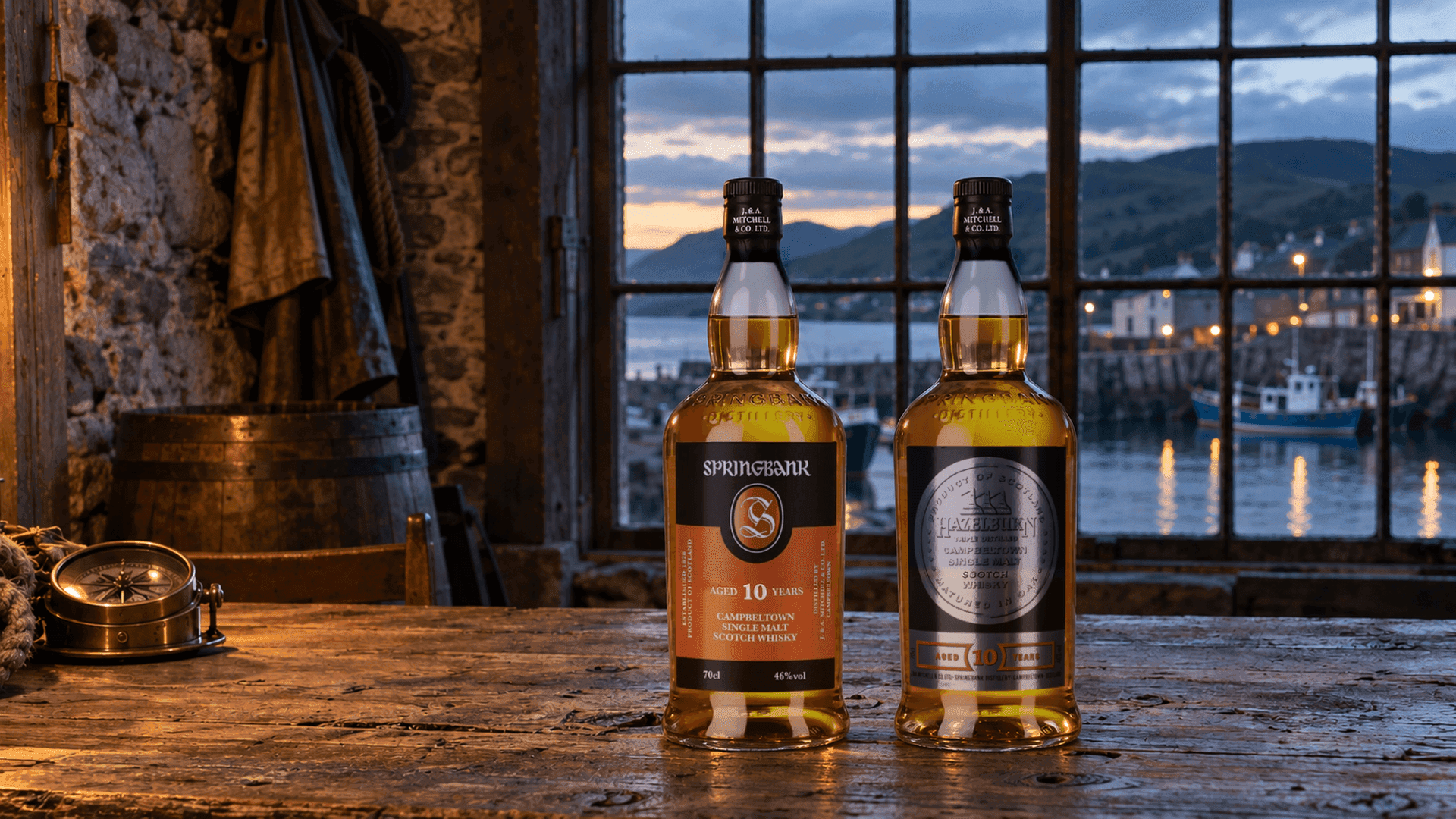
Springbank is known for distilling, maturing and bottling everything on its own site, including Longrow, its heavily peated line, and Hazelburn, its triple distilled malt. Its Longrow Red series, matured in ex bourbon casks before finishing in red wine casks, is one example of how the distillery has kept experimenting within that tradition. Spiritory's guide to the series looks at how it came about in What Is Longrow Red? Springbank's Wine Cask Whisky. Current core range bottles from both survivors are listed on Spiritory, including Springbank 10 Years Old and Glen Scotia Double Cask.
Why Glengyle Reopened as Kilkerran in 2004
Glengyle distillery was founded in 1872 by William Mitchell, a member of the same family that ran Springbank, after a dispute with his brother John led him to set up on his own. Like most of the town's distilleries, Glengyle did not survive the collapse of the 1920s, and it closed in 1925.
The buildings stood unused for most of the 20th century until Hedley Wright, a descendant of the original Mitchell family and the owner of J & A Mitchell, bought the site in 2000 and began restoring it. The restoration took four years, since almost all of the original equipment had been sold off decades earlier and had to be sourced again, much of it secondhand from other distilleries. The first new spirit was distilled at Glengyle in 2004.
The whisky made there is sold as Kilkerran rather than Glengyle, since another company holds the rights to the Glengyle name. A core range built around Kilkerran 12 Years Old and a rotating series of cask strength batches has grown steadily since the reopening.
Campbeltown's Place Among Scotland's Five Whisky Regions Today
The Scotch Whisky Regulations 2009, which came into force on 23 November 2009, name Campbeltown alongside Highland, Lowland, Speyside and Islay as one of the whisky producing areas that can be named on a bottle's label, so long as the whisky inside was actually distilled there. Under the regulations, Campbeltown covers the South Kintyre ward of the Argyll and Bute Council, and the whisky trade generally refers to all five together as Scotland's whisky regions, even though the regulations themselves technically classify Highland, Lowland and Speyside as protected regions and Campbeltown and Islay, the two smallest, as protected localities.
Three distilleries now carry that designation: Springbank, Glen Scotia and Glengyle. How their whiskies differ from each other, and from the town's Victorian era output, is a comparison worth its own look another day.
Tip: When shopping for a bottle from any of the three current Campbeltown distilleries, check whether it is a core range release or a limited single cask. Independent bottlings and cask specific editions from Springbank, Glen Scotia and Kilkerran turn over quickly and rarely repeat.
FAQ
How many distilleries did Campbeltown have at its peak?
Most accounts put the number at around 30 licensed distilleries during the second half of the 19th century, though the exact figure varies by source since distilleries opened and closed throughout the century. Counts of every distillery ever established in the town, including short lived ones, run higher.
Why did Campbeltown's whisky industry collapse?
Several factors hit at once in the 1920s and 1930s: United States Prohibition closed off a major export market, falling quality damaged the town's reputation, the local Drumlemble coal mine closed in 1923, and blenders increasingly preferred the lighter whiskies coming out of Speyside.
What does stinking fish mean in Campbeltown whisky history?
It was an unflattering nickname for Campbeltown whisky that circulated as its reputation declined. Writers on the subject have found no solid evidence that the whisky was actually stored in herring barrels, and the phrase may have started as a rival's jibe, but it reflected real damage to how the whisky was perceived at the time.
Which Campbeltown distilleries survived, and which reopened?
Springbank and Glen Scotia both survived the collapse, returning to production after pauses in the late 1920s and 1930s, and are still producing whisky today. Glengyle closed in 1925 and reopened in 2004 under Springbank's owner, J & A Mitchell, making a single malt called Kilkerran.
Is Campbeltown still an official Scotch whisky region?
Yes. The Scotch Whisky Regulations 2009 name Campbeltown alongside Highland, Lowland, Speyside and Islay as one of the whisky producing areas that can be named on a label, covering the South Kintyre ward of the Argyll and Bute Council.
About the author

Janis Wilczura
I'm one of Germany's leading whisky experts, featured in Handelsblatt and BILD. To me, whisky is craftsmanship and art.
To the author