

Reach thousands of whisky and spirits lovers every day.


The Whisky Sour: How to Make It Properly Every Time
 by Janis WilczuraI'm one of Germany's leading whisky experts, featured in Handelsblatt and BILD. To me, whisky is craftsmanship and art.
Follow Spiritory on Google News to get our latest guides and releases delivered straight to your feed.
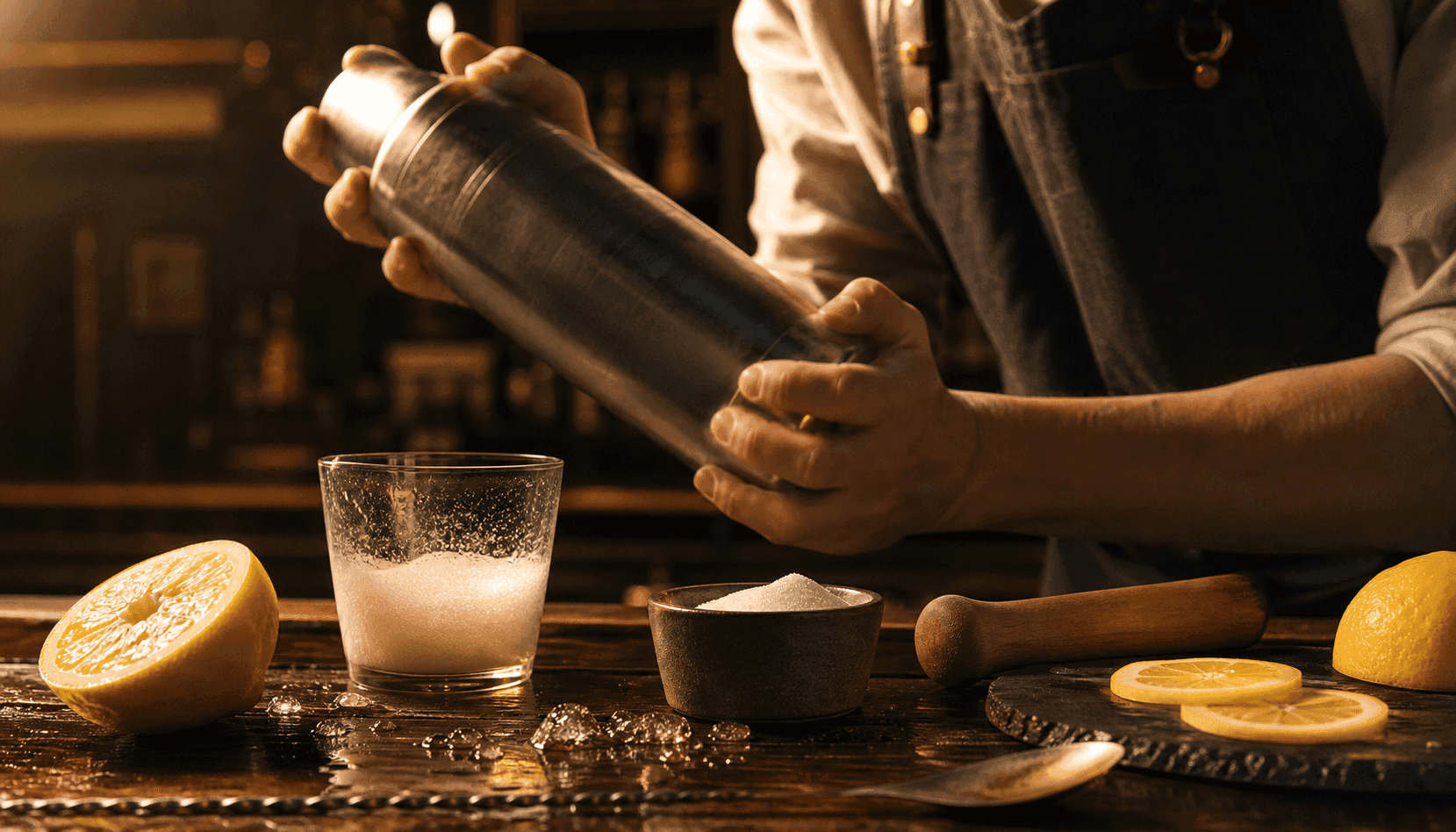
The Whisky Sour: How to Make It Properly Every Time
Key Takeaways
There is no single fixed ratio. The IBA official recipe uses 45 ml bourbon, 25 ml fresh lemon juice and 20 ml sugar syrup, while Difford's Guide describes 2:1:1 (whisky, lemon juice, 1:1 simple syrup) as the most common formula in the USA.
Fresh lemon juice is essential. The IBA recipe specifies it, and bottled juice gives a flatter, duller drink.
Egg white is optional in the IBA recipe. It adds a layer of foam and a silky texture; pasteurised egg white and aquafaba are alternatives to raw egg.
Bourbon is the classic base. Rye whiskey makes a drier, spicier sour, and a gently smoky Scotch a more layered one.
With egg white, shake first without ice to build the foam, then with ice to chill and dilute. The reverse dry shake swaps the order of the two steps.
Serve in a chilled coupe or over ice in a rocks glass. The IBA garnish is half an orange slice and a maraschino cherry.
The Classic Recipe
Before exploring variations and whisky choices, it is worth establishing the standard recipe. The whisky sour is a simple combination of whisky, lemon juice and sugar, with egg white as an optional addition, and the International Bartenders Association (IBA) lists it among its Unforgettables. Its roots lie in the nineteenth century. Jerry Thomas's 1862 book How to Mix Drinks, or The Bon-Vivant's Companion already included a Brandy Sour, a Gin Sour and a Santa Cruz Sour made with rum, but no whisky version, and one of the earliest known printed mentions of a whisky sour appeared in the Waukesha Plain Dealer, a Wisconsin newspaper, on 4 January 1870.
Ingredients
The IBA official recipe calls for 45 ml bourbon, 25 ml fresh lemon juice, 20 ml sugar syrup and, optionally, a few drops of egg white. Many bartenders pour a larger measure of whisky. Difford's Guide uses 60 ml bourbon, 30 ml lemon juice, 20 ml rich 2:1 sugar syrup, three dashes of Angostura bitters and 15 ml pasteurised egg white, while PUNCH pairs 60 ml bourbon with about 22 ml each of lemon juice and 1:1 simple syrup, plus 15 ml egg white. The IBA garnish is half an orange slice and a maraschino cherry, with orange zest as an option; a few drops of Angostura bitters on the foam are a popular alternative.
Method
Add the whisky, lemon juice, syrup and egg white to a shaker without ice and shake hard for about 15 seconds to build the foam; this is the dry shake. Add ice and shake for about 15 seconds more to chill and dilute. Some bartenders reverse the order, shaking with ice first, straining out the ice and then shaking again without it; Difford's Guide uses this reverse dry shake. Fine strain into a chilled coupe, or into a rocks glass filled with fresh ice. Without egg white, a single hard shake with ice is enough. To decorate the foam with bitters, place a few drops on the surface and draw a cocktail pick through them.
Choosing the Right Whisky
The whisky sour is a forgiving format for exploring different whiskies, but the choice of base spirit clearly shapes the finished drink. The best results come from whiskies with enough character to stand up to citrus, sugar and dilution.
Bourbon
Bourbon is the base in the IBA recipe and in most published recipes, and for good reason. Aged in new charred oak containers, it brings vanilla and caramel notes that sit comfortably alongside lemon and sugar. A bourbon bottled at a higher strength keeps its presence after shaking and dilution; both guest bartenders at a PUNCH whiskey sour tasting felt that a high proof bourbon could do the job well. Search bourbon expressions on Spiritory for bottles suited to mixing.
Rye Whiskey
Rye whiskey makes a drier, more assertive whisky sour, with spice that cuts through the sweetness. Because rye tastes less sweet than most bourbons, a touch more syrup may be needed to keep the drink in balance. The same PUNCH panelists considered rye the stronger choice when egg white is used, because it keeps more presence against the softening effect of the egg white.
Scotch Whisky
A blended Scotch or a gently smoky single malt is a less traditional but rewarding choice. Peat smoke and citrus combine into a complex, layered drink. Choose a whisky with enough body, as very delicate single malts can get lost behind the lemon and sugar. Highland Park, whose Orkney peat gives its single malts a subtle, aromatic smoke, is a good starting point.
Tip: To avoid raw egg, use pasteurised egg white or aquafaba, the liquid from a can of chickpeas, in the same measure. Aquafaba produces a similar foam but can carry a faint chickpea aroma; how noticeable it is depends on the other ingredients in the drink.
The Egg White Question
Whether to add egg white divides drinkers and bartenders. It was not part of most early recipes, but in 1922 the Belgian bartender Robert Vermeire wrote in Cocktails: How to Mix Them that a few drops of egg white improve all sours. Today a whisky sour made with egg white is often called a Boston Sour.
What Egg White Does
Egg white gives a cocktail a fuller body, a frothy texture and an appealing head of foam, and it tempers the whisky. Of the 17 whisky sours submitted to a PUNCH tasting, 13 contained it. Raw eggs can occasionally carry salmonella, so the US Food and Drug Administration (FDA) recommends pasteurised eggs or egg products for dishes served with raw egg, a precaution that matters most for children, older adults, pregnant women and people with weakened immune systems.
The Sour Without Egg White
A whisky sour without egg white is a perfectly valid drink, and the IBA lists egg white as optional. It is brighter and more direct, with a cleaner citrus profile and a lighter body. For those who prefer a more spirit focused drink, or simply prefer not to use egg, leaving it out is no real compromise, provided the balance and technique are right.
Variations Worth Exploring
The whisky sour's simple structure makes it an exceptionally adaptable template. Small changes to the sweetener, the finish or the base spirit open up a range of distinct drinks while keeping the character of the original.
The New York Sour
The New York Sour finishes a whisky sour with a float of dry red wine, poured slowly over the back of a bar spoon so that it rests on top of the drink. According to Difford's Guide, it is thought to have been first made by a Chicago bartender in the 1880s and went by several names, including Continental Sour, before New York Sour became the usual one. Difford's recipe uses 15 ml of chilled claret, a red Bordeaux. Egg white is not a classic part of the New York Sour, although many modern versions include it.
Gold Rush and Penicillin
Replacing sugar syrup with honey syrup turns a bourbon sour into the Gold Rush, conceived by T.J. Siegal at Milk & Honey in New York in the early 2000s; the bar's honey syrup was three parts honey to one part water. In 2005, Sam Ross, then at Milk & Honey, created the Penicillin, partly inspired by the Gold Rush: blended Scotch, lemon juice and honey and ginger syrup, finished with a float of smoky Islay single malt. Difford's Guide advises mixing only as much honey syrup as will be used within a few days and keeping it in the refrigerator.
The Amaretto Sour
The Amaretto Sour is usually built on amaretto rather than whisky, but bourbon can give it more backbone. The recipe bartender Jeffrey Morgenthaler published in 2012 combines 45 ml amaretto with 22.5 ml cask strength bourbon, 30 ml lemon juice, 5 ml rich 2:1 syrup and 15 ml egg white. Because amaretto is itself a sweet liqueur, only a little syrup is needed. It is best approached as its own recipe rather than as a modified whisky sour.
Common Mistakes to Avoid
The whisky sour is not a complex drink, but the same mistakes come up again and again, at home and behind the bar.
Using Bottled Lemon Juice
Bottled lemon juice is one of the most common errors. It lacks the bright aroma of freshly squeezed juice, which is why the IBA recipe specifies fresh lemon juice. Squeeze the lemons shortly before making the drink; the difference is not subtle.
Insufficient Shaking
Shaking chills and dilutes the drink and, when egg white is used, builds the foam. The IBA advises shaking a little harder when egg white is included. Give the dry shake around 15 seconds of full effort and the shake with ice about the same again. A sour that has not been shaken long enough stays too warm and has a thin foam that fades quickly.
Wrong Glass Temperature
A room temperature coupe quickly warms a drink served without ice. Chill the glass in the freezer, or fill it with ice water while you shake and empty it before straining. For egg white versions, the guest bartenders at the PUNCH tasting preferred the drink served up in a coupe, noting that egg white foam breaks down quickly on the rocks.
FAQ
What is the best whisky for a whisky sour?
Bourbon is the classic choice and the base of the IBA official recipe. A bourbon bottled at a higher strength keeps more presence after dilution. Rye whiskey makes a drier, spicier version, and a gently smoky Scotch a more complex, smoky one.
Can I make a whisky sour without egg white?
Yes. The IBA lists egg white as optional, and a sour without it is brighter and lighter. For a similar foam without raw egg, use pasteurised egg white, or aquafaba (chickpea liquid) in the same measure, bearing in mind that aquafaba can add a faint chickpea note.
How do I make simple syrup for a whisky sour?
Combine equal parts sugar and water and stir or shake until the sugar has dissolved; 1:1 syrup needs no heat. Store it in a clean, sealed bottle in the refrigerator. Difford's Guide prefers a rich 2:1 syrup, two parts sugar to one part water, which dilutes the drink less; 20 ml of 2:1 syrup is roughly as sweet as 30 ml of 1:1 syrup.
How much lemon juice goes in a whisky sour?
Published recipes use from about 22 to 30 ml of fresh lemon juice. The IBA recipe pairs 25 ml with 45 ml of bourbon, Difford's Guide uses 30 ml with 60 ml, and PUNCH about 22 ml with 60 ml. Adjust slightly to the acidity of your lemons so that neither the whisky nor the citrus dominates.
About the author

Janis Wilczura
I'm one of Germany's leading whisky experts, featured in Handelsblatt and BILD. To me, whisky is craftsmanship and art.
To the author