

Reach thousands of whisky and spirits lovers every day.


Fermentation: The Hidden Art Behind Great Whisky
 by Damian BaranHooked since a Talisker 10 in 2021, I've tasted over 800 whiskies and love Islay peat and independent bottlings.
Follow Spiritory on Google News to get our latest guides and releases delivered straight to your feed.
Fermentation: The Hidden Art Behind Great Whisky
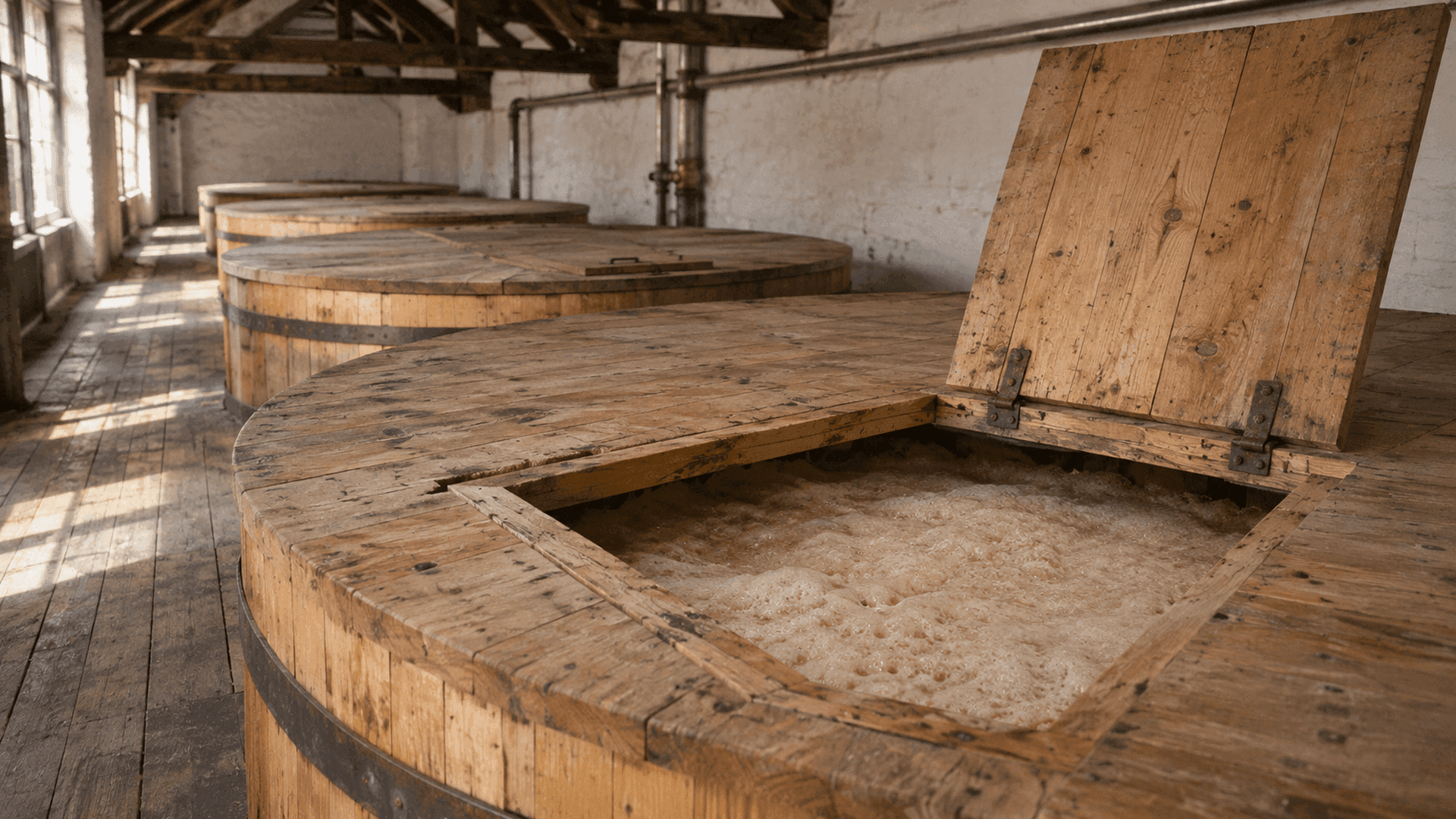
Fermentation shapes whisky flavour because yeast turns sugary wort into alcohol while also creating esters and other aroma compounds. In Scotch malt distilleries the wash usually reaches about 7 to 8% ABV over 48 to 60 hours, and longer fermentations of up to 120 hours give lactic acid bacteria time to add further character.
Why yeast, time and microorganisms play a far greater role in whisky production than most drinkers realise.
When discussing what makes a great whisky, the conversation usually turns to three familiar elements: the quality of the barley, the shape of the stills and, above all, the casks used for maturation. We talk about sherry casks, bourbon barrels, peat levels and years spent in oak.
Yet there is another stage of production that deserves considerably more attention: fermentation.
Taking place long before the spirit enters the still, fermentation is one of the most important stages in determining the character of the whisky. It is here that yeast transforms sugary wort into alcohol while simultaneously creating a complex mixture of flavour and aroma compounds.
And although fermentation might sound like a relatively straightforward biological process, the reality is much more fascinating.
From sweet wort to whisky wash
Before fermentation can begin, malted barley must undergo mashing. During this process, hot water extracts fermentable sugars from the malt, producing a sweet liquid known as wort.
Once cooled, the wort is transferred into large fermentation vessels called washbacks. These can be made from stainless steel or wood, depending on the distillery.
Yeast is then introduced, usually a strain of Saccharomyces cerevisiae, and the transformation begins.
The yeast consumes the available sugars, producing two primary products: ethanol and carbon dioxide. However, alcohol is only part of the story.
During fermentation, yeast also generates numerous secondary compounds, collectively known as congeners. These include esters, higher alcohols, aldehydes and other volatile substances that contribute to the eventual aroma and flavour of the spirit.
In other words, fermentation does much more than simply produce alcohol. It creates some of the building blocks of whisky's personality.
Yeast: The invisible flavour architect
Not all yeast behaves in the same way.
Different yeast strains can produce different quantities and combinations of flavour compounds, meaning that the choice of yeast can influence the character of the new make spirit.
Esters are particularly interesting. Depending on their chemical structure and concentration, they can contribute fruity and floral impressions.
Some compounds are associated with apple and pear, others with tropical fruit, banana or more delicate floral characteristics.
Higher alcohols, meanwhile, contribute to the complexity of the spirit, although excessive concentrations can produce heavier or less desirable characteristics.
This explains why fermentation is not simply about achieving the highest possible alcohol yield. Distillers must balance efficiency with flavour development.
Interestingly, research into alternative yeast strains suggests that there may still be considerable room for innovation in this area. Different microorganisms could potentially help producers develop new flavour profiles while maintaining the traditional identity of Scotch whisky.
Short versus long fermentation: Does time really matter?
One of the most frequently discussed aspects of whisky fermentation is its duration.
In many Scotch malt whisky distilleries, fermentation takes approximately two to five days, although individual production regimes can differ considerably.
A shorter fermentation generally focuses on efficiently converting sugars into alcohol. A longer fermentation allows more time for additional microbial activity and the development of different flavour compounds.
This is where things become particularly interesting.
After the main alcoholic fermentation, lactic acid bacteria can become increasingly important. These microorganisms produce organic acids and other compounds that can subsequently contribute to the formation of additional esters.
The result can be a different flavour profile, potentially with greater fruity, floral or creamy characteristics.
However, longer fermentation does not automatically mean better whisky.
It is a stylistic decision, influenced by the distillery's production philosophy, equipment, yeast selection and desired spirit character.
Some producers favour a relatively controlled and efficient fermentation, while others allow the process to continue for longer to encourage additional complexity.
Neither approach is inherently superior. They simply represent different ways of shaping the spirit.
Wooden washbacks versus stainless steel
Another fascinating element is the fermentation vessel itself.
Some distilleries continue to use traditional wooden washbacks, while others have adopted stainless steel vessels.
Wooden washbacks are often associated with traditional production methods and can harbour complex microbial communities within their surfaces.
Stainless steel, on the other hand, offers practical advantages in terms of cleaning, maintenance and process control.
It would be tempting to assume that wooden washbacks automatically produce more complex whisky. However, the reality is more complicated.
The final outcome depends on numerous interacting factors, including the microbial environment, fermentation temperature, yeast strain and production management.
The material of the washback alone cannot explain the flavour of the resulting spirit.
What makes this subject particularly interesting is the possibility that the microbial environment of a distillery contributes to its individual character.
Fermentation and the future of whisky
Although whisky production is deeply rooted in tradition, fermentation is an area where science continues to open new possibilities.
Recent research has investigated the potential of non-conventional yeast strains, including species outside the traditional Saccharomyces family.
These microorganisms are already being explored in other industries, particularly brewing and winemaking.
Their potential application in whisky production could offer distillers new ways of influencing ester production, aroma development and the overall character of new make spirit.
This does not mean traditional whisky production is about to disappear.
Rather, it demonstrates that even a centuries-old craft can benefit from a better understanding of microbiology.
For distilleries seeking to differentiate themselves in an increasingly competitive market, fermentation could become an important tool for creating distinctive spirits.
The stage before the cask that deserves more attention
Whisky is often described through the language of maturation. We discuss the influence of oak, previous cask contents, warehouse conditions and the passage of time.
All of these elements are undoubtedly important.
However, the spirit entering the cask is already the result of a remarkable series of chemical and biological transformations.
Fermentation establishes part of the aromatic foundation upon which distillation and maturation will subsequently build.
A beautifully selected sherry cask cannot completely rewrite the spirit's original character. It can transform, complement and develop it, but the foundations have already been laid.
Perhaps this is why fermentation deserves a much more prominent place in discussions about whisky quality.
The next time you discover an exceptionally fruity, floral or unusually complex dram, remember that some of its most interesting characteristics may have originated days before the spirit ever reached the copper still.
Great whisky does not begin in the cask. In many ways, it begins with yeast.
About the author

Damian Baran
Hooked since a Talisker 10 in 2021, I've tasted over 800 whiskies and love Islay peat and independent bottlings.
To the author