

Reach thousands of whisky and spirits lovers every day.


Tamdhu 28 Years Old – A Taste of Another Era. 28 Years of Speyside History in a Bottle
 by Damian BaranHooked since a Talisker 10 in 2021, I've tasted over 800 whiskies and love Islay peat and independent bottlings.
Follow Spiritory on Google News to get our latest guides and releases delivered straight to your feed.
Tamdhu 28 Years Old – A Taste of Another Era. 28 Years of Speyside History in a Bottle
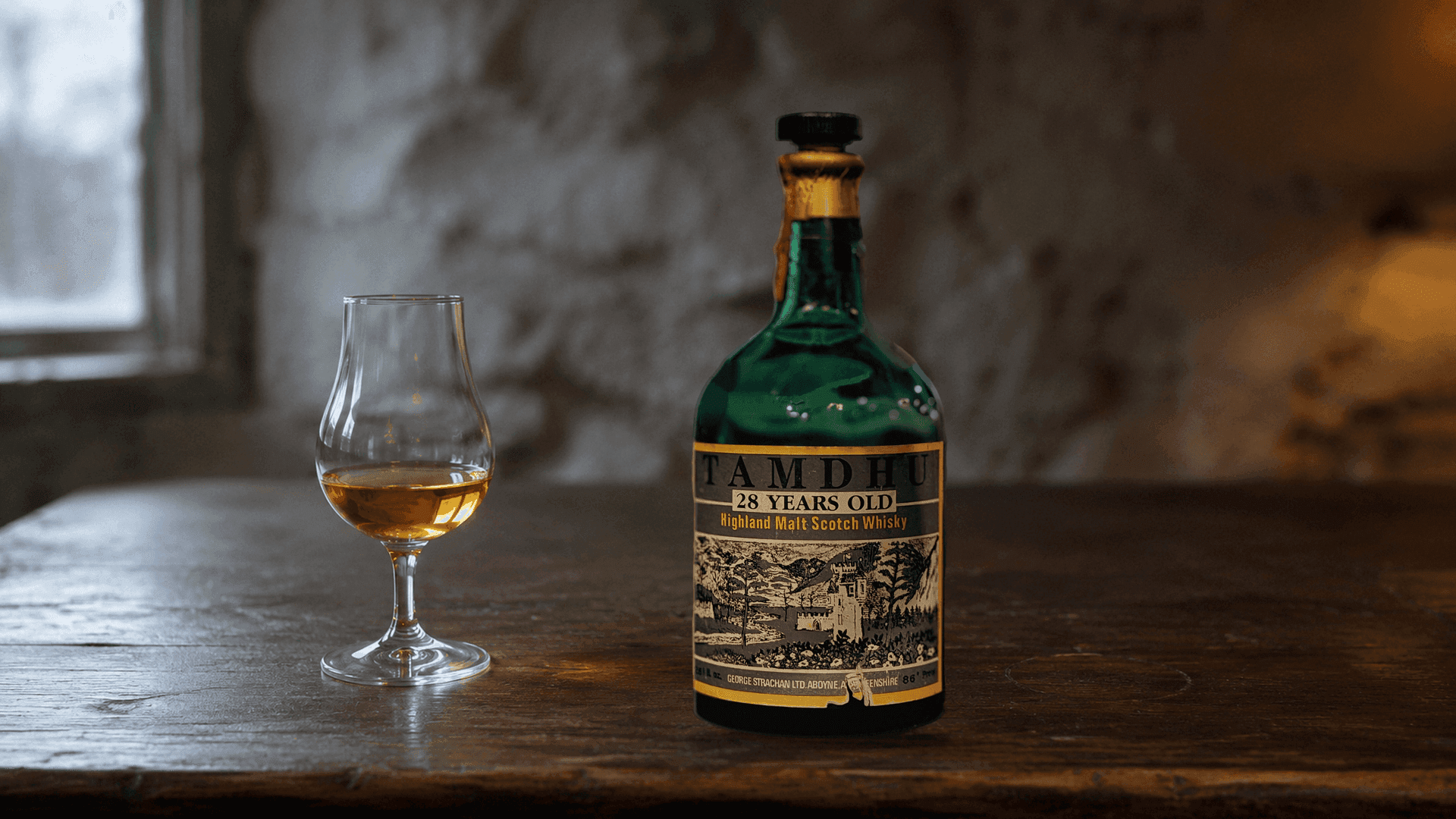
This Tamdhu 28 Years Old is a single malt from the Knockando distillery in Speyside, bottled by George Strachan Ltd. of Aboyne, Aberdeenshire, a family grocer and wine merchant founded in 1926. Tamdhu itself dates from 1897 and was designed by Charles Doig. The label describes it as Highland Malt Scotch Whisky and gives the strength as 86° Proof.
There are whisky bottles that attract our attention because of their age, others because of the distillery behind them, and some because they represent a particular moment in the history of Scotch whisky. And then there are bottles that combine all three.
This Tamdhu 28 Years Old, bottled by George Strachan Ltd. of Aboyne, Aberdeenshire, belongs to the latter category. It is more than a mature Speyside single malt. It is a small piece of whisky history, connecting a traditional Scottish distillery with the independent bottling culture of a time when the whisky industry looked very different from today.
When looking at a bottle like this, I find myself becoming just as interested in its history as in the liquid waiting inside. Who made it? What was the distillery producing almost half a century ago? And how different might this whisky be from the Tamdhu we know today?
Tamdhu – A Distillery Born in the Golden Age of Speyside
To understand this bottle, we need to travel back to 1897, when Tamdhu Distillery was established in Knockando, in the heart of Speyside.
Its name comes from Gaelic and is generally translated as little dark hill. The distillery was founded by a group of whisky entrepreneurs and blenders who recognised the potential of the Speyside region. Among the people associated with its creation was William Grant, while the design was entrusted to Charles Chree Doig, one of Scotland's most influential distillery architects.
Doig was responsible for designing numerous Scottish distilleries, and his influence can still be seen across the whisky landscape today. Tamdhu was conceived as a modern and efficient production facility, reflecting the technological ambitions of the late Victorian era.
The location was particularly advantageous. Situated close to the River Spey and connected to the railway network, the distillery benefited from access to transport routes that were essential for moving barley, coal and whisky casks.
However, Tamdhu's history was not always straightforward.
The distillery experienced a prolonged closure beginning in 1927, remaining silent until 1948. Its return to production marked the beginning of another important chapter. In 1951, Tamdhu became one of the early adopters of the Saladin Box malting system, a mechanical method of turning and aerating germinating barley.
This technology allowed the distillery to produce malt on a much larger scale than traditional floor maltings. Tamdhu eventually became an important supplier of malt to other distilleries within its wider whisky group.
The 1970s brought another period of expansion. Whisky demand was growing, and Tamdhu responded by increasing its production capacity. Its original two stills were expanded to four in 1972 and eventually to six in 1975.
This is particularly interesting when considering the age of the bottle in front of us. A whisky carrying a 28-year age statement, bottled during the 1970s, would have been distilled in an earlier period, when Tamdhu was operating with a considerably smaller production setup.
It is a fascinating connection between different generations of the distillery.
George Strachan – The Independent Bottler Behind the Story
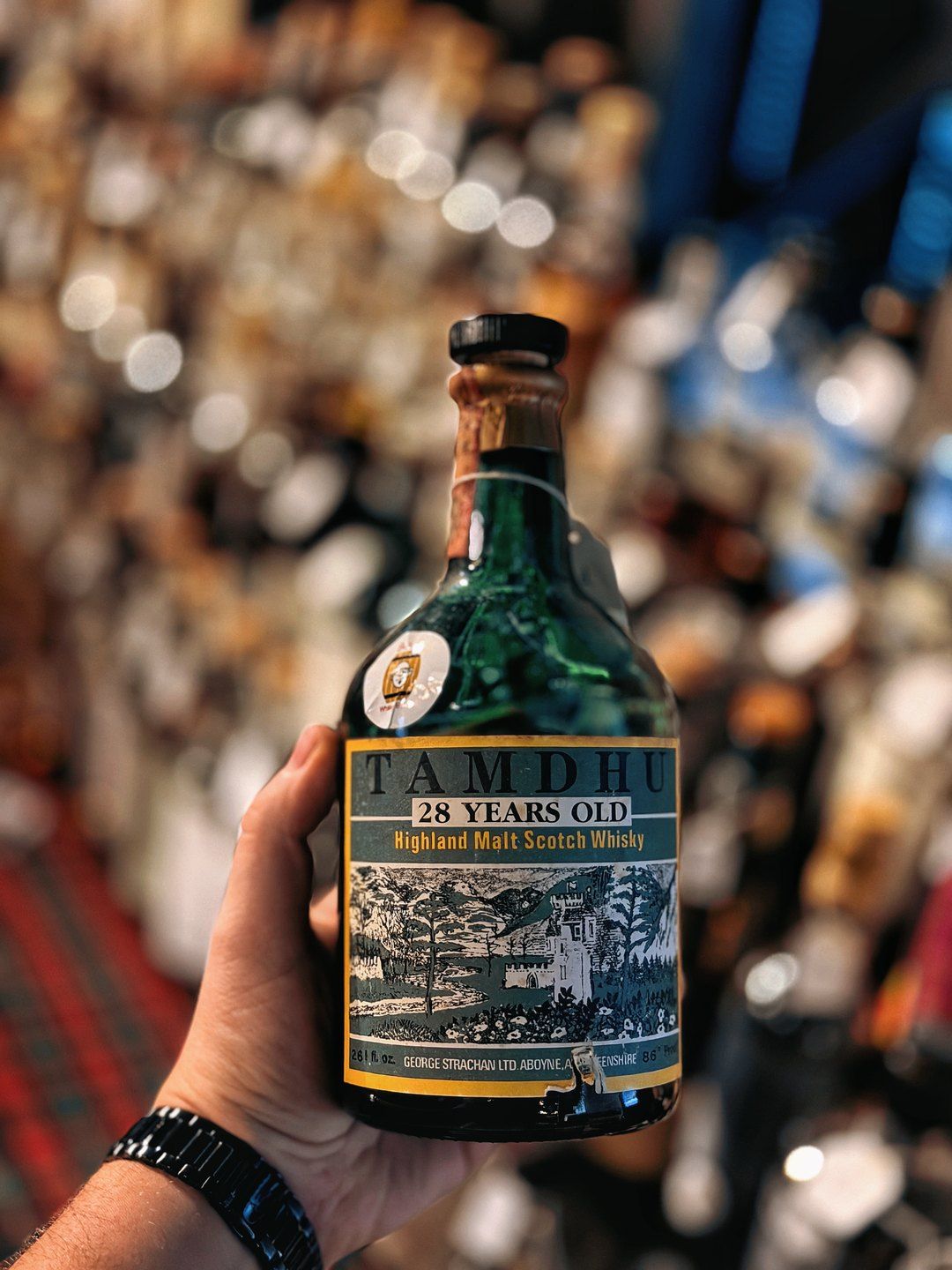
Another reason this bottle deserves attention is the name printed on its label: George Strachan Ltd., Aboyne, Aberdeenshire.
Independent bottlers have always played an important role in Scotch whisky. Before single malt became the global phenomenon it is today, many distilleries concentrated primarily on producing whisky for blends.
Independent merchants offered another route to the market. They could purchase mature casks, select individual whiskies and bottle them under their own names.
George Strachan was a Scottish family business established in 1926. Operating as a grocer and wine and spirits merchant, the company gradually developed its own whisky bottlings, offering enthusiasts access to mature single malts from different Scottish distilleries.
This is one of the aspects I find particularly attractive about historical independent bottlings.
They were not necessarily created to become collector's items. Their purpose was to offer good whisky to customers, often with an emphasis on age, provenance and the reputation of the merchant.
Today, however, bottles carrying the George Strachan name have become interesting historical objects in their own right.
The Tamdhu 28 Years Old is a wonderful example of that tradition: a mature Speyside whisky presented not as a modern luxury product, but as a straightforward expression of its distillery and its age.
Twenty-Eight Years in Oak – What Could Be Inside the Bottle?
Twenty-eight years is a considerable amount of time for a whisky to spend in a cask.
During maturation, the spirit gradually develops through its interaction with oak. Fruit, sweetness, spice and wood can evolve into something much more complex than the original new make spirit.
However, one important detail needs to be acknowledged: the available information does not establish the exact cask type used for this particular bottling.
This is especially important with Tamdhu because its modern reputation is strongly connected to sherry maturation. Today, the distillery is particularly associated with Oloroso sherry casks, dried fruit, chocolate, nuts and warming spices.
But we should not automatically apply that modern identity to every historical Tamdhu.
The distillery's exclusive sherry-cask approach developed much later, particularly during the 1990s. Earlier Tamdhu bottlings could show a broader range of maturation influences.
And this brings us to one of the most interesting questions: how might a 28-year-old Tamdhu from this period compare with the whisky produced and bottled today?
Tasting Notes – A Different Expression of Tamdhu
Nose
I would approach this whisky expecting a more delicate and evolved Speyside character than the rich, heavily sherried profile associated with modern Tamdhu.
The expected aromas include mature orchard fruits, stewed apples, dried apricots and raisins, accompanied by honey, caramel and soft malt sweetness.
With time in the glass, I would look for floral notes, mint, old-fashioned herbal character and perhaps a subtle suggestion of earthy smoke.
The oak should provide depth rather than dominate the experience, potentially bringing polished wood, leather and the atmosphere of an old library.
Palate
The expected palate is rounded and mature, with creamy caramel, fudge, honey and cooked fruit.
There could also be a gentle combination of herbal notes, soft spices and malty sweetness. Rather than the concentrated richness of a modern sherry bomb, I would expect a more restrained and layered character.
With 28 years of maturation, the texture and integration of flavours would be particularly interesting to explore.
Finish
A lingering finish with mature oak, gentle spices, toffee and fading fruit sweetness would be an appealing expectation.
Perhaps a little dryness towards the end, accompanied by an elegant herbal character.
The real pleasure of a whisky like this would be discovering how much complexity remains after almost three decades in oak.
Old Tamdhu vs Modern Tamdhu – Two Different Personalities?
One of the most fascinating aspects of historical whisky collecting is comparing older bottlings with the contemporary expressions produced by the same distillery.
Tamdhu is a particularly interesting example.
A useful historical reference is the Tamdhu 10 Years Old bottled in the late 1970s. Its documented tasting profile describes fresh sherry notes, marmalade, raisins, cooked fruit, honey, floral and minty aromas, alongside light heathery peat and an unusual old-book character.
On the palate, it was described as sweet and creamy, with fudge, herbal elements, a little smoke and a subtle grainy, grassy character.
This gives us an interesting picture of the older Tamdhu style.
It was not necessarily the intensely rich and concentrated sherry experience that many whisky enthusiasts associate with the brand today.
The older spirit appears to have offered a more varied combination of malt, fruit, honey, herbs and subtle smoky elements.
Modern Tamdhu, on the other hand, has built a very recognisable identity around Oloroso sherry casks. Dried fruits, raisins, cherries, dark chocolate, nuts, cinnamon and rich oak are now central to its flavour profile.
The difference is not simply about age. It also reflects changes in maturation policy, cask selection and the way the distillery presents its whisky to the market.
And this is precisely why I find older Tamdhu bottlings so fascinating.
They allow us to explore a different interpretation of the same distillery character, one that might be difficult to reproduce today.
Of course, a single historical 10-year-old bottling cannot define every Tamdhu produced during the 1970s. Nevertheless, it provides a valuable reference point when considering what this 28-year-old expression might offer.
Why This Bottle Matters to Collectors
There are many ways to collect whisky.
Some collectors concentrate on famous distilleries, others search for rare vintages, single casks or exceptional age statements. Personally, I find historical independent bottlings particularly rewarding because they combine several dimensions of collecting.
This Tamdhu offers:
- A substantial 28-year age statement.
- A connection to a historic Speyside distillery established in 1897.
- An association with George Strachan, an interesting name in the history of independent bottling.
- Traditional packaging that reflects another generation of Scotch whisky.
- An opportunity to explore a style of Tamdhu that predates the brand's modern sherry-focused identity.
It is also a reminder that the history of Scotch whisky cannot be understood through official distillery releases alone.
Independent bottlers preserved many expressions that might otherwise have remained forgotten or disappeared into blended Scotch.
They gave us access to individual distillery characters, different maturation styles and whiskies that represent a particular moment in time.
Final Thoughts – More Than 28 Years of Maturation
I have always believed that some bottles deserve more attention than their labels initially suggest.
This Tamdhu 28 Years Old is one of them.
Its appeal goes beyond the impressive age statement. It represents a connection between a historic Speyside distillery, the independent bottling tradition and a period when the whisky industry was still developing many of the practices we take for granted today.
What interests me most is the possibility of discovering a different side of Tamdhu.
Not necessarily the rich, dark and heavily sherried character we recognise from modern releases, but something more delicate, perhaps more herbal, fruity and traditionally Speyside in style.
And that is what makes historical bottles so rewarding.
They allow us to look beyond familiar brand identities and discover how a distillery's character has evolved over the decades.
Some bottles are collected because of what they are worth. Others because of what they represent.
For me, this Tamdhu belongs firmly in the second category.
Twenty-eight years in oak. Almost a century and a half of distillery history. And a little piece of Scotland preserved in glass.
- Tamdhu – A Distillery Born in the Golden Age of Speyside
- George Strachan – The Independent Bottler Behind the Story
- Twenty-Eight Years in Oak – What Could Be Inside the Bottle?
- Tasting Notes – A Different Expression of Tamdhu
- Old Tamdhu vs Modern Tamdhu – Two Different Personalities?
- Why This Bottle Matters to Collectors
- Final Thoughts – More Than 28 Years of Maturation
About the author

Damian Baran
Hooked since a Talisker 10 in 2021, I've tasted over 800 whiskies and love Islay peat and independent bottlings.
To the author