

Reach thousands of whisky and spirits lovers every day.


Michter's: The American Whiskey Brand That Has Entered the Collectors' Big League
 by Damian BaranHooked since a Talisker 10 in 2021, I've tasted over 800 whiskies and love Islay peat and independent bottlings.
Follow Spiritory on Google News to get our latest guides and releases delivered straight to your feed.
Michter's: The American Whiskey Brand That Has Entered the Collectors' Big League
Michter’s is a Louisville, Kentucky producer of bourbon, rye and American whiskey whose heritage traces back to a distillery founded in Schaefferstown, Pennsylvania, in 1753; the original company went bankrupt in 1989, and the brand was revived in the 1990s by the Magliocco family’s Chatham Imports. Collectors now watch it closely because Drinks International has named it the World’s Most Admired Whiskey four years in a row, from 2023 to 2026, and because its rarest bottlings have become serious auction pieces. According to Sotheby’s, the 25 Year Old bourbon and rye releases have sold for more than $20,000, while the 20 Year Old bourbon and Celebration Sour Mash have passed $10,000.
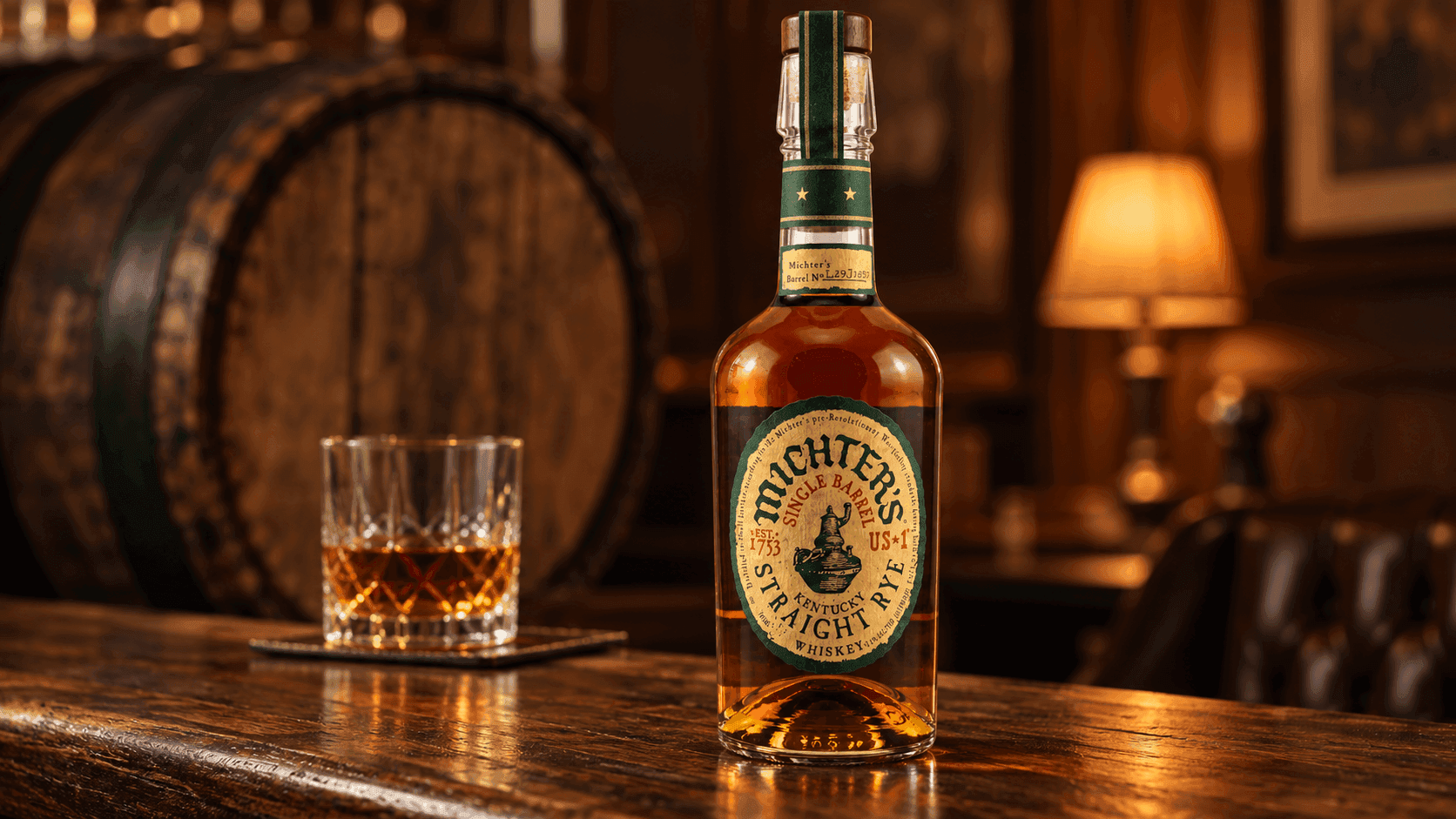
At first glance, the bottle in front of me may look relatively modest. The Michter’s US★1 Kentucky Straight Rye is not one of the ultra-rare bottles that commands five-figure prices at auction. Yet this bottle represents something much more interesting: a brand that has managed to transform itself from a forgotten name into one of the most respected and sought-after producers of American whiskey.
And that is what makes Michter’s so fascinating.
There is a growing belief among collectors that Michter’s could have extraordinary investment potential, perhaps even rivaling names such as Chichibu, Macallan, Yamazaki and some of the most prestigious Scotch whisky brands.
Would I say that Michter’s has already surpassed Chichibu or the great Scotch names as an investment?
Not yet.
The whisky market is far too complex for such a definitive statement. But when we look at the brand’s growth, reputation, limited availability, collector demand and, most importantly, the prices achieved by its rarest releases on the secondary market, Michter’s has unquestionably become a brand that serious collectors should be watching.
A 1753 Heritage With a Complicated Story
One of the most fascinating aspects of Michter’s is its history.
The number 1753 appears prominently on the brand’s labels, and Michter’s proudly refers to its historic roots.
The story really does go back to the eighteenth century. John Shenk, a Swiss Mennonite farmer, established a distillery in Schaefferstown, Pennsylvania, in 1753, producing whiskey from rye, a grain that played an important role in the region’s early whiskey industry.
Over the following centuries, the business changed names. It was first known as Shenk’s, later as Bomberger’s, and in the 1950s owner Lou Forman created the Michter’s name by combining parts of his sons’ names, Michael and Peter.
But there is an important distinction that collectors should understand.
Today’s Michter’s is not simply the uninterrupted continuation of the original distillery.
The original company eventually ceased operations and filed for bankruptcy in 1989.
In the 1990s, Chatham Imports, the company owned by the Magliocco family, acquired the rights to the Michter’s name, and Joseph J. Magliocco began rebuilding the brand.
According to Forbes, the rights to the name cost just $245.
It is one of the most remarkable business stories in modern American whiskey.
A brand that had effectively disappeared was brought back to life and gradually transformed into one of the most prestigious names in the category.
Today, Michter’s operates primarily from Kentucky, with its production centered around facilities including the Shively Distillery and the historic Fort Nelson Distillery in Louisville.
And this is where the modern Michter’s story truly begins.
Michter’s Never Tried to Be the Biggest
For me, this is one of the most important things to understand about the brand.
Michter’s has never appeared particularly interested in becoming the largest whiskey producer in America.
Quite the opposite.
The company has built its reputation around quality, craftsmanship and controlled production, particularly when it comes to its most exclusive releases.
The core portfolio includes US★1 Kentucky Straight Rye, US★1 Kentucky Straight Bourbon, US★1 Sour Mash and US★1 American Whiskey.
But above those releases sits a much more exclusive world:
10 Year Old.
20 Year Old.
25 Year Old.
And then there is Celebration Sour Mash.
This is where Michter’s becomes particularly interesting from a collector’s perspective.
You can buy a relatively accessible Michter’s US★1, such as the bottle pictured here, and at the same time know that the same name appears on bottles that are incredibly difficult to find and can command thousands, sometimes tens of thousands, on the secondary market.
That is an excellent way to build a luxury brand.
Not every bottle needs to cost thousands.
What matters is that collectors know that something exceptionally rare exists at the top of the pyramid.
That creates aspiration, desirability and, eventually, collectability.
Rye at the Heart of Michter’s
The bottle in the photograph is the Michter’s US★1 Kentucky Straight Rye.
Rye is particularly important to the identity of Michter’s.
The brand has spent decades establishing itself as one of the names associated with premium American rye whiskey, and its approach to production is deliberately different from many competitors.
Michter’s enters its whiskey into the barrel at 103 proof (51.5% ABV), a relatively low entry proof compared with many American whiskey producers and well below the 125 proof that is permitted.
According to the company, this approach increases production costs but allows the whiskey to develop a richer and more full-bodied character during maturation.
It is exactly these details that make Michter’s interesting.
The brand is not simply riding the current bourbon boom.
It is building its own identity.
And that identity is increasingly being recognised around the world.
From Premium Whiskey to Collector’s Monster
Things become particularly interesting once we move beyond the core range.
The Michter’s 10 Year Old Single Barrel has become one of the most recognisable and sought-after releases in the portfolio.
Then come the truly serious bottles:
Michter’s 20 Year Old Bourbon
Michter’s 25 Year Old Bourbon
Michter’s 25 Year Old Rye
and perhaps the most intriguing of them all:
Michter’s Celebration Sour Mash.
This is where the numbers start becoming remarkable.
According to Sotheby’s, since 2023 the auction house has sold both the 25 Year Old Bourbon and Rye releases for more than $20,000, while the 20 Year Old Bourbon and Celebration have also crossed the $10,000 mark.
At that point, we are no longer talking simply about premium bourbon.
We are talking about serious collectible whiskey.
Celebration Sour Mash: The Bottle That Changed the Conversation
If I had to choose one release that perfectly illustrates the evolution of Michter’s, it would be Celebration Sour Mash.
The first edition appeared in 2013.
Subsequent releases followed in 2016, 2019, 2022 and 2025.
What makes the series particularly fascinating is its extremely limited production.
The first four releases combined produced only 1,134 bottles, and the 2025 Edition added just 315 more.
That is precisely the kind of number that gets collectors interested.
Limited supply + prestigious brand + exceptional whiskey + global demand.
Celebration is also fascinating because of the age and character of the whiskey used in its composition. The releases combine bourbon and rye, with some components reaching more than 30 years of age.
The original release carried an initial price of around $4,000.
But the secondary market tells a very different story.
In 2024, a bottle of the first Celebration release sold for $20,000 at auction.
That is five times its original price.
Of course, one auction result is not a price guarantee.
And the wider secondary whisky market has continued to cool since then.
But results like this are exactly why serious collectors are beginning to look at Michter’s differently.
Tip: Every Celebration Sour Mash edition is a different blend with its own bottle count: 273 bottles in 2013, 256 in 2016, 277 in 2019, 328 in 2022 and 315 for the 2025 Edition, which shipped in February 2026. Always confirm the edition year before comparing prices, because auction results vary noticeably from one edition to the next.
This Is Not an Isolated Example
The story becomes even more interesting when we look at older Michter’s releases.
A Michter’s 25 Year Old Bourbon from 2017 has appeared on the secondary market in the region of several thousand dollars, depending on the specific bottle and auction.
One 2017 bottle sold at Whisky.Auction in March 2026 for £4,400.
These figures are important not because they prove that every Michter’s bottle will appreciate in value.
They do not.
What they demonstrate is something much more valuable:
Michter’s already has a functioning collector market.
For anyone interested in collecting whiskey, that is far more meaningful than simply seeing a high recommended retail price.
A collectible bottle needs buyers.
And Michter’s clearly has them.
But What About Chichibu?
This is where the discussion becomes particularly interesting.
Among collectors, I increasingly hear comparisons between Michter’s and Chichibu.
Some even suggest that Michter’s could ultimately have greater investment potential.
Would I make that statement as a fact?
No.
Chichibu remains one of the most collectible modern Japanese whisky distilleries in the world. Its rarest releases continue to command serious prices, and the cultural status of Japanese whisky gives the category an extraordinary collector base.
However, the performance of the broader secondary market also demonstrates something important:
Even highly desirable Japanese whisky is not immune to corrections.
Some Chichibu releases that once traded at extremely high levels can now be found considerably lower.
That does not mean Chichibu has lost its importance.
It simply reminds us that collectible whisky is still a market.
Prices go up.
Prices go down.
Hype changes.
Collectors move on.
And this is why I would not say that Michter’s has “beaten” Chichibu.
I would say something much more interesting:
Michter’s has created its own collectible category and is increasingly competing for the attention of the same collectors who once focused almost exclusively on Macallan, Yamazaki, Karuizawa, Chichibu and the legendary names of Scotch whisky.
Why Is Michter’s Potential So Interesting?
For me, there are several reasons.
1. The modern brand is relatively young
And that could be a major advantage.
The greatest Scotch whisky names often have centuries of history behind them.
Michter’s, in its modern form, began rebuilding itself in the 1990s.
The fact that it has reached this level within just a few decades is extraordinary.
If a brand can move from obscurity to five-figure auction bottles in such a relatively short period, it deserves attention.
2. Michter’s has global reach
The brand is now available across dozens of international markets.
That matters enormously.
A collectible whiskey needs a global audience.
And Michter’s is no longer simply an American story.
3. The reputation is extremely strong
Michter’s has developed an exceptional reputation among bartenders, whiskey professionals and collectors.
In recent years, it has repeatedly appeared at the very top of international rankings.
In fact, Drinks International named Michter’s the World’s Most Admired Whiskey in 2026 for the fourth consecutive year.
That is a remarkable achievement.
Four consecutive years at the top is very difficult to dismiss as a temporary trend.
Four Years at the Top
This may actually be one of the most interesting aspects of the Michter’s story.
The brand did not simply reach number one once.
It has remained there.
Four consecutive years: 2023, 2024, 2025 and 2026.
The ranking is voted on by an academy of drinks buyers, journalists, bartenders and whisky experts from more than 25 countries.
That suggests something more significant than short-term hype.
It suggests that Michter’s has successfully created a consistent reputation for quality across its portfolio while simultaneously building a powerful luxury image.
And when a brand combines quality with scarcity, reputation and strong storytelling, collectors tend to pay attention.
Would I Buy Michter’s as an Investment?
This is where I would be very selective.
I would not treat every Michter’s bottle as an investment.
The US★1 Rye in the photograph is, first and foremost, a whiskey I would buy because I want to drink it.
And that is exactly how I think it should be.
But if we move into the world of collecting, several releases immediately become much more interesting:
Michter’s 10 Year Old Single Barrel
Michter’s 20 Year Old
Michter’s 25 Year Old Bourbon
Michter’s 25 Year Old Rye
Celebration Sour Mash
Along with exceptionally limited releases, early editions and historically important bottlings.
The most important rule, however, remains the same:
Never buy a bottle simply because someone tells you that it will increase in value.
The whisky market has already demonstrated that even prestigious names can experience substantial corrections.
According to Knight Frank, rare whisky values have been falling since the market peaked in the summer of 2022.
Buy the bottle because you understand the brand, appreciate the whiskey and believe in its long-term collector appeal.
The investment potential should be the bonus, not the only reason for owning it.
Tip: Michter’s 25 Year Old releases are bottled from single barrels or small batches, so bottle count, proof and release year change from one release to the next. When checking auction records, match the exact release year, barrel or batch number and proof rather than relying on the age statement alone.
Could Michter’s Be One of the Brands of the Next Decade?
This is ultimately what makes Michter’s so exciting to me.
It is not simply the price of one bottle.
It is the structure of the entire brand.
We have historical roots.
We have a strong identity.
We have controlled production.
We have limited releases.
We have global recognition.
We have an exceptional reputation among professionals.
We have ultra-premium expressions.
And, perhaps most importantly, we have real secondary-market results.
That last point is crucial.
There is a huge difference between a brand claiming that its whiskey is collectible and collectors actually paying substantial sums for it.
Michter’s has crossed that line.
And What About the Bottle in the Photograph?
The US★1 Kentucky Straight Rye may look almost ordinary when placed next to a 25-year-old Michter’s or a bottle of Celebration.
But that is precisely why I like it.
It gives us an opportunity to taste the DNA of the brand without immediately entering the world of ultra-rare collector releases.
The official profile of the US★1 Rye highlights peppery spice, citrus, butterscotch and oak, a combination that gives the whiskey a distinctly American character while maintaining the balance and elegance that Michter’s has become known for.
Every bottle comes from a single barrel and is bottled at 84.8 proof (42.4% ABV).
And perhaps this is the most exciting thing about Michter’s today.
We are no longer looking at a brand trying to prove that it belongs among the great names of whiskey.
We are looking at a producer that has already reached the top of the American whiskey world, and whose rarest bottles are increasingly being treated as serious collectible assets.
Will Michter’s become the next Chichibu?
Will it eventually sit alongside Macallan, Karuizawa and Yamazaki as one of the great names of the collector’s market?
Or will the current enthusiasm eventually cool?
Nobody knows.
And that uncertainty is part of the excitement.
But one thing is certain:
Michter’s is no longer a brand that serious whisky collectors can afford to ignore.
For me, that is exactly when collecting becomes interesting.
Not when everyone is already talking about a bottle.
But when you start paying attention to the brand before everyone else does.
- A 1753 Heritage With a Complicated Story
- Michter’s Never Tried to Be the Biggest
- Rye at the Heart of Michter’s
- From Premium Whiskey to Collector’s Monster
- Celebration Sour Mash: The Bottle That Changed the Conversation
- This Is Not an Isolated Example
- But What About Chichibu?
- Why Is Michter’s Potential So Interesting?
- Four Years at the Top
- Would I Buy Michter’s as an Investment?
- Could Michter’s Be One of the Brands of the Next Decade?
- And What About the Bottle in the Photograph?
About the author

Damian Baran
Hooked since a Talisker 10 in 2021, I've tasted over 800 whiskies and love Islay peat and independent bottlings.
To the author