

Reach thousands of whisky and spirits lovers every day.


Longrow 21 Year Old – When Peat Meets Time
 by Damian BaranHooked since a Talisker 10 in 2021, I've tasted over 800 whiskies and love Islay peat and independent bottlings.
Follow Spiritory on Google News to get our latest guides and releases delivered straight to your feed.
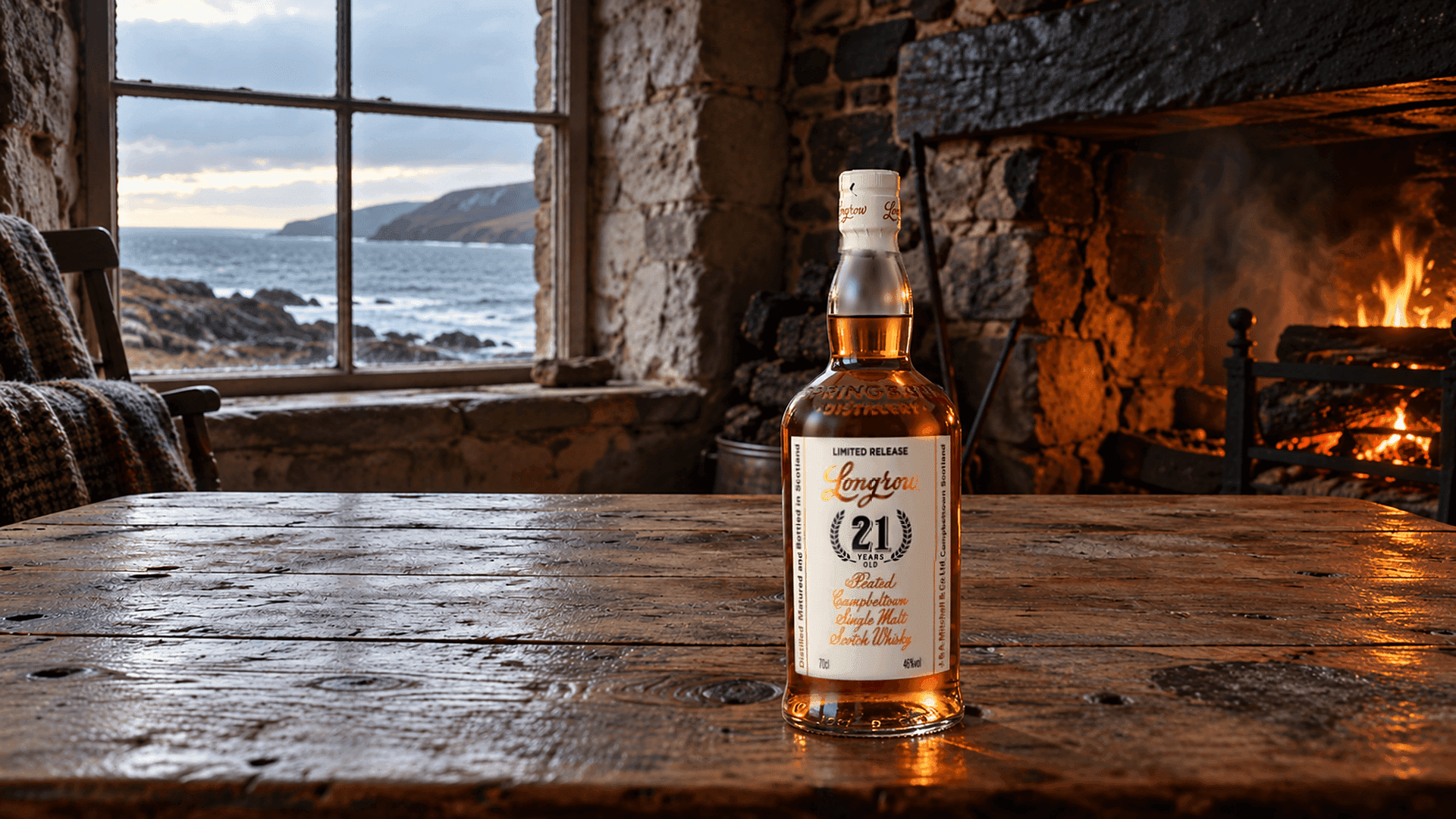
Longrow 21 Year Old – When Peat Meets Time
Longrow 21 Year Old is a heavily peated single malt from Springbank Distillery in Campbeltown, matured for 21 years. The 2023 release was bottled at 46% ABV after maturation in about 65% sherry casks and 35% bourbon casks. Longrow is the double distilled, peated style of Springbank, which also produces Springbank and Hazelburn.
There are whiskies that immediately announce themselves.
Some do it through peat. Others through sherry, oak, age or sheer intensity. And then there are whiskies that become more interesting the longer you spend with them — bottles that reveal themselves slowly, layer after layer, rewarding patience rather than demanding attention.
Longrow 21 Year Old belongs firmly in that last category.
It is a whisky that carries the unmistakable DNA of Springbank, yet speaks with a voice entirely its own. Heavily peated, maritime, oily and deeply complex, Longrow has always been an unusual member of the Campbeltown family. At 21 years old, that character becomes something more refined. The smoke is no longer simply smoke. The peat has had two decades to integrate with oak, fruit, spice and time.
And that is what makes Longrow 21 so fascinating.
A different side of Springbank
Longrow is produced at Springbank Distillery in Campbeltown, on the Kintyre peninsula.
For whisky collectors, Springbank needs little introduction. The distillery has developed a reputation for traditional production methods, limited availability and an unusually strong connection between the whisky and the place where it is made.
But Springbank is not just one whisky.
The distillery produces three distinctive styles: Springbank, Hazelburn and Longrow. Each has its own production character, with Longrow representing the heavily peated side of the family.
Longrow was first produced in 1973 as an experiment. The intention was to create a heavily peated whisky in a style traditionally associated with the west coast and Islay. Yet Longrow never became simply an imitation of an Islay malt.
That distinction matters.
Longrow carries peat, certainly, but also the unmistakable character of Campbeltown. There is often an oily texture, maritime salinity, earthy smoke and a slightly rustic quality that gives the whisky personality.
It is smoky, but not one-dimensional.
Twenty-one years changes everything
Young heavily peated whisky can be spectacular.
At five, six or ten years old, peat can be loud, energetic and sometimes almost aggressive. Smoke dominates the conversation. The distillery character is easy to identify because there is still relatively little between the spirit and the glass.
Twenty-one years is a different story.
Two decades of maturation allow the spirit to absorb, exchange and transform. Oak contributes sweetness, spice and tannins. The spirit becomes softer. Fruit develops. Smoke becomes integrated rather than simply powerful.
With Longrow 21, the interesting question is therefore not simply how smoky the whisky is.
It is what the smoke has become.
The peat feels less like an attack and more like a foundation. Beneath it appear dried fruits, citrus, nuts, leather, tobacco, maritime notes and spices. The whisky has time behind it, and you can taste that time.
This is one of the reasons I find older peated whisky so fascinating.
Age does not automatically make a whisky better. But in the right spirit, sufficient maturation can create a completely different dimension.
The importance of the cask
One of the most fascinating aspects of Longrow 21 is that the expression has not always followed exactly the same maturation recipe.
Different releases have used different combinations of casks, making individual editions particularly interesting to collectors.
For example, the 2023 edition was matured in a combination of approximately 65% sherry casks and 35% bourbon casks.
That balance is significant.
Sherry casks can introduce dried fruit, dark sweetness, nuts, chocolate, leather and baking spices. Bourbon casks can contribute vanilla, citrus, honey and a brighter fruit character.
When combined with heavily peated spirit, the result can be remarkably complex.
This is where Longrow 21 becomes more than simply an older smoky whisky.
The smoke does not stand alone. It interacts with the sweetness of the cask, the fruitiness of the spirit and the character of Campbeltown.
And that interaction is what I want from a mature whisky.
In the glass
Pouring Longrow 21 into a Glencairn, the first impression is not simply smoke.
There is smoke, of course, but it feels mature and integrated.
The nose begins with coastal peat and soft ash, followed by dried fruit, citrus peel and a subtle sweetness. There are hints of leather and polished wood, together with roasted nuts and a faint earthy quality.
Then the maritime character appears.
Salt.
Sea air.
Something slightly mineral and coastal.
It is a reminder that Campbeltown whisky has a sense of place.
Given a few minutes in the glass, the whisky begins to open further. Darker notes emerge: tobacco, walnuts, spices and perhaps a touch of old leather.
This is not a whisky I would rush.
It rewards time in the glass.
The first sip
The texture is one of the highlights.
Longrow has always been associated with a rich, oily character, and age does not erase that identity.
The first sip brings smoke, but it is accompanied by sweetness and fruit. Dried citrus, dark fruit and toffee appear alongside toasted nuts and earthy peat.
There is a lovely tension between sweet and savoury.
One moment the whisky feels rich and sherried; the next, the maritime side takes over. Salt and smoke return, followed by oak spice and a slightly dry, nutty character.
This is where the 21 years become apparent.
The whisky has enough maturity to be complex without losing the character that made Longrow famous in the first place.
That balance is difficult to achieve.
Too much oak can bury the distillery character.
Too little maturation can leave heavily peated whisky dominated by smoke.
Longrow 21 finds a fascinating middle ground.
Peat with elegance
When people talk about heavily peated whisky, the conversation often revolves around intensity.
How smoky is it?
How much peat?
How powerful?
But mature peat can offer something completely different: elegance.
Longrow 21 demonstrates that heavily peated whisky does not have to shout.
It can whisper.
The smoke becomes part of a larger composition — one that includes fruit, oak, salt, nuts, leather and spice.
This is perhaps the biggest difference between a young peated whisky and a mature expression.
The younger whisky tells you that it is smoky.
The older whisky gives you something to discover underneath the smoke.
The Campbeltown character
There is also something particularly appealing about the fact that Longrow comes from Campbeltown.
Campbeltown was once one of the most important whisky-producing regions in Scotland. Today, the region has far fewer active distilleries, but its reputation has returned strongly over recent decades.
Springbank is at the centre of that story.
For me, Campbeltown whisky has always possessed a certain individuality. It can be maritime without becoming simply "Islay-style". It can be funky without becoming chaotic. It can be rich without becoming overly sweet.
Longrow expresses those qualities through peat.
That is what makes it worth seeking out.
You can taste the smoke, but you can also taste where the whisky comes from.
A bottle for collectors
Longrow 21 is also interesting from a collecting perspective.
There is an important difference between owning an old whisky and owning a whisky with a story.
Longrow has both.
The 21 Year Old sits at the intersection of age, limited availability, Springbank's reputation and Longrow's distinctive production style. Different releases also offer variations in maturation, meaning that collectors can become interested not only in the whisky itself but in individual editions.
This creates an interesting collecting journey.
One Longrow 21 tells you about the expression.
Several different releases begin to tell you about the evolution of the expression.
That is a completely different kind of collecting.
Instead of simply asking, "Which bottle is the oldest?", you begin asking questions about casks, release years, maturation styles and how the whisky changes over time.
For me, that is where whisky collecting becomes particularly rewarding.
Not just another old Springbank
It would be easy to look at the number 21 and focus entirely on age.
But Longrow 21 deserves more attention than that.
It is not simply an older Springbank.
It is a mature expression of Longrow — a heavily peated whisky with enough time in oak to allow the smoke, fruit, spice and maritime character to become part of the same conversation.
And that distinction is important.
A whisky can be old without being interesting.
Longrow 21 is interesting because age is only one part of the story.
The distillery matters.
The production style matters.
The casks matter.
The release year matters.
And, ultimately, the character in the glass matters most of all.
Final thoughts
There are bottles that you buy because everyone knows the name.
There are bottles that you buy because the age statement looks impressive.
And then there are bottles that make you stop and think about what whisky can become after two decades in wood.
Longrow 21 is one of those bottles.
It brings together everything I enjoy about mature Scotch whisky: peat, maritime character, sweetness, fruit, oak, texture and complexity. But most importantly, it does so without losing its identity.
It remains Longrow.
That is perhaps the greatest compliment I can give it.
The smoke is still there. The sea is still there. The earthy Campbeltown character is still there.
But after 21 years, everything has become quieter, deeper and more sophisticated.
For a collector, that is part of the attraction.
You are not simply opening a bottle of old whisky.
You are opening twenty-one years of maturation, craftsmanship and history — captured in glass.
And with Longrow 21, the most rewarding part may be discovering how much of that history remains alive in every sip.
About the author

Damian Baran
Hooked since a Talisker 10 in 2021, I've tasted over 800 whiskies and love Islay peat and independent bottlings.
To the author