

Reach thousands of whisky and spirits lovers every day.


How Does Water Sourcing Shape Scotch Whisky?
 by Max RinkI’m a whisky enthusiast and aspiring writer, exploring new flavours and the stories behind every bottle.
Follow Spiritory on Google News to get our latest guides and releases delivered straight to your feed.
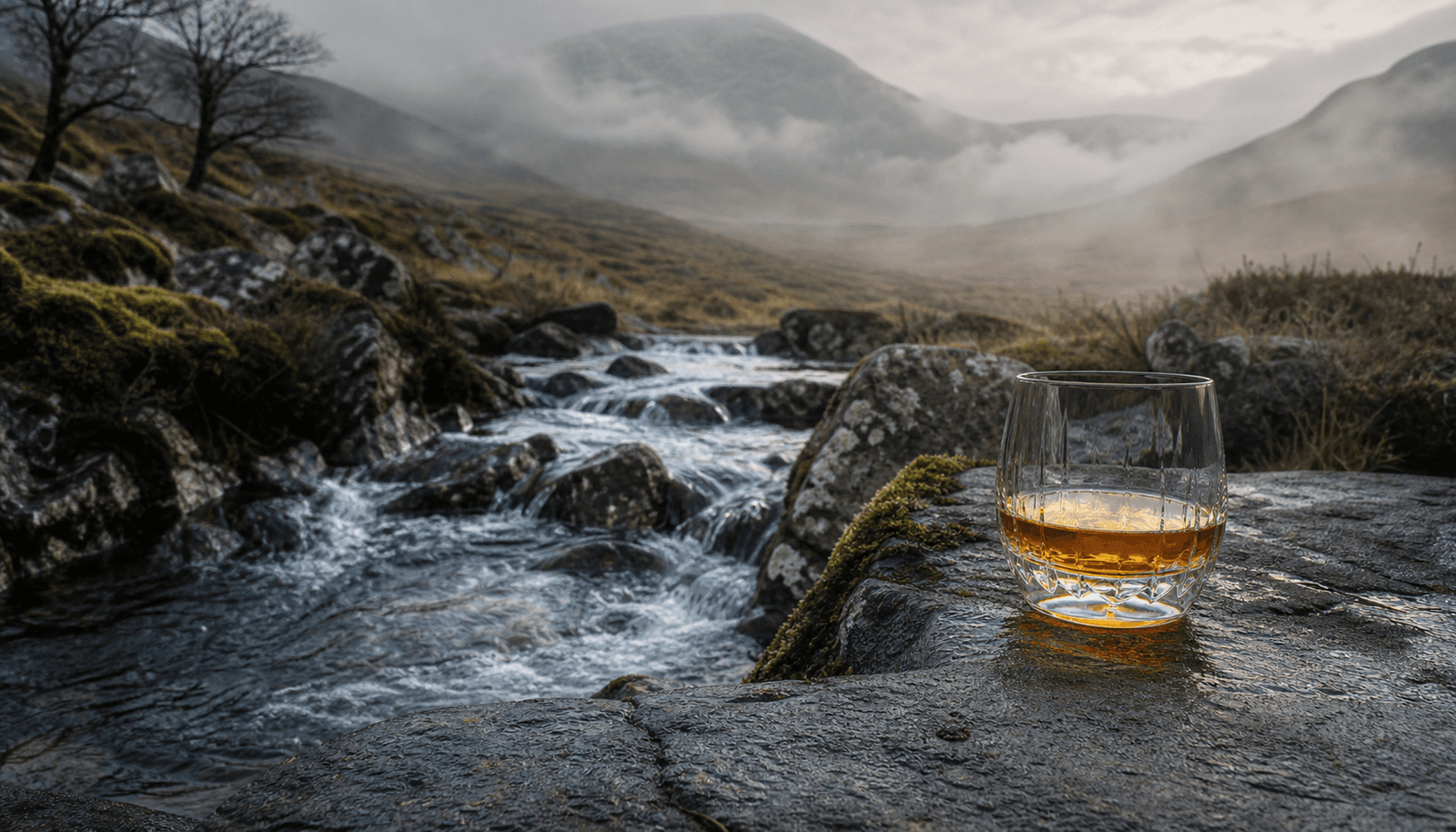
How Does Water Sourcing Shape Scotch Whisky?
What Recent Challenges Have Highlighted the Importance of Water Sourcing in Scotch Whisky?
Recent climate challenges have underscored the critical importance of water sourcing for Scotch whisky production, affecting distillery operations across Scotland.
Severe droughts in the summer of 2018 forced five of Islay’s ten distilleries, along with Blair Atholl and Edradour in Perthshire, to halt production temporarily. Glenfarclas in Speyside lost about 300,000 litres of whisky output during this period. More recently, in 2021, Pulteney distillery paused operations due to critically low water levels in its sole source, Loch Hempriggs. These disruptions illustrate how water availability has moved from a background consideration to a strategic priority for distilleries.
This renewed focus on water sourcing ties directly into the broader trend emphasising water’s role and terroir in Scotch whisky. As climate change impacts water quality and quantity, distilleries must rethink their sourcing strategies to safeguard production and maintain flavour integrity. Understanding water’s provenance now matters not only for operational continuity but also for marketing authenticity and consumer trust.
How Does Water Influence the Flavor of Single Malt Scotch?
Water significantly influences the flavour of single malt Scotch through its mineral content and impact on key production stages such as mashing, fermentation, and cooling.
The mineral profile of water—its hardness, pH, and dissolved solids—affects enzyme activity during mashing, yeast health during fermentation, and ultimately the spirit’s texture and flavour complexity. For example, soft water tends to yield lighter, more delicate spirits typical of Lowlands and Speyside malts, while hard water can produce fuller-bodied whiskies with more oily texture found in Highland and island distilleries.
Water used for cooling also plays a subtle but important role. Traditional worm tub condensers rely on cold, clean water to create heavier, more sulphurous spirits; conversely, shell-and-tube condensers fed by the same source produce cleaner, fruitier profiles. These variations demonstrate that water is not just an ingredient but a defining element shaping each distillery’s unique character.
What Role Does Water Play During Mashing?
Water’s mineral content during mashing determines enzyme efficiency and directly impacts the whisky's texture and character.
During mashing, enzymes break down starches from malted barley into fermentable sugars. The presence of calcium and magnesium ions in hard water improves this enzymatic activity, resulting in more efficient sugar extraction and a richer new-make spirit. Soft water with low mineral content leads to a lighter mouthfeel and more delicate flavours. This is why regions like Speyside with naturally soft waters produce elegant single malts, while distilleries drawing from hard water sources tend to craft oilier spirits with greater depth.
Understanding these subtle effects helps explain regional flavour distinctions and why distilleries historically chose locations based on local water chemistry rather than convenience or transport links.
How Does Water Chemistry Affect Fermentation?
Water chemistry influences yeast health and congener production, which are crucial for defining a distillery’s house style.
Fermentation converts sugars into alcohol while producing congeners—flavour-active compounds that contribute fruity esters, spicy phenols, or sulphurous notes depending on yeast strain and conditions. The mineral balance in water affects yeast vitality and metabolism; for instance, calcium supports robust fermentation while certain dissolved solids can inhibit or alter yeast performance.
Each distillery’s unique water profile thus shapes the bouquet of congeners produced during fermentation. This biochemical interplay contributes significantly to the distinct aroma and flavour profiles associated with iconic single malts.
Why Is Water Quality Important in Cooling Processes?
Water quality during cooling impacts the spirit’s final characteristics by influencing condensation efficiency and flavour development.
Traditional worm tub condensers use cold spring or river water to cool vapours; impurities or temperature fluctuations can affect how congeners condense back into liquid form. Cleaner, colder water promotes heavier sulphurous compounds that add complexity typical of certain island whiskies like Springbank or Mortlach.
Modern shell-and-tube condensers produce lighter spirits partly because they interact differently with cooling water chemistry. Thus, even after distillation, the quality and temperature of cooling water remain essential factors contributing to a whisky’s signature taste.
Which Historical Factors Shaped the Water Sourcing Practices of Scotch Distilleries?
Historical factors like geographical location and access to pure, reliable water sources profoundly shaped Scotch whisky distilling practices from their inception.
Before modern transport infrastructure existed, distilleries had no choice but to locate near springs, burns, or lochs that provided clean water essential for mashing and fermentation. The Campbeltown peninsula once thrived as Scotland’s whisky capital largely because of its abundant springs supplying several iconic distilleries.
Springbank draws from Crosshill Loch—a source imparting distinctive minerality that defines its complex oily spirit—while Highland Park on Orkney uses Crantit spring flowing through peat and heather beds that lend honeyed floral notes unique to its profile. These choices were empirical wisdom passed down through generations; the invisible mineral content was as important as barley quality or cask selection.
This geographical determinism established terroir-like influences long before marketing adopted that language, embedding local waters into each whisky's DNA.
What Are the Current Regulatory Frameworks Regarding Water in Scotch Whisky Production?
Current regulations acknowledge water’s importance in Scotch whisky but do not impose strict standards on its quality beyond basic requirements.
The Scotch Whisky Regulations of 2009 specify that whisky must be made from malted barley and water but do not dictate precise parameters for the latter. Instead, they define five whisky-producing regions—Highlands, Lowlands, Speyside, Islay, and Campbeltown—each shaped by distinctive local waters alongside tradition.
Speyside’s dominance owes much to the River Spey’s pure soft waters filtered through gravel beds that supported industrial-scale production without compromising quality. Yet climate projections warn that low-flow periods may double by mid-century, threatening this natural advantage.
Thus regulation respects regional heritage linked to local waters but leaves technical adaptation largely to producers themselves.
How Are Distilleries Adapting to Modern Water Sourcing Challenges?
Distilleries are adopting innovative strategies such as renewable energy use and catchment management to ensure sustainable water sourcing amid climate pressures.
Deanston harnesses the River Teith not only as its water source but also for renewable hydroelectric power—a model increasingly emulated across Scotland. On Islay, Laphroaig offers tours highlighting its pristine spring source to deepen visitor appreciation of provenance amid growing consumer demand for authenticity.
Meanwhile, large groups like Chivas Brothers fund research into nature-based solutions addressing scarcity by slowing run-off after heavy rains or replenishing aquifers naturally. The Scotch Whisky Association’s net-zero emissions goal by 2040 complements these efforts though securing reliable water remains an immediate challenge given drought risks.
What Initiatives Are Distilleries Taking For Water Sustainability?
Distilleries implement renewable energy integration alongside advanced catchment management to conserve precious water resources sustainably.
Deanston’s use of hydro-power exemplifies how combining energy generation with responsible sourcing creates resilience against climate variability. Others invest in infrastructure improvements such as reservoirs or boreholes to buffer against drought-induced shortages.
Industry-wide collaborations support research projects exploring natural methods like reforestation or wetland restoration that enhance groundwater retention—measures promising not only environmental benefits but also long-term production security.
These initiatives demonstrate whisky producers’ commitment beyond compliance towards stewardship of their most vital ingredient.
How Is Provenance Marketing Influencing Consumer Perceptions?
Provenance marketing highlighting unique water sources enhances consumer trust by connecting whisky flavour with authentic geographical origins.
Distilleries increasingly showcase their springs or burns as part of storytelling experiences; Laphroaig’s guided hike to its Crantit spring is one example fostering emotional bonds between visitor and dram. Collectors value bottles explicitly mentioning famous sources like Springbank’s Crosshill Loch or Glengoyne’s crystal-clear waters paired with limited editions or older releases.
Auction results reflect this trend: whiskies tied closely to distinctive waters often command premiums due to perceived rarity or character continuity amid changing environmental conditions. This provenance dimension deepens appreciation beyond cask type or age statement alone.
What Future Trends Should Whisky Collectors Watch Regarding Water Sourcing?
Future trends will see provenance linked to unique water sources increasingly valued by collectors as climate change reshapes availability and flavour profiles evolve accordingly.
As some historic springs become scarcer due to droughts or regulatory restrictions on usage tighten, whiskies from resilient distilleries may gain reputational edge—and potential pricing power—among enthusiasts seeking authentic connections to place. Limited edition releases highlighting such challenges will attract attention on secondary markets.
Moreover, innovations like borehole sourcing combined with sustainable farming partnerships (e.g., Bruichladdich) signal a shift towards integrated terroir narratives encompassing barley origin alongside water provenance.
Collectors should watch how these environmental pressures influence both production continuity and flavour evolution; understanding a dram’s original recipe today includes appreciating its source waters’ story within a changing climate context—the very essence highlighted by recent trends emphasising terroir-driven marketing in Scotch single malts.
FAQs
Why Is Water So Important In Single Malt Scotch Production?
Water is crucial because it affects every stage—from mashing enzyme activity through fermentation yeast health to cooling processes—shaping the whisky's final character profoundly. At Spiritory, you’ll find detailed provenance information illustrating how each distillery’s unique source influences flavour nuances worth exploring.
How Are Distilleries Dealing With Water Shortages Due To Climate Change?
Many are adopting sustainable practices like renewable hydro-power usage at Deanston or natural catchment management funded by major producers such as Chivas Brothers. Spiritory offers insights into these innovations helping secure future supplies while maintaining quality standards collectors appreciate.
Can The Source Of Water Affect The Price Of A Whisky Bottle?
Yes; bottles linked explicitly to rare or iconic sources like Crosshill Loch at Springbank often command premiums among collectors valuing provenance narratives alongside cask strength or age statements available on Spiritory's verified listings platform.
Does Water Quality Affect Whisky Flavour As Much As Cask Type Or Yeast?
While cask maturation heavily influences flavour (about 60–70%), residual minerals in local waters subtly impact fermentative congeners and spirit texture—contributing uniquely alongside yeast choice and cask interaction for each distillery's house style.
How Can I Learn More About A Whisky's Water Source Before Buying?
Spiritory provides detailed descriptions including historical context about each distillery's springs or burns when available—allowing enthusiasts to connect deeper with terroir stories before purchase decisions at our marketplace.
Enjoy responsibly — please drink in moderation; legal drinking age applies; not for sale to minors.
- What Recent Challenges Have Highlighted the Importance of Water Sourcing in Scotch Whisky?
- How Does Water Influence the Flavor of Single Malt Scotch?
- Which Historical Factors Shaped the Water Sourcing Practices of Scotch Distilleries?
- What Are the Current Regulatory Frameworks Regarding Water in Scotch Whisky Production?
- How Are Distilleries Adapting to Modern Water Sourcing Challenges?
- What Future Trends Should Whisky Collectors Watch Regarding Water Sourcing?
- FAQs
About the author

Max Rink
I’m a whisky enthusiast and aspiring writer, exploring new flavours and the stories behind every bottle.
To the author