

Reach thousands of whisky and spirits lovers every day.


Bruichladdich 1991 Gordon & MacPhail - A Taste of the Past
 by Damian BaranHooked since a Talisker 10 in 2021, I've tasted over 800 whiskies and love Islay peat and independent bottlings.
Follow Spiritory on Google News to get our latest guides and releases delivered straight to your feed.
Bruichladdich 1991 Gordon & MacPhail - A Taste of the Past
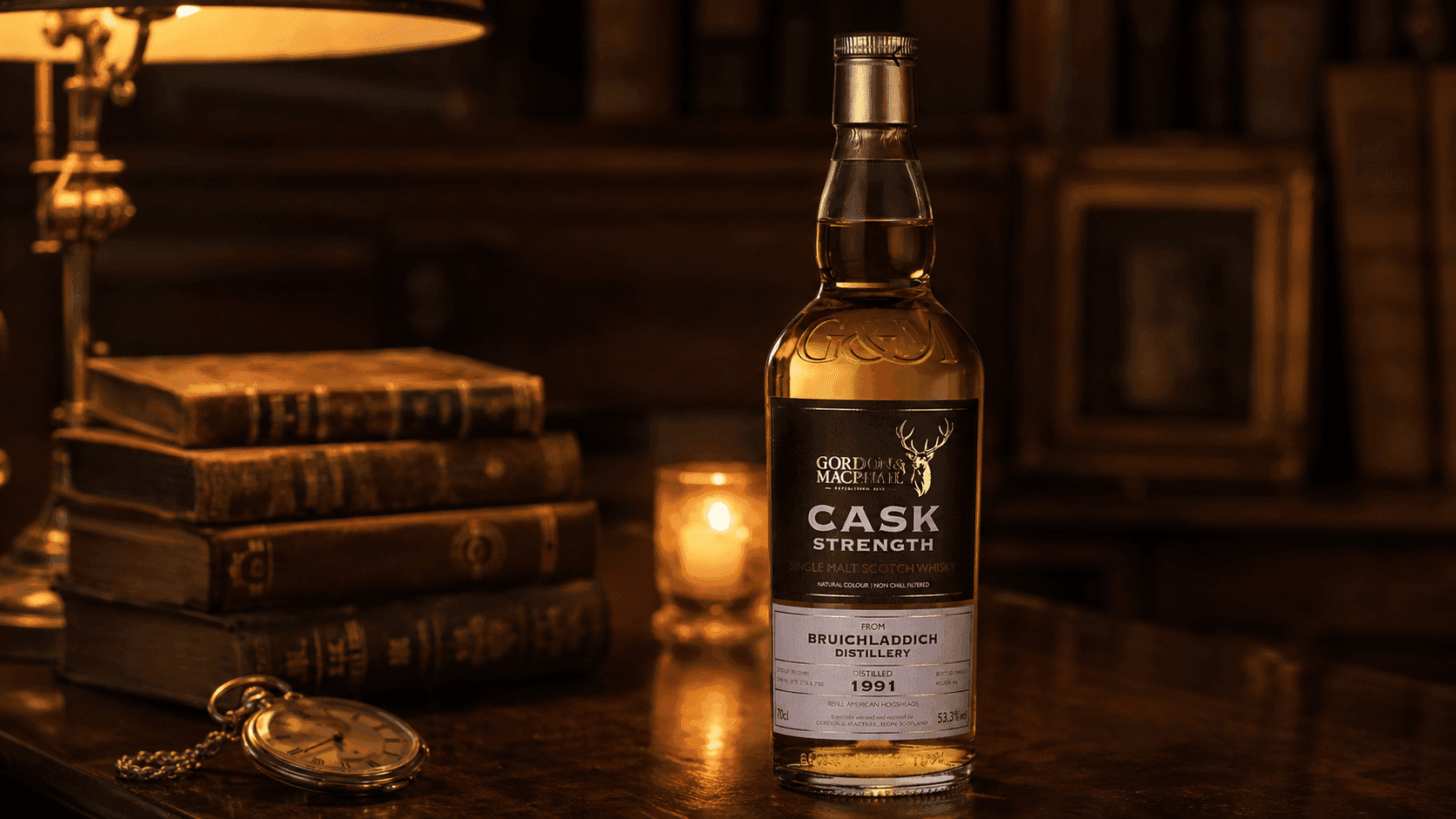
Bruichladdich 1991 Gordon & MacPhail Cask Strength is a single malt Scotch whisky distilled in October 1991 and bottled by independent bottler Gordon & MacPhail in April 2015, matured in refill American hogsheads and bottled at natural cask strength of 53.3% ABV. The release was drawn from three casks, numbered 2775, 2776 and 2780, and predates Bruichladdich's own famous revival under new ownership in 2001.
Whisky from My Birth Year
There are bottles we buy because they are rare. Others catch our attention because of a beautiful label, the history of the distillery, or the name of a respected independent bottler. And then there are those special whiskies that feel much more personal.
1991. That is what makes this bottle so special to me. I love discovering the flavours of the past, but I love it even more when that past is connected to my own story. A whisky distilled in the same year I was born will always be more than just another bottle on my shelf.
This time, it is Bruichladdich 1991 Cask Strength, bottled by Gordon & MacPhail in 2015. The whisky was matured in refill American hogsheads, with the final release coming from casks 2775, 2776 and 2780. It was bottled at 53.3% ABV.
1991 was the beginning of my story. For this whisky, it was the beginning of a completely different journey. In October 1991, a spirit was distilled at Bruichladdich that would spend the following decades quietly maturing in oak, at exactly the same time my own life was just beginning.
When I look at a bottle from 1991, I don't see just its age. I see a small piece of history. This whisky was produced in a completely different era, by people working at a distillery that was in a very different place in its own story. And there is something even more fascinating about this particular bottle: the Bruichladdich of 1991 was not the same Bruichladdich we know today.
Tip: When tasting an old independent bottling like this, resist the urge to judge it against modern, heavily oaked releases. Vintage casks from this era were often refill wood with a lighter influence, so the distillery's own raw character, rather than the cask, tends to be the real story.
Bruichladdich Before the Great Revival
The story of Bruichladdich is one of the most fascinating in modern Scotch whisky. The distillery was built in 1881 by the Harvey brothers and, over the following decades, went through numerous changes of ownership as well as periods of closure and reopening. In 1994, the distillery was mothballed once again, and for a time it looked as though its story might be over.
That means my bottle comes from the final years of the old Bruichladdich, and for me, that is one of its greatest attractions.
The spirit distilled in 1991 predates the famous revival of Bruichladdich that began after a group of investors led by Mark Reynier, Simon Coughlin and Jim McEwan bought the distillery in 2000 and reopened it in 2001, with McEwan installed as master distiller. When the new owners took over, they found thousands of casks of whisky left behind from the previous era, much of it unpeated, reflecting the traditional style for which Bruichladdich had been known for decades.
Only later did the distillery develop its modern peated identities, including Port Charlotte and Octomore. That makes a glass of Bruichladdich 1991 feel, at least to me, like meeting an earlier version of the distillery.
Gordon & MacPhail, The Perfect Partner
The next important part of this story is Gordon & MacPhail. For a whisky collector, that name carries considerable weight. For decades, independent bottlers have offered whisky enthusiasts the opportunity to explore spirits from distilleries whose official releases were limited or sometimes almost impossible to find.
This release is a wonderful example. Gordon & MacPhail allowed this old Bruichladdich spirit to mature for more than two decades before bottling it at natural cask strength, and that 53.3% ABV makes a real difference.
This is not a whisky designed simply to appeal to the widest possible audience. It has not been diluted down to a standard bottling strength. Instead, we get power, texture and the opportunity to see how the whisky develops with a few drops of water. That is exactly the kind of whisky I enjoy most.
The First Encounter
The colour is golden and relatively light, which fits well with the use of refill hogsheads. This is not a whisky trying to impress through deep colour and heavy oak influence. Here, the distillate is the star.
The first impression on the nose is fascinating. There are melons, underripe apricots and citrus fruits, followed by something much more unusual: hints of soy sauce and bouillon appear, with subtle savoury and almost meaty notes.
It is a profile that immediately reminds you this is an old whisky, rather than another modern, sweet single malt. I am not looking for vanilla, caramel or obvious oak sweetness here. This whisky has its own character.
On the Palate
The palate reveals even more. The opening is relatively gentle, but quickly develops into dry citrus, grapefruit, bitter orange and grassy notes. There are also touches of ash, pepper and bitter caramel.
This is definitely not a whisky for someone looking for a dessert like dram. It is drier, more mineral, at times almost austere, and that is precisely why it deserves time.
After several minutes in the glass, the aromas begin to shift. The alcohol gradually steps back and the fruit becomes more apparent, allowing the whisky to reveal additional layers. At 53.3%, I would absolutely recommend experimenting with a small amount of water. Just a few drops can open the nose and reveal more of what happened inside those casks over more than two decades.
The Finish, A Flavour That Remains
The finish is medium in length, oily and, above all, dry. What remains are citrus peel, grass, pepper and a gentle bitterness, accompanied by subtle mineral and slightly metallic notes.
On Whiskybase, this release currently holds a community rating of 87.39 out of 100, based on more than 40 individual ratings, a solid result for a whisky this old and this dry. But a score cannot really capture the full meaning of this bottle for a collector, because whisky can be judged in many different ways.
We can judge it purely as a drink, looking at balance, intensity, finish and oak influence. But we can also look at it as a time capsule. And that is when Bruichladdich 1991 becomes something much more interesting.
A Taste of the Past
This is what I love most about whisky. Every vintage bottle tells a story. Sometimes it is the story of a particular distillery. Sometimes it is the story of an owner, a bottler or a single cask. And sometimes it becomes part of our own story.
For me, the 1991 vintage makes this whisky personal. When I hold the bottle, I know that the spirit was distilled in exactly the same year in which my own story began.
More than three decades have passed. Bruichladdich was closed, saved and eventually reopened. New styles of whisky were created. Port Charlotte and Octomore became part of the distillery's identity. Bruichladdich underwent an extraordinary transformation and today stands among the most distinctive producers on Islay.
And somewhere in the middle of that history is this bottle. Bruichladdich 1991. A whisky from my birth year.
Tip: A cask strength whisky like this rewards patience more than most. Pour a small measure, let it sit for ten minutes before the first sip, and taste it again after adding a few drops of water; the aromatic profile at 53.3% can change substantially once it opens up in the glass.
To Open or To Keep?
That is always the difficult question for a collector. Should the bottle remain on the shelf, appreciated as part of the collection? Or should it be opened and allowed to tell its story?
For me, the answer is simple. Whisky was made to be discovered.
Of course, a bottle like this can be preserved as a collectible and its value may continue to change over time. But for me, the most important thing is the opportunity to taste something that can never truly be recreated. We cannot go back to 1991. We cannot produce exactly the same spirit again. We cannot recreate the precise maturation journey of casks 2775, 2776 and 2780.
We can only open the bottle, pour a dram into a glass and try to understand what the world tasted like more than three decades ago. And that is why this bottle found its place in my collection, not simply because it is an old Bruichladdich, not simply because it was bottled by Gordon & MacPhail, not simply because it is a cask strength whisky, but above all, because it is from 1991. My year.
Sometimes all it takes is 20 to 25 ml of whisky in a glass and a few minutes of patience, and suddenly you realise you are no longer drinking just a spirit. You are drinking history.
Bruichladdich 1991: my birth year, more than three decades captured in a single bottle. Another reminder that in the world of whisky, time is not just a number. Time is flavour.
About the author
Damian Baran
Hooked since a Talisker 10 in 2021, I've tasted over 800 whiskies and love Islay peat and independent bottlings.
To the author