

Reach thousands of whisky and spirits lovers every day.


Bowmore, Revisited: Why Independent Bottlers Are Falling in Love with Islay Again
 by Damian BaranHooked since a Talisker 10 in 2021, I've tasted over 800 whiskies and love Islay peat and independent bottlings.
Follow Spiritory on Google News to get our latest guides and releases delivered straight to your feed.
Bowmore, Revisited: Why Independent Bottlers Are Falling in Love with Islay Again
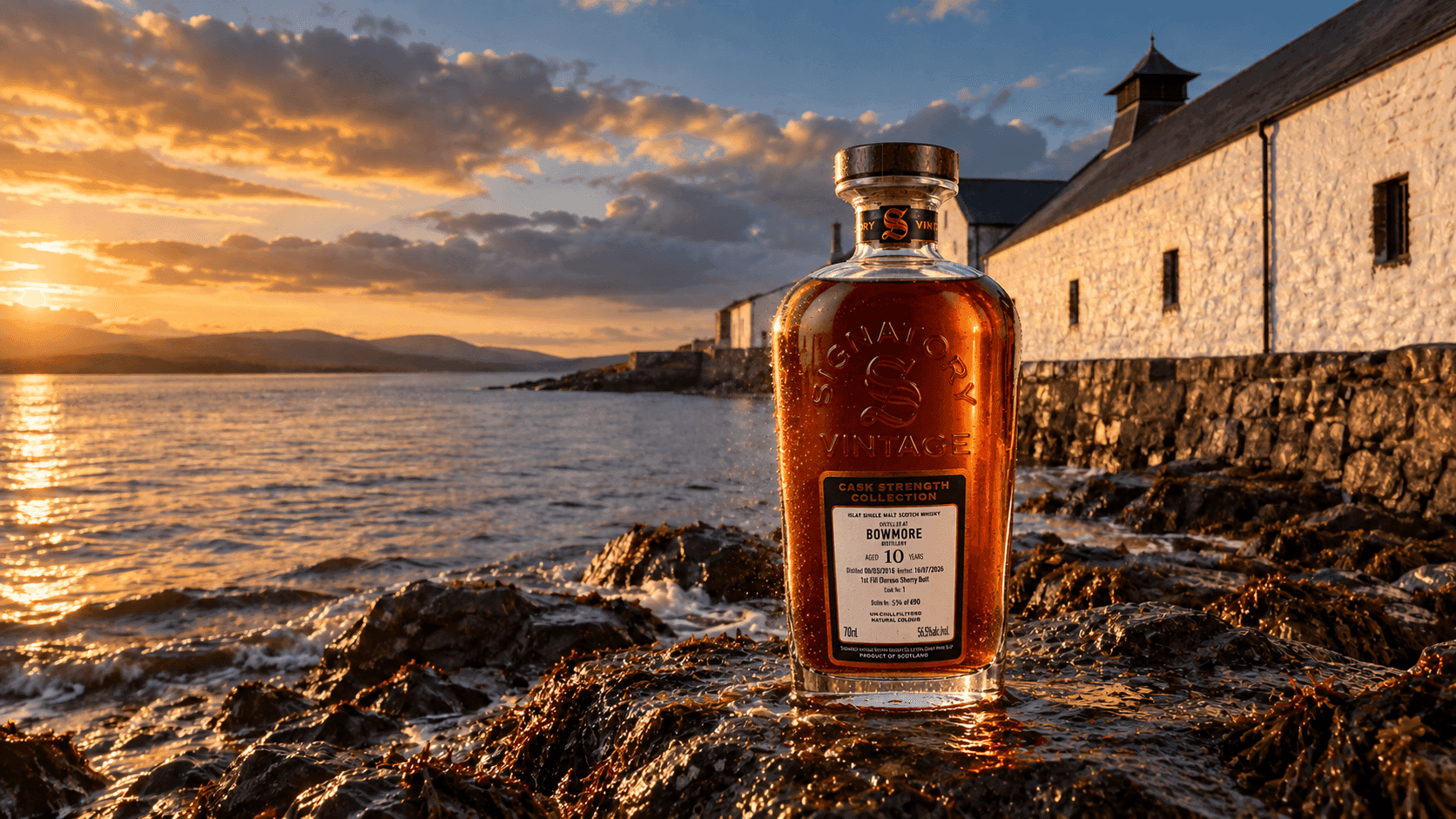
Independent bottlers are releasing more Bowmore because casks from Islay’s oldest licensed distillery, founded in 1779, have become easier to find at a time when the Scotch industry is holding record stocks: the Financial Times reports that whisky maturing in Scottish casks has more than tripled in a decade to around 1.4 billion litres. Recent single casks include a 10 year old 2016 Bowmore from Signatory Vintage matured in a first fill Oloroso sherry butt and bottled at 56.5% ABV, 21 year old 2004 casks from Thompson Brothers and Uncharted Whisky Co., and a 6 year old from The Caskhound. Bowmore’s balance of moderate peat, fruit and maritime character lets individual casks show very different personalities, which is exactly what independent bottlers and collectors look for.
There are certain distilleries that never really disappear from the whisky conversation.
Bowmore is one of them.
For decades, the name has carried an almost mythical weight. Founded in 1779, sitting on the shores of Loch Indaal, with its famous warehouses facing the Atlantic and a history intertwined with the identity of Islay itself, Bowmore has long been one of Scotland’s great names.
And then, of course, there is Black Bowmore.
Few whiskies have achieved the same level of collector mythology. The name alone is enough to evoke auctions, extraordinary prices, legendary bottlings and the golden age of Islay single malt.
Yet for a period, Bowmore was not necessarily the first name that came to mind when thinking about the modern independent bottling scene.
That seems to be changing.
Quite dramatically.
Look across recent independent releases, specialist retailers and whisky auctions, and one thing becomes increasingly difficult to ignore:
Bowmore is everywhere.
The Whisky Agency. Thompson Brothers. Signatory Vintage. The Caskhound. East Asia Whisky Company. Whisky Sponge. Living Souls. Uncharted Whisky Co. And many others.
Some are releasing mature Bowmore from the early 2000s. Others are going much younger.
Single casks. Cask strength. Refill bourbon. Oloroso. Sherry finishes. Natural colour. No chill filtration.
Suddenly, Bowmore is no longer simply an iconic distillery to admire from a distance.
It has become a playground for independent bottlers.
And, for collectors, that could be very interesting indeed.
Bowmore Has Always Had the Raw Material
Before asking why independent bottlers are suddenly showing so much interest in Bowmore, it is worth remembering what makes the distillery so fascinating in the first place.
Bowmore was established in 1779, making it the oldest licensed distillery on Islay and one of the oldest in Scotland.
Its location is almost impossibly romantic: right on the shores of Loch Indaal, surrounded by the sea air, Islay’s changing weather and the landscape that has shaped generations of whisky.
The warehouses are particularly important to Bowmore’s identity. Maturation by the water has become part of the distillery’s mythology, but there is also a very real sense that Bowmore occupies a distinctive place within the Islay spectrum.
It is not usually as aggressively smoky as Ardbeg or Laphroaig.
Nor is it simply a soft, lightly peated malt.
At its best, Bowmore can sit somewhere beautifully in between.
Smoke, salt, citrus, tropical fruit, vanilla, dark sweetness, mineral notes and maritime character can all coexist in the same dram.
That complexity is precisely what makes Bowmore so attractive to independent bottlers.
A distillery does not need to produce the most heavily peated whisky on the island to produce a fascinating single cask.
In fact, sometimes the opposite is true.
Bowmore has enough peat to announce its Islay origins, but enough fruit and texture to allow the cask to take the conversation in completely different directions.
And that is where things become interesting.
So Why Now?
This is perhaps the most interesting question.
It would be easy to say that independent bottlers have simply “rediscovered” Bowmore.
I don’t think that tells the whole story.
Something else appears to be happening.
Bowmore casks have become considerably more visible.
At the Whisky in Leiden festival in June 2026, my conversations with several independent bottlers suggested just how significant the current availability appears to be. Some had acquired multiple Bowmore casks, in some cases approaching ten, with a number coming from around 2004 and younger vintages.
That is no longer an isolated release.
It starts to look like a pattern.
And whenever several independent companies begin buying casks from the same distillery at roughly the same time, it is worth paying attention.
There is probably a reason.
The Whisky Market Has Changed
The broader Scotch whisky market provides an important part of the explanation.
After years of extraordinary growth, speculation and investment, the market has entered a much more cautious period.
Scotland has accumulated enormous stocks of maturing whisky. The Financial Times has reported figures of around 1.4 billion litres of whisky sitting in Scottish warehouses, equivalent to roughly three years of consumption.
The secondary market has cooled as well. Auction values and volumes have fallen back from their peak, and rising prices can no longer be taken for granted.
That creates a very different environment from the one we saw during the boom years.
There is more spirit.
There are more mature casks.
And producers, owners and brokers have to think increasingly carefully about where that whisky ultimately goes.
For independent bottlers, however, this can create opportunity.
More casks potentially mean more choice.
More choice can mean more experimentation.
And, importantly, it can give smaller bottlers access to distilleries that might previously have been considerably harder or more expensive to source.
Bowmore fits this environment extremely well.
A Blue Chip Name Without the Same Heat
Imagine the perfect independent bottling proposition.
You want a whisky that:
- has a globally recognised distillery name;
- has a distinctive flavour profile;
- appeals to collectors;
- can work beautifully as a single cask;
- does not require a fortune to acquire;
- and gives you the freedom to create something different from the official range.
Bowmore ticks almost every box.
It is undeniably a blue chip distillery.
But in collector terms, it has not been subjected to quite the same level of market heat as names such as Macallan or some of the most aggressively collected Springbank releases.
That creates an intriguing middle ground.
The name carries prestige.
The spirit carries character.
And there is still room for discovery.
For collectors, that combination is difficult to resist.
The Return of Young Bowmore
There is another shift that deserves attention.
For years, the word “Bowmore” in collector circles often meant old Bowmore.
1980s Bowmore.
1990s Bowmore.
Black Bowmore.
Fèis Ìle releases.
Old single casks.
Whisky aged thirty years.
But the current independent bottling wave is telling us something important:
young Bowmore can be seriously interesting too.
Recent releases have included Bowmore at six, ten, eleven, thirteen years old and beyond, alongside a growing number of bottlings from the first half of the 2000s.
Signatory Vintage, for example, released a 10 year old Bowmore distilled in 2016 and bottled in 2026, matured in a first fill Oloroso sherry butt, bottled at 56.5% ABV with an outturn of 690 bottles.
That is precisely the sort of whisky that appeals to the modern enthusiast.
You do not necessarily need to spend thousands on a 30 year old Bowmore to experience something compelling.
You can buy a single cask.
You can see the distillation and bottling dates.
You can know the cask type.
You can taste it at natural strength.
And suddenly the bottle becomes more than another expression of a brand.
It becomes a snapshot of a particular moment in the life of that whisky.
Tip: Read the cask wording on the label closely. “Matured in” a first fill Oloroso butt, as with Signatory Vintage’s 2016 Bowmore, means the sherry cask shaped the whisky for its full ten years, while a “finish” means the whisky spent only its final months or years in that wood. Two sherried Bowmores at similar prices can therefore be very different whiskies.
Independent Bottlers Give Bowmore a Second Life
This, for me, is the heart of the story.
An official distillery bottling has to represent the brand.
An independent bottler primarily represents the cask.
That distinction is enormous.
When a distillery releases a whisky, it has to fit within a portfolio, a house style, a marketing strategy and a brand identity built for the long term.
An independent bottler can take a completely different approach.
They can say:
This cask is exceptional. Let’s bottle it.
And that opens the door to experimentation.
One Bowmore might be intensely fruity.
Another might be salty and mineral.
Another could be packed with citrus and vanilla.
A sherry cask might bring dark chocolate, raisins and spice.
A refill bourbon barrel might allow the distillery character to dominate.
Same distillery.
Same fundamental spirit.
Completely different whisky.
That is the beauty of independent bottling.
The Whisky Agency and the Beauty of the Cask
A particularly good illustration comes from The Whisky Agency, which has bottled Bowmore from the early 2000s, including a 22 year old cask distilled in 2004 and released in 2026.
What makes these releases particularly appealing is not simply the distillery name.
It is the opportunity to compare individual casks.
Two whiskies can share the same vintage and broadly similar maturation parameters, yet taste remarkably different.
And that changes the question we ask.
Instead of:
“What does Bowmore taste like?”
we begin asking:
“What does this Bowmore taste like?”
For a collector, that is a significant shift.
It moves the focus away from brand recognition and towards provenance.
Thompson Brothers and the Collector Effect
The same phenomenon can be seen with Thompson Brothers.
Their releases have developed a remarkably loyal following among whisky enthusiasts, and their Bowmore bottlings are particularly interesting because the reputation of the bottler itself has become part of the attraction.
The Thompson Brothers have released Bowmore from several vintages, including 2004, 2006 and younger expressions.
And this is important.
A bottler such as Thompson Brothers does not necessarily need to rely on the distillery name alone.
Collectors trust their selection process.
They are buying the bottler’s judgement as much as they are buying Bowmore spirit.
When the two reputations meet, the result can be extremely compelling.
The Collector’s Sweet Spot
There is another reason I find the current Bowmore situation fascinating:
price.
The Bowmore market has enormous depth.
At one end are relatively accessible young independent bottlings.
At the other are highly mature single casks with tiny outturns and serious collector appeal.
A 35 year old Bowmore 1990 bottled for Royal Mile Whiskies, for example, produced just 222 bottles and has already appeared at several auctions.
Then there are older Bowmore single casks from specialist bottlers that can command considerably higher prices, particularly when the combination of age, cask type, provenance and bottler creates something genuinely scarce.
This range is important.
Bowmore can be:
an enthusiast’s whisky.
a collector’s whisky.
or a serious trophy bottle.
Few distilleries offer all three categories so naturally.
Perhaps Bowmore Was Simply Too “Official”
Here is my personal theory.
For years, Bowmore invested heavily in positioning itself as a luxury whisky brand.
Aston Martin.
Prestige packaging.
Mizunara.
Black Bowmore.
Highly expensive collector editions.
Grand presentations.
And there is absolutely nothing wrong with that.
It has helped build Bowmore into one of the world’s most recognisable whisky brands.
But there is a certain irony here.
The more polished the official presentation becomes, the more some whisky geeks begin looking for something rawer.
Something less polished.
Something that feels closer to the liquid itself.
That is exactly where independent bottlers excel.
They can strip away much of the noise.
No elaborate brand story is required.
No luxury presentation is necessary.
Sometimes the entire story is simply:
Bowmore. Distilled in 2004. One cask. 21 years old. 51.3%. 261 bottles.
For a whisky collector, that can be more powerful than a hundred pages of marketing.
Cask Strength Changes the Conversation
One of the things I find particularly exciting about the current wave is the number of Bowmore releases appearing at or close to natural cask strength.
Single cask.
Cask strength.
Natural colour.
No chill filtration.
These are not merely technical details.
They give the collector more information about what actually happened inside the barrel.
Take that Signatory Vintage 2016 Bowmore at 56.5% ABV.
Compare that experience with a standard 40 to 43% ABV expression.
They are not competing for the same purpose.
One is designed to provide a consistent representation of a whisky.
The other allows you to explore what a particular cask became.
And for whisky geeks, that distinction matters.
A Bowmore Boom?
So, are we witnessing a genuine Bowmore boom?
I believe we are.
But I would not describe it simply as fashion.
It feels more like several trends arriving at exactly the right moment.
Greater cask availability.
A cooler whisky market.
The growing influence of independent bottlers.
Renewed interest in single casks and cask strength.
Collectors searching beyond the obvious names.
And, most importantly:
Bowmore has the spirit to justify the attention.
This is not a distillery whose reputation survives purely because of its name.
At its best, Bowmore is one of the most versatile and characterful malts on Islay.
What Should Collectors Look For?
If you are considering building a collection of independent Bowmore, I would resist the temptation to buy simply because the label says Bowmore.
The distillery name is only the beginning.
Look at:
distillation vintage.
age.
cask type.
ABV.
number of bottles.
bottler.
cask number.
distillation and bottling dates.
And, perhaps most importantly, the reputation of the bottler.
Because when you buy an independent bottling, you are not simply buying Bowmore.
You are buying someone’s decision to select that particular cask from all the others available.
That decision is part of the value.
Why 2004 Is Particularly Interesting
If I were building a serious independent Bowmore collection today, there is one vintage I would watch particularly closely:
2004.
It is becoming a fascinating collector’s playground.
There are Bowmore 2004 releases from Thompson Brothers, The Whisky Agency, Uncharted Whisky Co., Single Cask Nation, the Scotch Malt Whisky Society and other independent bottlers.
And this is where things get really exciting.
Imagine collecting several Bowmore distilled in the same year but matured in different casks and selected by different bottlers.
One might be a first fill bourbon barrel.
Another a refill hogshead.
Another influenced by sherry.
Different cask numbers.
Different strengths.
Different outturns.
Different bottlers.
Suddenly, you are no longer collecting “Bowmore”.
You are building a study of Bowmore through the cask.
That is a much more sophisticated way to collect whisky.
And, in my opinion, a much more rewarding one.
Tip: Compare the distillation and bottling dates, not just the age statement. An age statement counts only completed years, so Uncharted Whisky Co. labelled its 2004 Bowmore casks 21 years old even though they were bottled just three weeks short of their 22nd birthday, while The Whisky Agency’s 2004 cask bottled in 2026 carries a 22 year age statement.
The Future Collectible Bowmore May Already Be Here
This is perhaps the most exciting thought of all.
When collectors look back ten or fifteen years from now, they may not only be searching for the oldest Bowmore bottles.
They may be looking for the independent releases appearing right now.
The 2025 bottling.
The 2026 bottling.
The obscure single cask that received little attention at release.
The bottle from a small independent company that later became highly regarded.
This is how whisky collecting works.
The significance of a bottle is not always obvious when it is released.
Sometimes it takes years for the market to understand what it was looking at.
That is not a promise of rising prices, especially in a secondary market that has cooled since the boom years. Significance and value do not always move together.
That is why I find the current Bowmore landscape so fascinating.
We may be watching the beginning of a new chapter rather than simply another temporary wave of releases.
Bowmore Is Worth Watching Again
A few years ago, seeing another Bowmore independent bottling might not have made me particularly excited.
Today, my reaction is completely different.
When I see another independent Bowmore appear, I don’t think:
“Another Bowmore.”
I think:
“I wonder what this cask has done.”
And that, perhaps more than anything else, tells us how much the perception of Bowmore has changed.
The distillery is no longer just a legendary name from Islay.
It is becoming a canvas.
A place where different casks, different maturation strategies and different bottlers can reveal completely different sides of the same spirit.
And for a whisky collector, that is incredibly exciting.
Because sometimes the most interesting bottle in your collection is not the one released by the distillery itself.
Sometimes it is the bottle that represents one particular cask.
A cask someone discovered.
A cask someone bought.
A cask someone patiently watched mature.
And, at exactly the right moment, someone decided was ready to become whisky.
Perhaps that is what we are seeing with Bowmore today.
Not simply a revival.
Not simply a trend.
But the beginning of a new independent chapter in the story of one of Islay’s most important distilleries.
And personally, I intend to follow that story very closely.
Because the next great Bowmore might not be the oldest one.
It might simply be the one cask that someone got exactly right.
- Bowmore Has Always Had the Raw Material
- So Why Now?
- The Whisky Market Has Changed
- A Blue Chip Name Without the Same Heat
- The Return of Young Bowmore
- Independent Bottlers Give Bowmore a Second Life
- The Whisky Agency and the Beauty of the Cask
- Thompson Brothers and the Collector Effect
- The Collector’s Sweet Spot
- Perhaps Bowmore Was Simply Too “Official”
- Cask Strength Changes the Conversation
- A Bowmore Boom?
- What Should Collectors Look For?
- Why 2004 Is Particularly Interesting
- The Future Collectible Bowmore May Already Be Here
- Bowmore Is Worth Watching Again
About the author

Damian Baran
Hooked since a Talisker 10 in 2021, I've tasted over 800 whiskies and love Islay peat and independent bottlings.
To the author