

Reach thousands of whisky and spirits lovers every day.


What Is Blaue Maus Whisky and Why Is It Collectable?
 by Max RinkI’m a whisky enthusiast and aspiring writer, exploring new flavours and the stories behind every bottle.
Follow Spiritory on Google News to get our latest guides and releases delivered straight to your feed.
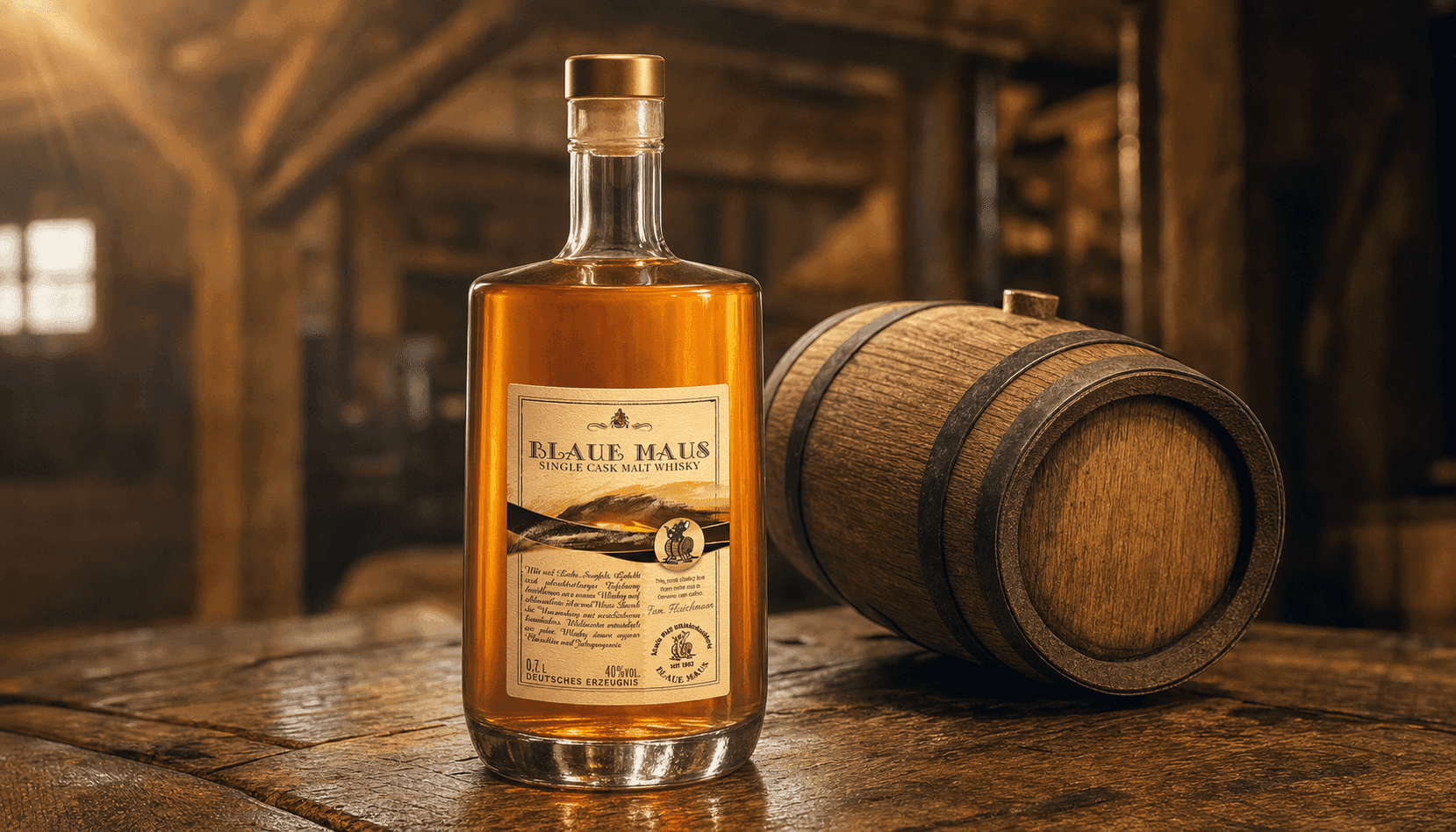
What Is Blaue Maus Whisky and Why Is It Collectable?
Key Takeaways
Blaue Maus was founded in 1983 and is regarded as Germany's first and longest-running single malt whisky distillery.
All expressions are bottled as single cask, cask strength releases; no blending, no chill-filtration, no added colouring.
Annual production volumes are extremely small, making each bottling a genuinely limited release.
The distillery uses both German and imported barley, with maturation in a range of cask types including ex-bourbon and ex-sherry wood.
Collector interest has grown steadily as German domestic whisky has received increased international recognition.
Bottles are most reliably found through specialist retailers and specialist online platforms; mainstream retail rarely carries the full range.
History and Origins
The story of Blaue Maus begins with a cultural gap. In the early 1980s, Germany was a significant importer of Scotch whisky but had no established domestic tradition of single malt production. Robert Fleischmann recognised this and established a small distillery in Franconia with the aim of producing German whisky to the same standard as the Scotch expressions he admired.
The Franconian context
Franconia (the northern part of Bavaria) has a deep tradition of small-scale artisanal food and drink production. The region produces wines, beers, and various spirits within a craft framework that prioritises quality and local identity. Blaue Maus fits naturally within this tradition, even though whisky was a novel category for the region when the distillery was established.
Decades of quiet production
For much of its early history, Blaue Maus operated in relative obscurity: it was known primarily to a tight circle of local enthusiasts and collectors who had sought out the distillery directly. It was only as German whisky began to receive broader international attention in the 2000s and 2010s that Blaue Maus gained recognition commensurate with its historical importance. Being Germany's oldest continuously operating whisky distillery is a significant claim, and it has increasingly translated into collector demand.
Tip: When evaluating any Blaue Maus bottling, look for the cask number, distillation year, and bottling year on the label; these are the markers that distinguish individual releases and allow meaningful comparison between expressions.
What Makes Blaue Maus Whisky Distinctive?
The most immediately notable characteristic of Blaue Maus is its commitment to single cask, cask strength bottling. Every expression is an individual cask (not a vatting of multiple casks) bottled without dilution to the strength at which it emerged from the wood. This means each bottling is genuinely unique, with its own character shaped by the specific cask, the position in the warehouse, and the years of maturation.
Cask types and maturation
Blaue Maus uses a variety of cask types across its programme, including ex-bourbon barrels and ex-sherry casks. The choice of wood has a profound effect on the final character: ex-bourbon wood tends to yield lighter, fruitier expressions with vanilla and coconut notes, while ex-sherry casks produce richer, darker flavours with dried fruit, spice, and sometimes chocolate. Given the small volume of production, each cask type represents a distinct release rather than a permanent range.
German terroir?
The concept of terroir (the influence of local geography, climate, and ingredients on a finished spirit) is a contested one in whisky, but Blaue Maus provides a genuine case study. Franconian grain, local water sources, and a continental climate with more temperature variation than the Scottish west coast all potentially contribute to a character that differs from the Scotch malts the distillery was originally inspired by. Whether this constitutes terroir in a meaningful sense is an open debate among enthusiasts, but it is part of what makes the distillery's output genuinely interesting to explore.
Why Collectors Value Blaue Maus
The collector case for Blaue Maus rests on several converging factors: genuine scarcity, historical significance, and the growing credibility of German whisky as a category worth serious attention.
Scarcity
Annual production volumes at Blaue Maus are genuinely small, a consequence of the distillery's single pot still setup and its artisanal approach. Individual cask bottlings are produced in quantities that can be counted in hundreds of bottles rather than thousands. This scarcity is not manufactured by artificial allocation systems; it is structural. Once a specific bottling sells through, it is gone.
The German whisky premium
As global interest in whisky beyond Scotland, Ireland, Japan, and the United States has grown, German distilleries have benefited from increased collector attention. Blaue Maus, as the oldest and most historically significant of these distilleries, has received disproportionate collector focus. Older bottlings (expressions distilled in the 1990s and early 2000s that are still occasionally available through specialist channels) carry particular interest as evidence of what German whisky was doing before the current wave of enthusiasm.
Investment considerations
Rare Blaue Maus bottlings have appreciated on the secondary market as collector awareness has grown. However, as with any artisanal expression, the investment case is strongest for bottles with clear documentation, excellent storage history, and specific characteristics (older distillation years, unusual cask types) that distinguish them from more recent releases. Buyers considering Blaue Maus as an investment should prioritise individual cask documentation over brand name alone.
Tip: For collectors sourcing Blaue Maus outside Bavaria, specialist German whisky retailers and online platforms are the most reliable channels. The distillery's small distribution footprint means that many bottlings never reach international markets through standard retail.
How to Approach Buying Blaue Maus
Buying Blaue Maus requires more deliberate effort than purchasing a widely distributed Scotch or Japanese whisky. The distillery's limited production and regional distribution mean that most expressions are not available through major online spirits retailers or supermarket chains.
Direct and regional sourcing
The distillery sells directly through its own shop and website, and via a small number of specialist retailers in Bavaria and across Germany. Building a relationship with a Bavarian spirits specialist is the most reliable way to stay informed about new bottlings. Some expressions sell out before they reach wider distribution.
Secondary market access
Older Blaue Maus bottlings that have passed through collector hands appear occasionally on the secondary market. Specialist whisky auction houses and marketplace platforms are the primary channels for these releases. When evaluating secondary market purchases, provenance documentation (original purchase receipts, storage history) adds meaningful value to the transaction.
FAQ
Is Blaue Maus whisky made to German legal standards or Scotch standards?
Blaue Maus produces single malt whisky under German spirits law. German whisky regulations were formally established to mirror the quality requirements of Scotch (including minimum maturation periods in oak), but the expressions are categorised as German single malt whisky, not Scotch. They cannot legally be labelled as Scotch whisky.
How does Blaue Maus compare to major Scotch distilleries in terms of quality?
Direct comparison is difficult given the entirely different scale and context of production. Serious tasters who have evaluated Blaue Maus expressions against equivalent aged Scotch typically note genuine complexity and an interesting character that diverges from the standard Scotch reference points. Whether it ranks above or below comparable Scotch is a matter of individual preference rather than objective ranking.
Where can I buy Blaue Maus in Germany?
The most reliable starting points are specialist whisky retailers in Bavaria and Franconia, the distillery's own direct sales, and occasionally through online specialist platforms. Major supermarket chains and general off-licences rarely stock the full range.
Are older Blaue Maus expressions still available?
Occasionally. Older bottlings from the 1990s and early 2000s surface through specialist auctions and private collector sales. These are increasingly rare and command significant premiums over more recent releases.
About the author

Max Rink
I’m a whisky enthusiast and aspiring writer, exploring new flavours and the stories behind every bottle.
To the author